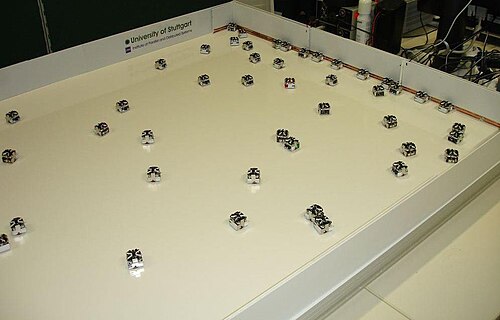
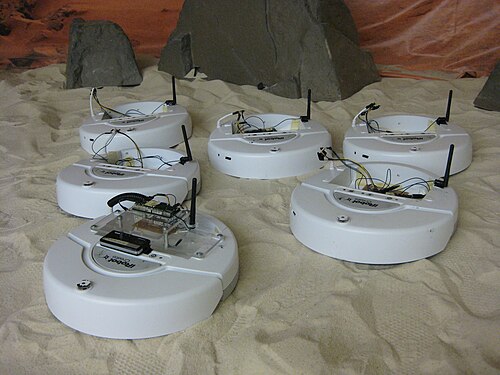
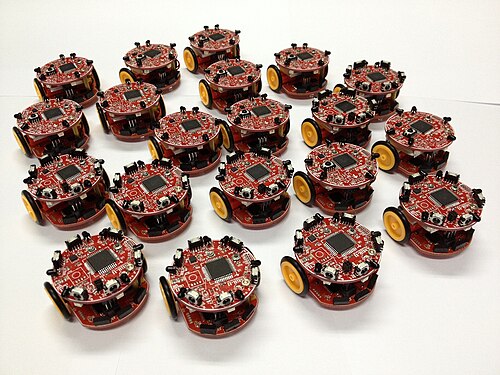
The phrase "swarm robotics" was reported to have first appeared in 1991, according to Google Scholar, but research regarding swarm robotics began to grow in the early 2000s. The initial goal of studying swarm robotics was to test whether the concept of stigmergy could be used as a method for robots to indirectly communicate and coordinate with each other.[5]
One of the first international projects regarding swarm robotics was the SWARM-BOTS project funded by the European Commission between 2001 and 2005, in which a swarm of up to 20 of robots capable of independently physically connect to each other to form a cooperating system were used to study swarm behaviors such as collective transport, area coverage, and searching for objects. The result was demonstration of self-organized teams of robots that cooperate to solve a complex task, with the robots in the swarm taking different roles over time. This work was then expanded upon through the Swarmanoid project (2006–2010), which extended the ideas and algorithms developed in Swarm-bots to heterogeneous robot swarms composed of three types of robots—flying, climbing, and ground-based—that collaborated to carry out a search and retrieval task.[5]
Applications
There are many potential applications for swarm robotics.[8] They include tasks that demand miniaturization (nanorobotics, microbotics), like distributed sensing tasks in micromachinery or the human body. A promising use of swarm robotics is in search and rescue missions.[9] Swarms of robots of different sizes could be sent to places that rescue-workers cannot reach safely, to explore the unknown environment and solve complex mazes via onboard sensors.[9] Swarm robotics can also be suited to tasks that demand cheap designs, for instance mining or agricultural shepherding tasks.[10]
↑ Brambilla, Manuele; Ferrante, Eliseo; Birattari, Mauro; Dorigo, Marco (2013年1月17日). "Swarm robotics: a review from the swarm engineering perspective" . Swarm Intelligence . 7 (1): 1– 41. doi : 10.1007/s11721-012-0075-2 . hdl : 2013/ULB-DIPOT:oai:dipot.ulb.ac.be:2013/153305 . ISSN 1935-3812 .
1 2 3 Dorigo, Marco; Theraulaz, Guy; Trianni, Vito (2021年6月18日). "Swarm Robotics: Past, Present, and Future [Point of View]". Proceedings of the IEEE . 109 (7): 1152–1165 . doi : 10.1109/JPROC.2021.3072740 . hdl : 2013/ULB-DIPOT:oai:dipot.ulb.ac.be:2013/326716 . ISSN 0018-9219 .
↑ Hu, Junyan; Bhowmick, Parijat; Lanzon, Alexander (2020-11-10). "線形群システムのための2層分散型フォーメーション・コンテインメント制御戦略:アルゴリズムと実験" . International Journal of Robust and Nonlinear Control . 30 (16): 6433– 6453. doi : 10.1002/rnc.5105 . ISSN 1049-8923 .
↑ Kagan, Eugene 編 (2020).自律移動ロボットとマルチロボットシステム:動作計画、通信、群知能(第 1版). Hoboken, NJ: John Wiley & Sons, Inc. ISBN978-1-119-21286-7。
↑ Cheraghi, Ahmad Reza; Shahzad, Sahdia; Graffi, Kalman (2021-01-03), Past, Present, and Future of Swarm Robotics , arXiv : 2101.00671
↑ Saska, M.; Langr J.; L. Preucil.自己安定化されたマイクロ航空機群による煙の追跡. 自律システムのためのモデリングとシミュレーション、2014 年。
↑ Saska, M.; Kasl, Z.; Preucil, L.マイクロ航空機の編隊のモーションプランニングと制御。国際自動制御連盟第19回世界会議議事録。2014年。
↑ Saska, M.; Vonasek, V.; Krajnik, T.; Preucil, L.ホークアイ方式で位置特定された異種UAV-UGVチームの協調とナビゲーション。Wayback Machineに2017年8月10日にアーカイブ済み。2012 IEEE/RSJ International Conference on Intelligent Robots and Systemsの議事録。2012年。
↑ Chung, Soon-Jo, et al.「空中群ロボットに関する調査」IEEE Transactions on Robotics 34.4 (2018): 837-855.
↑ Saska, M.; Vonasek, V.; Krajnik, T.; Preucil, L.モデル予測制御スキームの下で「鷹の目」のようなアプローチによって位置特定された異種MAV–UGVフォーメーションの協調とナビゲーション。International Journal of Robotics Research 33(10):1393–1412、2014年9月。
↑ Kwon, Hyukseong; Pack, Daniel J. (2012). "センサー融合品質を用いた協調型無人航空機のための堅牢な移動目標位置特定方法" . Journal of Intelligent & Robotic Systems . 65 ( 1– 4): 479– 493. doi : 10.1007/s10846-011-9581-5 . S2CID 254656907 .
↑ Zahugi, Emaad Mohamed H.; Shabani, Ahmed M.; Prasad, TV (2012), "Libot: 屋外群ロボット向け低コスト移動ロボットの設計", 2012 IEEE International Conference on Cyber Technology in Automation, Control, and Intelligent Systems (CYBER) , pp. 342– 347, doi : 10.1109/CYBER.2012.6392577 , ISBN978-1-4673-1421-3, S2CID14692473
↑Arvin, F.; Murray, J.C.; Licheng Shi; Chun Zhang; Shigang Yue, "Development of an autonomous micro robot for swarm robotics," 2014 IEEE International Conference on Mechatronics and Automation (ICMA), vol., no., pp.635,640, 3-6 Aug. 2014 doi: 10.1109/ICMA.2014.6885771
↑"Technology". 25 July 2020. Archived from the original on 4 August 2020. Retrieved 16 August 2020.
External links
Fully decentralized robotic swarm performing collective search and exploration – Applied Complexity Group and Motion, Energy Control Lab at SUTD
Swarm-bots: Swarms of self-assembling artifacts – EU IST-FET project (2001–2005)
Award-winning swarm-bot video at AAAI 2007
Category:
Multi-robot systems
Hidden categories:
Articles with short description
Short description matches Wikidata
Wikipedia articles with style issues from May 2016
All articles with style issues
Webarchive template wayback links
Pages displaying short descriptions of redirect targets via Module:Annotated link