The campaign logo, illustrating a baby sleeps on a supine position
The Safe to Sleep campaign, formerly known as the Back to Sleep campaign,[1] is an initiative backed by the U.S. National Institute of Child Health and Human Development (NICHD) at the U.S. National Institutes of Health to encourage parents to have their infants sleep on their backs (supine position) to reduce the risk of sudden infant death syndrome (SIDS). The target age group of the campaign is 0–1 years of age, because this is when babies are at the greatest risk of experiencing SIDS.[2] Since "Safe to Sleep" was launched in 1994, the incidence of SIDS has declined by more than 50%.[2] However, there has been a rise in infant sleep-related suffocation events. Consequently, the campaign has broadened its goal to focus on safe sleep conditions and further preventative measures.
History
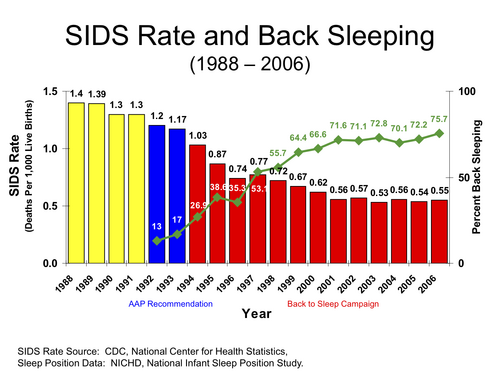
A plot of SIDS rate from 1988 to 2006
In 1992, the American Academy of Pediatrics (AAP) recommended[a] that babies sleep on their backs or sides to reduce the risk of SIDS (a revised statement in 1996 retracted the side-sleeping option). NICHD launched the "Back to Sleep" campaign in 1994 to spread the message.[2]
The campaign was successful in significantly reducing the percentage of babies sleeping on their stomachs (prone position). It was found, however, that a significant portion of African-American babies were still sleeping on their stomachs; in 1999, an African-American baby was 2.2 times more likely to die of SIDS than a white baby. Thus, then Secretary of Health and Human ServicesDonna Shalala and Tipper Gore refocused the "Back to Sleep" campaign on minority babies.[2]
↑"American Academy of Pediatrics AAP Task Force on Infant Positioning and SIDS: Positioning and SIDS". Pediatrics. 89 (6 Pt 1): 1120–6. June 1992. doi:10.1542/peds.89.6.1120. PMID1503575. S2CID6692631.
↑U.S. Department of Human Services. "BACK TO SLEEP" CAMPAIGN SEEKS To Reduce Incidence of SIDS In African American Populations Press Release. Tuesday, October 26, 1999
↑"Positioning and sudden infant death syndrome (SIDS): update. American Academy of Pediatrics Task Force on Infant Positioning and SIDS". Pediatrics. 98 (6 Pt 1): 1216–8. December 1996. doi:10.1542/peds.98.6.1216. PMID8951285. S2CID12399873.
123456TASK FORCE ON SUDDEN INFANT DEATH SYNDROME (2016-10-24). "SIDS and Other Sleep-Related Infant Deaths: Updated 2016 Recommendations for a Safe Infant Sleeping Environment". Pediatrics. 138 (5): e20162938. doi:10.1542/peds.2016-2938. ISSN0031-4005. PMID27940804. S2CID4930719.
↑Bigger, Harold R.; Silvestri, Jean M.; Shott, Susan; Weese-Mayer, Debra E. (July 1998). "Influence of increased survival in very low birth weight, low birth weight, and normal birth weight infants on the incidence of sudden infant death syndrome in the United States: 1985-1991". The Journal of Pediatrics. 133 (1): 73–78. doi:10.1016/s0022-3476(98)70181-7. ISSN0022-3476. PMID9672514.
123456TASK FORCE ON SUDDEN INFANT DEATH SYNDROME (2016-10-24). "SIDS and Other Sleep-Related Infant Deaths: Updated 2016 Recommendations for a Safe Infant Sleeping Environment". Pediatrics. 138 (5): e20162938. doi:10.1542/peds.2016-2938. ISSN0031-4005. PMID27940804. S2CID4930719.
123456Hauck, Fern R.; Thompson, John M. D.; Tanabe, Kawai O.; Moon, Rachel Y.; Vennemann, Mechtild M. (2011-07-01). "Breastfeeding and Reduced Risk of Sudden Infant Death Syndrome: A Meta-analysis". Pediatrics. 128 (1): 103–110. doi:10.1542/peds.2010-3000. ISSN0031-4005. PMID21669892. S2CID1257376.