Loading article…
P -700グラニット(ロシア語: П-700 "Гранит"、英語: granite)は、ソ連およびロシアの海軍対艦巡航ミサイルである。GRAU の名称は3M45、NATO の報告名はSS-N-19 Shipwreckである。対艦ミサイルと潜水艦発射ミサイルがあり、地上目標に対しても使用できる。[ 2 ] [ 3 ]
P-700は1970年代に、P-70アメティストとP-120マラヒトの後継として設計された。両ミサイルはどちらも効果的なミサイルだったが、米海軍空母打撃群の兵器性能向上に伴い、射程が短すぎた。このミサイルはP-500バザルトを部分的にベースとしている。
チェロメイ/ NPOマシノストロエニア社が製造したこの膨らんだ 10mミサイルは、後退翼と後退尾部を持ち、重量は約7,000キログラムで、750 キログラムのHE弾頭、FAE弾頭、または500キロトンの熱核弾頭のいずれかを搭載できます。発射時には、後部に短い円筒形の固体燃料ロケットが取り付けられます。このブースターステージは、ミサイルが持続飛行に入ると切り離されます。長年、このミサイルは持続飛行中にターボジェットエンジンを使用していると考えられていましたが、ロシアと西側のメディアがその性能特性を入手した後、その推進システムはラムジェットであることがわかりました。[ 4 ] [ 5 ]
P-700は機首に特徴的な環状の空気取り入れ口を備えている。最高速度はマッハ1.6からマッハ2.5の間であると考えられている。[ 6 ]航続距離は400km 、[ 7 ] 500km 、[ 3 ]および550~625kmと推定されている 。[ 8 ]誘導システムは慣性誘導、終末能動レーダーホーミング誘導、および対レーダーホーミングを備えた混合モードである。中間コース修正は可能である。
ミサイルが群れ(4~8発のグループ)で発射されると、独自の誘導モードを持つことが広く主張されている。ミサイルのうち1発が高高度まで上昇して目標を指定する間、他のミサイルが攻撃する。目標指定を担当するミサイルは、迎撃されにくくするために短時間上昇する。ミサイルはデータ接続でリンクされ、ネットワークを形成する。目標指定ミサイルが破壊された場合、次のミサイルが上昇してその役割を引き継ぐ。ミサイルは、飛行中に収集された情報と、搭載コンピュータに事前にプログラムされた艦種と戦闘編成を使用して、目標を識別し、グループを検出し、目標の優先順位を自動的に決定することができる。ミサイルは優先順位の高いものから低いものへと順に目標を攻撃する。最初の目標を破壊した後、残りのミサイルは次の優先順位の目標を攻撃する。[ 9 ] [ 10 ]このような説明には疑問が呈されている。[ 11 ]ミサイルには、攻撃してくる対ミサイルに対抗する手段がある。また、搭載コンピューターには、敵の電子戦に対抗し、対抗措置を回避するために設計されたデータが搭載されている。[ 12 ] [ 13 ]
P-700は、ターボジェットエンジンを搭載したP-500バザルトミサイルから派生したものである。[ 14 ] P-700は、ラムジェット推進を使用するP-800オニクス、そしてP-800のインドとロシアの共同近代化であるブラモスミサイルへと発展した。
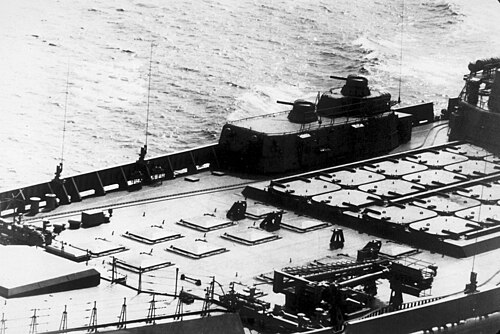
1980年に巡洋艦キーロフ(現在のウシャコフ提督)に最初に配備され、1983年7月19日にミサイルが運用開始された。[ 12 ]
航空母艦としては珍しく、クズネツォフ級にはグラニートミサイル発射機が12基搭載されていた。これによりアドミラル・クズネツォフは追加の主攻撃能力を得たが[ 15 ] 、また、艦を航空巡洋艦に分類するという政治的な利点もあった[ i ]。未確認の情報によると、航空機格納庫のスペースを増やすため、2000年にミサイルは撤去されたという。

It is currently in service with the Russian Northern Fleet on the Kirov-classbattlecruisersAdmiral Nakhimov and Pyotr Velikyi, and with the Russian Northern and Pacific fleets as the main weapon of the Oscar-class cruise missile submarines.
The Kursk carried 24 missiles when it sank following a torpedo explosion during an exercise on 12 August 2000. The Russian navy was extremely concerned about possible NATO attempts to recover a missile and guarded the site of the wreck throughout the recovery effort. The missiles were recovered intact following a $65 million salvage operation.[16][17][18][19]
The size of the missile limits the platforms on which it can operate and be launched from.[20] It has only been deployed from Oscar-class submarines, Kirov-class battlecruisers, and the Admiral Kuznetsov aircraft carrier. Ships of all three types will have their Granit missiles replaced with new launch cells to carry smaller Oniks and Kalibr[21] cruise missiles in greater numbers.
The P-1000 missile was partially derived from the P-500 and P-700.[22][23][24] Its maximum speed is claimed to be between Mach 1.5 - Mach 2.5 depending on altitude, and its range is claimed to be between 700 and 1000 km (800).[25] Warhead: 500 kg. Years of production 1985–1992.[26] The body of the missile resembles that of the P-500, but it has the ability of the P-700 to overcome defensive countermeasures. Long range missile can achieve the target only at low altitudes (up to 25 meters or lower) approximation (in which case the maximum range is less than 500 km).
Starting in 2018, the P-700 is planned to be replaced by the Zircon (missile).[27]