
Loading article…
対分布関数は、与えられた体積内に含まれる粒子のペア間の距離の分布を表します。[ 1 ]数学的には、aとbが2つの粒子である場合、 aに対するbの対分布関数は次のように表されます。粒子bが距離にあるときに見つかる確率はから、座標の原点として。
対分布関数は、媒体内における物体の分布を記述するために使用されます(例えば、木箱の中のオレンジやガスボンベの中の窒素分子など)。媒体が均質である場合(つまり、すべての空間位置が同一の特性を持つ場合)、どの位置にも物体が存在する確率密度は等しくなります。:
どこは容器の体積です。一方、特定の位置で物体のペアが見つかる確率(つまり、2体確率密度)は一様ではありません。たとえば、硬いボールのペアは、少なくともボールの直径分だけ離れていなければなりません。ペア分布関数これは、二体確率密度関数を物体の総数でスケーリングすることによって得られる。そして容器のサイズ:
コンテナ内のオブジェクトの数が多い一般的なケースでは、これは次のように簡略化されます。
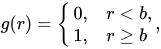
最も単純なペア分布関数は、すべてのオブジェクトの位置が互いに独立していると仮定し、次のようになります。
どここれは、一対の物体間の距離を表します。しかし、前述のように、硬い物体の場合、これは不正確です。なぜなら、物体間に必要とされる最小距離を考慮していないからです。穴補正(HC)近似は、より優れたモデルを提供します。
どここれは、物体の一つの直径です。
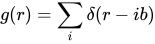
HC近似は疎に詰められた物体については妥当な記述を与えるが、密に詰められた物体については破綻する。これは、同一の硬球で完全に満たされた箱を考えれば説明できる。各球は隣接する球に接触している。この場合、箱の中のすべての球のペアは正確に の距離で隔てられている。どこは正の整数である。したがって、硬球で完全に満たされた体積の対分布は、次の形式のディラックのデルタ関数の集合となる。
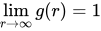
最後に、大きな距離で隔てられた一対の物体は、互いの位置に影響を与えないことに注意すべきである(容器が完全に満たされていない場合)。したがって、
In general, a pair distribution function will take a form somewhere between the sparsely packed (HC approximation) and the densely packed (delta function) models, depending on the packing density .
Of special practical importance is the radial distribution function, which is independent of orientation. It is a major descriptor for the atomic structure of amorphous materials (glasses, polymers) and liquids. The radial distribution function can be calculated directly from physical measurements like light scattering or x-ray powder diffraction by performing a Fourier Transform.
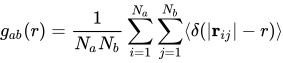
In Statistical Mechanics the RDF is given by the expression
When thin films are disordered, as they are in electronic devices, pair distribution is used to view the strain and structure-properties of that material or composition. They have these properties that cannot be exploited in the bulk or crystalline form. There is a method with the radial distribution that is able to view the local structure of a disordered thin film of . But the creators of this method called a need for a better method to view the mid-range order of disordered films. The creation of thin-film Pair Distribution Function (tfPDF) uses a statistical distribution of a material's mid-range order that enables viewing important details like the disorder. In this technique, 2D data from a scattering method is integrated and Fourier transformed into 1D data that shows the probability of bonds in that material. TfPDF works best when in conjunction with other characterization methods like transmission electron microscopy. Although a developing methodology, tfPDF can give complete structure-property relationships through a reliable characterization technique.
Atomic pair distribution function (PDF) analysis contains both Bragg peaks and diffuse scattering components within the diffraction pattern. Due to this, the existing atomic order characterized by Bragg peaks is combined with defects within the structure to produce a PDF. This allows PDF analysis to better characterize materials with a broken periodicity due to structural distortion when compared to traditional powder x-ray analysis.[2]
Fischer-Colbrie, Bienenstock, Fuoss, Marcus. Phys. Rev. B (1988) 38, 12388
Jensen, K. M., Billinge, S. J. (2015). IUCrJ, 2(5), 481–489.








![{\displaystyle {\mathrm {GeSe} {\vphantom {A}}_{\smash[{t}]{2}}}}](https://wikimedia.org/api/rest_v1/media/math/render/svg/fb6389feb395eb0739e5c69eae2fa3c64e2ff2dd)