Loading article…
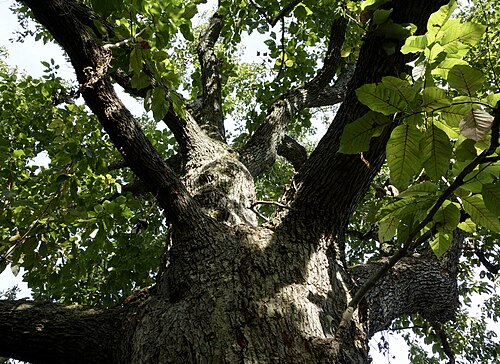
Magnolia acuminata, commonly called the cucumber tree (often spelled as a single word "cucumbertree"), cucumber magnolia or blue magnolia, is one of the largest magnolias, and one of the cold-hardiest. It is a large forest tree of the Eastern United States and Southern Ontario in Canada. It is a tree that tends to occur singly as scattered specimens, rather than in groves.[4]
The cucumber tree is native primarily within the Appalachian belt, including the Allegheny Plateau and Cumberland Plateau, up to western Pennsylvania and New York. There are also numerous disconnected outlying populations through much of the southeastern U.S., and a few small populations in Southern Ontario. In Canada, the cucumber tree is listed as an endangered species and is protected under the Canadian Species at Risk Act.[5] In 1993 the North American Native Plant Society purchased Shining Tree Woods to preserve a stand of Magnolia acuminata, which is also known as "The Shining Tree".
The leaves are deciduous, simple and alternate, oval to oblong, 12–25 centimetres (4.7–9.8 in) long and 6–12 centimetres (2.4–4.7 in) wide, with smooth margins and downy on the underside. They come in two forms, acuminate at both ends, or moderately cordate at the base (these are usually only formed high in the tree).
Unlike most magnolias, the flowers are not showy. They are typically small, yellow-green, and borne high in the tree in April through June. The leaves of Magnolia acuminata are pointed at the tip and provide it with its name - 'acuminate' means tapering to a fine point. The name "cucumber tree" refers to the unripe fruit, which is green and often shaped like a small cucumber; the fruit matures to a dark red color and is 6–8 centimetres (2.4–3.1 in) long and 4 centimetres (1.6 in) broad, with the individual carpels splitting open to release the bright red seeds, 10–60 per fruit. The ripe fruit is a striking reddish orange color.
キュウリノキは公園や庭園の日陰樹として最適ですが、街路樹としては推奨されません。栽培下では通常、高さ15~20メートル(49~66フィート)にしか成長しませんが、理想的な森林環境では30メートル(98フィート)を超えることもあります。非常に巨大になることもあり、オハイオ州スターク郡にある米国国内(そしておそらく世界)チャンピオンは、直径8フィート(2.4メートル)、高さ96フィート(29メートル)です。キュウリノキは、弱酸性で水はけの良い、深く湿った土壌で最もよく育ちますが、アルカリ性土壌にも耐性があります。
根が太く肉厚なため移植は難しく、浅めに植え付け、春先に土をしっかりと固めて移植する必要があります。
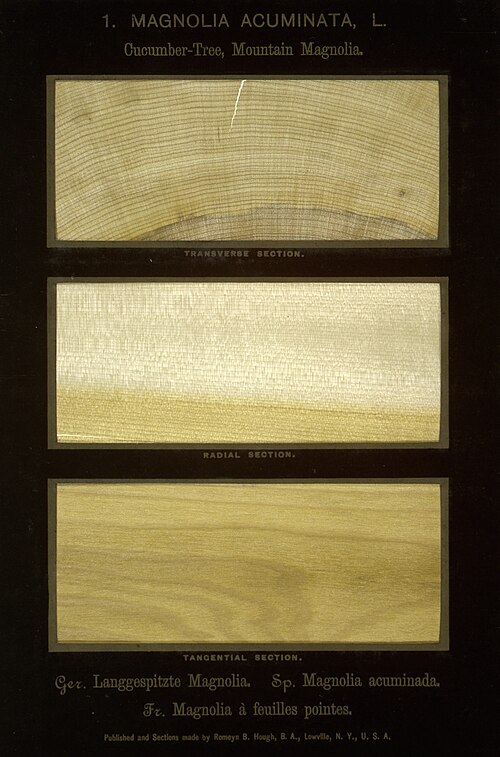
木材取引においては、この木の木材は近縁種のユリノキ(Liriodendron tulipifera)の木材と互換性がある。
マグノリア・アクミナタは、黄色い花の色と耐寒性を共有する新しい品種の交配に利用されてきた。
さらに、ミツバチやチョウを引き寄せ、支える受粉植物としても知られています。チョウの幼虫期の食草となる植物でもあります。[ 6 ]