
Loading article…
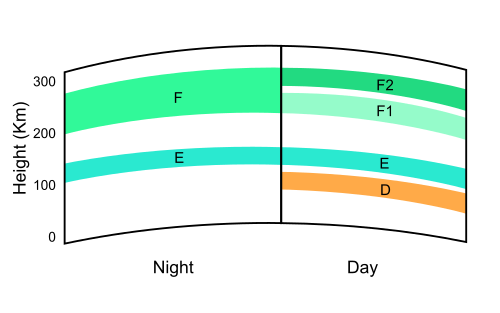
ヘヴィサイド層[ 1 ] [ 2 ]は、アーサー・E・ケネリーとオリバー・ヘヴィサイドにちなんでケネリー・ヘヴィサイド層[ 3 ] [ 4 ]とも呼ばれ、地上約90~150km (56~93マイル)上空に存在する電離ガスの層で、地球の電離層を構成するいくつかの層の1つです。E領域とも呼ばれます。中周波の電波を反射します。この反射層のおかげで、空に放射された電波は地平線の向こう側で地球に戻ってくることがあります。この「スカイウェーブ」または「スキップ」伝搬技術は、1920年代から大陸横断距離までの長距離無線通信に利用されてきました。
電波の伝搬は時間帯によって影響を受ける。日中は太陽放射によってこの層が地球に近づくため、電波を反射できる距離が制限される。逆に、地球の夜側(風下側)では、太陽風によって電離層が遠ざけられるため、電波が反射によって伝搬できる距離が大幅に増加する。この効果の程度は、季節や太陽黒点活動の量によっても影響を受ける。[ 5 ] [ 6 ]
反射層の存在は、1902年にアメリカの電気技師アーサー・エドウィン・ケネリー(1861–1939)[ 7 ]とイギリスの博学者オリバー・ヘヴィサイド(1850–1925)によってほぼ同時に独立に予測され、1901年にグリエルモ・マルコーニが観測した電波の地平線を超えた伝播の説明として提唱された。しかし、その存在がイギリスの科学者エドワード・V・アップルトンによって実証されたのは1924年のことで[ 8 ]、彼はその功績により1947年のノーベル物理学賞を受賞した[ 9 ]。
Physicists resisted the idea of the reflecting layer for one very good reason; it would require total internal reflection, which in turn would require that the speed of light in the ionosphere would be greater than in the atmosphere below it. Since the latter speed is essentially the same as the speed of light in vacuum (c), scientists were unwilling to believe the speed in the ionosphere could be higher. Nevertheless, Marconi had received signals in Newfoundland that were broadcast in England, so clearly there must be some mechanism allowing the transmission to reach that far. The paradox was resolved by the discovery that there were two velocities of light, the phase velocity and the group velocity. The phase velocity can in fact be greater than c, but the group velocity, being capable of transmitting information, cannot, by special relativity, be greater than c. The phase velocity for radio waves in the ionosphere is indeed greater than c, and that makes total internal reflection possible, and so the ionosphere can reflect radio waves. The geometric mean of the phase velocity and the group velocity cannot exceed c, so when the phase velocity goes above c, the group velocity must go below it.
In 1925, Americans Gregory Breit and Merle A. Tuve first mapped the Heaviside layer's variations in altitude. The ITU standard model of absorption and reflection of radio waves by the Heaviside Layer was developed by the British Ionospheric physicist Louis Muggleton[10] in the 1970s.
Around 1910, William Eccles proposed the name "Heaviside Layer" for the radio-wave reflecting layer in the upper atmosphere,[1] and the name has subsequently been widely adopted.[2] The name Kennelly–Heaviside layer was proposed in 1925 to give credit to the work of Kennelly,[3][7] which predated the proposal by Heaviside by several months.