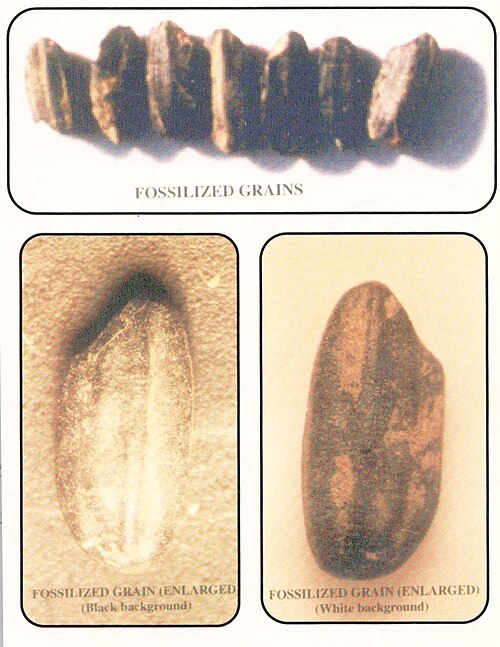
Chinese monk Fa-hien wrote that when Buddha visited Kapilvastu for the first time after attaining 'enlightenment', he was stopped at Mathla village by the people. The villagers asked Siddhartha to give them prasad. Siddhartha took the rice he had taken in alms and gave it to the people, asking them to sow it in a marshy place. The rice thus produced "will have a typical aroma which will always remind people of me," he said. Bajha jungle later vanished replaced by Bajha village near Kapilvastu. Mudila village replaced Mathla. The belt is still believed to run between Bajha and Aligarhwa. This variety, if sown elsewhere, loses its aroma and quality.
The first effort to conserve Kalanamak rice was made by Englishmen William Pepe, J H Hemprey, and Edcan Walker (Jamindars of Alidapur, Birdpur, and Mohana) during the British Raj. They built reservoirs at Bajha, Marthi, Moti, and Majhauli to produce Kalanamak. They produced this variety for their consumption and transported it to England from Uska-bazar mandi, passing through Dhaka (now in Bangladesh). Due to increasing demand, the British captured the land around Kapilvastu and established Birdpur and Alidapur estates. They produced Kalanamak through bonded labor and exported it to Britain. When Gujarati businessmen came to know about this business potential, they formed a mandi at Uska-bazar to export Kalanamak. British "shopkeepers" built a rail route to carry rice via rail to counter them. After independence, Uska-bazar mandi became nonfunctional due to negligence, and reservoirs gathered silt. This led to a fall in production of Kalanamak.[2]
GI Tag
Kalanamak rice was granted the Geographical Indication (GI) Tag in 2012 by the Government of India. A geographical area was defined where Kalanamak rice can be produced. Kalanamak rice grown only in this area can be labelled as Kalanamak rice.[3] The GI tag is used for agricultural, natural and manufactured goods.
The geographical area for Kalanamak rice lies between 26° 42′ North to 27° 75′ North Latitude and 81° 42′ to 83° 88′ East Longitude in UP.
Kalanamak Rice is approved for 11 districts of Zone 7 of UP. These 11 districts are located in the divisions of Gorakhpur (Deoria, Gorakhpur, Mahrajganj, Siddharth Nagar districts), Basti (Basti, Sant Kabir Nagar, Siddharth Nagar districts), and Devipatan (Bahraich, Balrampur, Gonda, Shravasti districts).
Quality
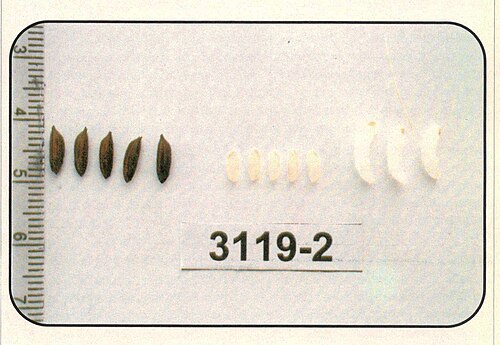
Comparison of the grain length of cooked and uncooked kernel of Kalanamak rice grain. The Elongation after cooking is almost 2.2 times the grain length
Kalanamak rice is a non-basmati rice with medium slender grain length. The four varieties of Kalanamak are KN 3, Bauna Kalanamak 101, Bauna Kalanamak 102, and Kalanamak Kiran were developed by Dr. R. C. Chaudhary. The aroma of Kalanamak rice is said to be Buddha's gift. It is stronger than all Basmati varieties. It elongates after cooking, which is one of its most important quality traits.[4] Cooked kalanamak is softer and fluffier than other rice varieties. Amylose content is close to 20% as compared to 24% and higher in Basmati. High amylose levels tend to make the rice cook firm and dry. Rice with a medium amylose content, between 16% and 22%, usually cooks softer and the grains stick together more readily.
Kalanamak rice is rich in micronutrients such as iron and zinc. It has 11% protein, almost double that of common rice varieties. It has a low Glycemic Index (49% to 52%) making it relatively sugar-free and suitable for diabetics. The government of India came out with its Nutri-Farm scheme in 2013, intending to promote food crops that offer critical micronutrients to improve the nutrition status of the vulnerable section of society. Kalanamak rice was one of the nutri-crop selected for this scheme.
References
↑Rediscovering Scented Rice Cultivar Kalanamak; Reproduced from Asian Agri-History Vol. 9, No. 3, 2005 (211–219)
↑"Welcome to Asian Agri-History Foundation (AAHF)". Archived from the original on 2015-04-03. Retrieved 2015-03-24.
↑GOVERNMENT OF INDIA GEOGRAPHICAL INDICATIONS JOURNAL NO. 48 NOVEMBER 29, 2012 / AGRAHAYANA 08, SAKA 1934
↑"Amylose and Amylopectine in rice". vcampus.uom.ac.mu. Archived from the original on 2018-09-03. Retrieved 2017-05-13.
Sources
Chaudhary, R. C. 1979a. Productive mutants in scented rices in Uttar Pradesh. Proc. Symp. Role of Induced Mutations in Crop Improvement. Sept. 10 - 13,1979. BARC - OU Hyderabad, Abs. P.60.
Chaudhary, R. C. 1979b. Increasing the mutagenic efficiency of EMS in rice. Proc. Symp. Role of Induced Mutations in Crop Improvement. Sept. 10 - 13, 1979. BARC - OU Hyderabad, Abs. P.60.
Chaudhary, R. C. 2002. Consequences of WTO and Geographic Indicators on economics, production, trend and marketing of speciality rices. Proc. World Rice Commerce 2002 Conference; Beijing, China, 16–18 September 2002; 20 pp
Chaudhary, R. C. 2005. India the Great Cradle of Rice. In: Rice Landscapes of Life. Eds. A. Ferrero and G. M. Scansetti; Edzioni Mercurio, Torino, Italy; 161 – 175, pp.
Chaudhary, RC および Prajapati, SC 2007. 米の原産地:ウッタル・プラデーシュ州(インド)における米の品種、農業生態系、農民の相互に関連する多様性。In: Agro-Economical traits of Rice Cultivation in Europe and India. Eds. Aldo Ferrero および Francesco Vidotto, EU – ECCP, Edcioni Mercurio, Vercelli, Italy.
Chaudhary, RC および Mishra, SB 2010. イネ(Oryza sativa L.)の発祥地であるウッタル・プラデーシュ州東部からの貴重なイネ遺伝資源の収集。In: Genetic Resources of Rice in India: Past and Present; Ed. SD Sharma. Today & Tomorrow's Printers、ニューデリー、ページ: 587 - 594。
Chaudhary, R. C.; Prajapati, S. C.; Chaudhary, P.; Anita; and Shukla, A. K. 2007. Diversity in rice, its cultivation and its uses in the area of its origin: Eastern Uttar Pradesh, India. In: Geographical Researches on Rice: A Comparative Analysis of Rice Districts in the European Union and India; 165 – 176 pp.In: Geographical Researches on Rice: A Comparative Analysis of Rice Districts in the European Union and India. Editors Davide Papotti and Carlo Brusa; EU – ECCP, Edizioni Mecurio, Vercelli, Italy.
Chaudhary, R. C.; Mishra, S. B.; Yadav, S. K. and Jabir Ali 2012. Extinction to distinction: Current status of Kalanamak, the heritage rice of eastern Uttar Pradesh and its likely role in farmers’ prosperity. LMA Convention Journal. Vol 8 (1): 7 – 14.
Chaudhary, R. C.; Mishra, S. B. and Kumar, D. 2013. Organic Farming of Kalanamak rice (in Hindi). Kheti, Vol 66 (1); April 2013; 3 – 6.
Chaudhary, R. C.; Mishra, S. B. and Gandhe Abhay 2014b. Development of Kalanamak Rice and Technology Transfer to Farmers for Convincing Politicians for Organic Rice and Biofortification of Zinc and Iron through it. International Conference on Scientific Knowledge Transfer into Politics and Society, University of Bonn, Germany. Abs.
Khan, Suhail 2015. Models of market and marketing linkage for Kalanamak rice. Report submitted to PRDF Gorakhpur (U. P.), pp.20 (Mimeo).
Mishra, S. B. and Chaudhary, R. C. 2011. Chlorophyll mutation in M2 as an indicator for recovering useful mutants in rice. Oryza 48 (4): 378 – 379.
Nanda, J. S.; Chaudhary, R. C.; Singh, J. P.; Singh, H. P.; and Gupta, M. D. 1974. Breeding for quality rice through induced mutation. Proc. Symp. Use of Radiations and Radioisotopes in Studies of Plant Productivity. Pantnagar, April 12–14, 1974. pp.24–32.
Yadav, S. K; Chaudhary, R. C.; Kumar, Sunil Kumar and Mishra, S. B. 2019. Breakthrough in Tripling Farmers Income Sustainably by Producing Kalanamak rice. Journal of Agri Search, Vol. 6(1): 1 – 5.
Categories:
Rice varieties
GI Tagged Rice varieties of India
Geographical indications in Uttar Pradesh
Hidden categories:
Articles with short description
Short description matches Wikidata
Articles needing additional references from March 2015
All articles needing additional references
Wikipedia articles needing clarification from July 2022
All articles with unsourced statements
Articles with unsourced statements from July 2022
Articles needing additional references from March 2024