古典力学における熱力学のような結果
古典力学のヘルムホルツの定理は 次 のようになります。
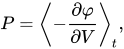
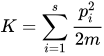
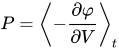
を1次元システムの ハミルトニアン と します。ここで は 運動エネルギー 、 は パラメータ に依存する 「U字型」の ポテンシャルエネルギー プロファイルです。 は 時間平均を表します。
H
(
x
,
p
;
V
)
=
K
(
p
)
+
φ
(
x
;
V
)
{\displaystyle H(x,p;V)=K(p)+\varphi (x;V)}
K
=
p
2
2
m
{\displaystyle K={\frac {p^{2}}{2m}}}
φ
(
x
;
V
)
{\displaystyle \varphi (x;V)}
V
{\displaystyle V}
⟨
⋅
⟩
t
{\displaystyle \left\langle \cdot \right\rangle _{t}}
E
=
K
+
φ
,
{\displaystyle E=K+\varphi ,}
T
=
2
⟨
K
⟩
t
,
{\displaystyle T=2\left\langle K\right\rangle _{t},}
P
=
⟨
−
∂
φ
∂
V
⟩
t
,
{\displaystyle P=\left\langle -{\frac {\partial \varphi }{\partial V}}\right\rangle _{t},}
S
(
E
,
V
)
=
log
∮
2
m
(
E
−
φ
(
x
,
V
)
)
d
x
.
{\displaystyle S(E,V)=\log \oint {\sqrt {2m\left(E-\varphi \left(x,V\right)\right)}}\,dx.}
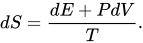
それから
d
S
=
d
E
+
P
d
V
T
.
{\displaystyle dS={\frac {dE+PdV}{T}}.}
古典力学 のこの定理の命題は、 熱力学 の熱定理とまったく同じです 。この事実は、特定の力学的量の間に熱力学のような関係が存在することを示しています。これにより、1 次元の機械システムの「熱力学的状態」を定義できます。特に、温度 は 運動エネルギーの時間平均で与えられ、 エントロピーは 作用 の対数 (つまり、 )で与えられます。
この定理の重要性は、 平衡熱力学 の機械的基礎を提供するために、この定理をマクロ システム (つまり、多次元システム) に適用する方法を見出していた ルートヴィヒ ボルツマンによって認識されました。この研究活動は、彼の エルゴード仮説 の定式化と厳密に関連していました。 ジョージ デイビッド バーコフ の エルゴード定理 に基づくヘルムホルツの定理の多次元バージョンは、 一般化ヘルムホルツの定理として知られています。
T
{\displaystyle T}
S
{\displaystyle S}
∮
d
x
2
m
(
E
−
φ
(
x
,
V
)
)
{\textstyle \oint dx{\sqrt {2m\left(E-\varphi \left(x,V\right)\right)}}}
一般版 一般 化ヘルムホルツの定理は、 ヘルムホルツの定理を多次元に一般化したものであって、次のようになります。
させて
p
=
(
p
1
,
p
2
,
.
.
.
,
p
s
)
,
{\displaystyle \mathbf {p} =(p_{1},p_{2},...,p_{s}),}
q
=
(
q
1
,
q
2
,
.
.
.
,
q
s
)
,
{\displaystyle \mathbf {q} =(q_{1},q_{2},...,q_{s}),}
をs 次元 ハミルトン系 の 標準座標 とし 、
H
(
p
,
q
;
V
)
=
K
(
p
)
+
φ
(
q
;
V
)
{\displaystyle H(\mathbf {p} ,\mathbf {q} ;V)=K(\mathbf {p} )+\varphi (\mathbf {q} ;V)}
ハミルトン 関数、ここ
で
K
=
∑
i
=
1
s
p
i
2
2
m
{\displaystyle K=\sum _{i=1}^{s}{\frac {p_{i}^{2}}{2m}}}
、 運動エネルギー で
あり
φ
(
q
;
V
)
{\displaystyle \varphi (\mathbf {q} ;V)}
はパラメータ に依存する ポテンシャルエネルギー です。 システムの2 s 次元位相空間における一定エネルギーの超曲面が 計量的に分解不可能 であり、が 時間平均を表すものとします。量 、 、 、 を次のように定義します。
V
{\displaystyle V}
⟨
⋅
⟩
t
{\displaystyle \left\langle \cdot \right\rangle _{t}}
E
{\displaystyle E}
P
{\displaystyle P}
T
{\displaystyle T}
S
{\displaystyle S}
E
=
K
+
φ
{\displaystyle E=K+\varphi }
、
T
=
2
s
⟨
K
⟩
t
{\displaystyle T={\frac {2}{s}}\left\langle K\right\rangle _{t}}
、
P
=
⟨
−
∂
φ
∂
V
⟩
t
{\displaystyle P=\left\langle -{\frac {\partial \varphi }{\partial V}}\right\rangle _{t}}
、
S
(
E
,
V
)
=
log
∫
H
(
p
,
q
;
V
)
≤
E
d
s
p
d
s
q
.
{\displaystyle S(E,V)=\log \int _{H(\mathbf {p} ,\mathbf {q} ;V)\leq E}d^{s}\mathbf {p} d^{s}\mathbf {q} .}
それから:
d
S
=
d
E
+
P
d
V
T
.
{\displaystyle dS={\frac {dE+PdV}{T}}.}
参考文献 ヘルムホルツ、H.、フォン (1884a)。 Principien der Statik monocyklischer Systeme。 Borchardt-Crelle's Journal für die reine und angewandte Mathematik 、97、111–140 (Wiedemann G. (Ed.) (1895) Wissenschafltliche Abhandlungen. Vol. 3 (pp. 142–162, 179–202). ライプツィヒ: ヨハンアンブロシャス・バース)。 ヘルムホルツ、H.、フォン (1884b)。 Studien zur Statik 単自転車システム。 Sitzungsberichte der Kö niglich Preussischen Akademie der Wissenschaften zu Berlin 、I、159–177 (Wiedemann G. (Ed.) (1895) Wissenschafltliche Abhandlungen. Vol. 3 (pp. 163–178). Leipzig: Johann Ambrosious Barth)。 ボルツマン、L. (1884)。 Über die Eigenschaften monocyklischer und anderer damit verwandter Systeme。 Crelles Journal , 98: 68–94 (また、Boltzmann, L. (1909). Wissenschaftliche Abhandlungen (Vol. 3, pp. 122–152), F. Hasenöhrl (編). Leipzig. Reissued New York: Chelsea, 1969 )。 Gallavotti, G. (1999). 統計力学:小論文 . ベルリン:Springer. カンピシ、M. (2005) 熱力学の機械的基礎について: 一般化されたヘルムホルツの定理 現代物理学の歴史と哲学の研究 36: 275–290