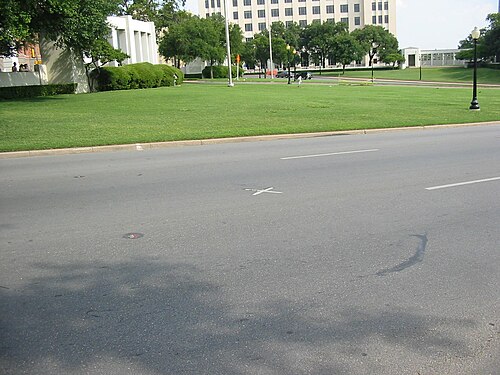
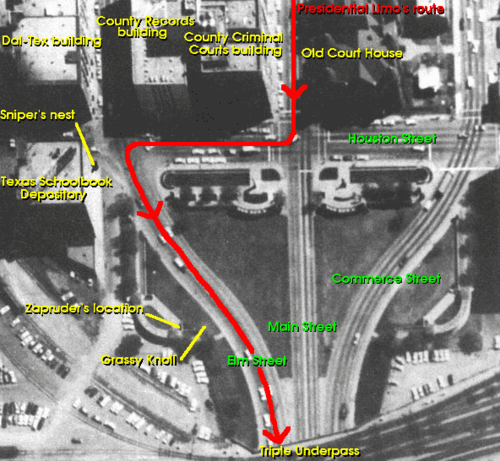
Located near the north grassy knoll on November 22, 1963, there were several witnesses, three large traffic signposts, four sidewalk lamp posts, the John Neely Bryan north pergola concrete structure including its two enclosed shelters, a tool shed, one concrete wall 3.3 feet (1m) high connected to each of the pergola shelters; ten tall, wide, low-hanging live oak trees; a five-foot-high (1.5m), wooden, cornered, stockade fenceline measured at approximately 169 feet (52m) long; six street curb sewer openings, their sewer manholes and their interconnecting large pipes; and several 2 to 6 feet (60 to 180cm) tall bushes, trees and hedges.
The term "grassy knoll" was first used to describe this area by reporter Albert Merriman Smith, known as Smitty, of UPI, who was riding in the press "pool car" following 150 to 200 yards (140 to 180m) behind Kennedy's car and had use of the car's radio-telephone.[19] In his second dispatch from the car just 25 minutes after the shooting, he said, "Some of the Secret Service agents thought the gunfire was from an automatic weapon fired to the right rear of the president's car, probably from a grassy knoll to which police rushed." These words were then repeated on national television by CBS News anchor Walter Cronkite in his second CBS bulletin on the shooting.[20][21][22][23]
Smitty, who was the main UPI reporter covering the presidential motorcade and was seated in the front seat of the sixth car known as the White House Pool car or the wire car,[a] used a radiotelephone to file his report with the UPI office when shots had been fired at President Kennedy. Smith popularized the term "grassy knoll" and received the 1964 Pulitzer Prize for his reporting.[19][24][25][26]
↑Staff (August 4, 2016). "West End Historic District"(PDF). Department of Urban Planning, City of Dallas. p.3. Archived(PDF) from the original on August 3, 2018. Retrieved August 2, 2018.
12Williams, Joe; Hardy, Danny; Moore, David (November 14, 1978). "National Register of Historic Places Inventory–Nomination Form: Westend Historic District"(PDF). National Park Service. Archived(PDF) from the original on August 2, 2018. Retrieved August 2, 2018.
↑Fetzer, James H. (2013). Murder in Dealey Plaza: What We Know that We Didn't Know Then about the Death of JFK. Open Court. p.30. ISBN978-0812698657. Retrieved October 25, 2017.
↑"12 WPA Projects that Still Exist". How Stuff Works. Publications International, Ltd. September 16, 2007. Archived from the original on March 2, 2009. Retrieved March 11, 2009.
↑Riordan, James (1996). Stone: A Biography of Oliver Stone. Aurum Press. p.371.
↑Riordan, James (1996). Stone: A Biography of Oliver Stone. Aurum Press. p.375.
1234Sanderson, Bill (November 5, 2016). "How this forgotten journalist scored the 20th century's biggest scoop". New York Post. Archived from the original on March 11, 2022. Retrieved March 10, 2022.
↑Pages documenting this are held by Gary Mack, Curator of The Sixth Floor Museum at Dealey Plaza. The Man Who Named the Grassy KnollArchived 2004-07-25 at the Wayback Machine at the museum's website, page found 2012-12-07.
12Mack, Gary (curator). "The Man Who Named the Grassy Knoll". Sixth Floor Museum at Dealey Plaza. Archived from the original on May 11, 2022. Retrieved March 10, 2022.
↑ Carlson, Darren K. (2001年4月11日) 「ほとんどのアメリカ人はオズワルドがJFK暗殺のために他者と共謀したと信じている:陰謀論への支持は1970年代に急激に高まり、それ以来高い水準を維持している」。ギャラップ・ニュース・サービス。2017年7月6日のオリジナルからアーカイブ。2022年3月10日取得。
↑ Reinherz, Adam (2022年1月3日) 「Cyril Wechtは新著でウォーレン委員会に引き続き異議を唱える。『JFK暗殺の解剖:法医学者Cyril Wechtによる分析』は、大統領暗殺に関する報告書とWechtの旅行記録の両方の役割を果たしている」。The Times of Israel。2022年3月11日のオリジナルからアーカイブ。 2022年3月10日取得。
さらに読む
ディーリー、ジェリー・T. (2002). D in the Heart of Texas . JEDI Management Group. ISBN0-9723913-0-4。(ディーリープラザの歴史も含む)