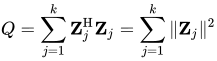
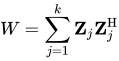
In probability theory, the family of complex normal distributions, denoted or , characterizes complex random variables whose real and imaginary parts are jointly normal.[1] The complex normal family has three parameters: location parameter μ, covariance matrix , and the relation matrix . The standard complex normal is the univariate distribution with , , and .
An important subclass of complex normal family is called the circularly-symmetric (central) complex normal and corresponds to the case of zero relation matrix and zero mean: and .[2] This case is used extensively in signal processing, where it is sometimes referred to as just complex normal in the literature.
Definitions
Complex standard normal random variable
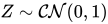
The standard complex normal random variable or standard complex Gaussian random variable is a complex random variable whose real and imaginary parts are independent normally distributed random variables with mean zero and variance .[3]:p. 494[4]:pp. 501 Formally,
where denotes independence and denotes that is a standard complex normal random variable.
Complex normal random variable
Suppose and are real random variables such that is a 2-dimensional normal random vector. Then the complex random variable is called complex normal random variable or complex Gaussian random variable.[3]:p. 500
Complex standard normal random vector
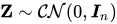
A n-dimensional complex random vector is a complex standard normal random vector or complex standard Gaussian random vector if its components are independent and all of them are standard complex normal random variables as defined above.[3]:p. 502[4]:pp. 501 That is a standard complex normal random vector is denoted .
↑ Goodman, NR (1963). "Statistical analysis based on a certain multivariate complex Gaussian distribution (an introduction)" . The Annals of Mathematical Statistics . 34 (1): 152– 177. doi : 10.1214/aoms/1177704250 . JSTOR 2991290 .










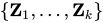
![{\displaystyle [\mathbf {X} ,\mathbf {Y} ]}](https://wikimedia.org/api/rest_v1/media/math/render/svg/39633a1d2cf0edd432b5ceee258360ac47ebf9db)


![{\displaystyle \mu =\operatorname {E} [\mathbf {Z} ],\quad \Gamma =\operatorname {E} [(\mathbf {Z} -\mu )({\mathbf {Z} }-\mu )^{\mathrm {H} }],\quad C=\operatorname {E} [(\mathbf {Z} -\mu )(\mathbf {Z} -\mu )^{\mathrm {T} }],}](https://wikimedia.org/api/rest_v1/media/math/render/svg/d8186b266f6fa5b1c962c01bcc77a666d4ae579b)






![{\displaystyle {\begin{aligned}&V_{XX}\equiv \operatorname {E} [(\mathbf {X} -\mu _{X})(\mathbf {X} -\mu _{X})^{\mathrm {T} }]={\tfrac {1}{2}}\operatorname {Re} [\Gamma +C],\quad V_{XY}\equiv \operatorname {E} [(\mathbf {X} -\mu _{X})(\mathbf {Y} -\mu _{Y})^{\mathrm {T} }]={\tfrac {1}{2}}\operatorname {Im} [-\Gamma +C],\\&V_{YX}\equiv \operatorname {E} [(\mathbf {Y} -\mu _{Y})(\mathbf {X} -\mu _{X})^{\mathrm {T} }]={\tfrac {1}{2}}\operatorname {Im} [\Gamma +C],\quad \,V_{YY}\equiv \operatorname {E} [(\mathbf {Y} -\mu _{Y})(\mathbf {Y} -\mu _{Y})^{\mathrm {T} }]={\tfrac {1}{2}}\operatorname {Re} [\Gamma -C],\end{aligned}}}](https://wikimedia.org/api/rest_v1/media/math/render/svg/7816194d319a6f156db69f13e9f2add16b9937fe)

![{\displaystyle {\begin{aligned}f(z)&={\frac {1}{\pi ^{n}{\sqrt {\det(\Gamma )\det(P)}}}}\,\exp \!\left\{-{\frac {1}{2}}{\begin{bmatrix}z-\mu \\{\overline {z}}-{\overline {\mu }}\end{bmatrix}}^{\mathrm {H} }{\begin{bmatrix}\Gamma &C\\{\overline {C}}&{\overline {\Gamma }}\end{bmatrix}}^{\!\!-1}\!{\begin{bmatrix}z-\mu \\{\overline {z}}-{\overline {\mu }}\end{bmatrix}}\right\}\\[8pt]&={\tfrac {\sqrt {\det \left({\overline {P^{-1}}}-R^{\ast }P^{-1}R\right)\det(P^{-1})}}{\pi ^{n}}}\,e^{-(z-\mu )^{\ast }{\overline {P^{-1}}}(z-\mu )+\operatorname {Re} \left((z-\mu )^{\intercal }R^{\intercal }{\overline {P^{-1}}}(z-\mu )\right)},\end{aligned}}}](https://wikimedia.org/api/rest_v1/media/math/render/svg/736e45cbaf3e68d9ca78dbb9cafda0402ed3c4b3)

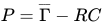




![{\displaystyle 2{\Big [}(\mathbf {Z} -\mu )^{\mathrm {H} }{\overline {P^{-1}}}(\mathbf {Z} -\mu )-\operatorname {Re} {\big (}(\mathbf {Z} -\mu )^{\mathrm {T} }R^{\mathrm {T} }{\overline {P^{-1}}}(\mathbf {Z} -\mu ){\big )}{\Big ]}\ \sim \ \chi ^{2}(2n)}](https://wikimedia.org/api/rest_v1/media/math/render/svg/a4752c39ed434c1a5f987accdda45de63384153f)

![\displaystyle {\sqrt {T}}{\Big (}{\tfrac {1}{T}}\textstyle \sum _{t=1}^{T}Z_{t}-\operatorname {E} [Z_{t}]{\Big )}\ \xrightarrow {d} \ {\mathcal {CN}}(0,\,\Gamma ,\,C),}](https://wikimedia.org/api/rest_v1/media/math/render/svg/7a8e03845ead334b995c22f8fb6a63887477b36d)
![{\displaystyle \Gamma =\演算子名 {E} [ZZ^{\mathrm {H} }]}](https://wikimedia.org/api/rest_v1/media/math/render/svg/040fb5df40ce465da42594603d54e851879ccdf9)
![{\displaystyle C=\operatorname {E} [ZZ^{\mathrm {T} }]}](https://wikimedia.org/api/rest_v1/media/math/render/svg/d57ca27eba4a64bb77bac89459414af49a542522)


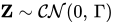


![{\displaystyle \Gamma =\演算子名 {E} [\mathbf {Z} \mathbf {Z} ^{\mathrm {H} }]}](https://wikimedia.org/api/rest_v1/media/math/render/svg/5664837bef03da1b45373e4aefa316892ccf80ed)






![{\displaystyle [-\pi ,\pi ]}](https://wikimedia.org/api/rest_v1/media/math/render/svg/cb064fd6c55820cfa660eabeeda0f6e3c4935ae6)