
Loading article…

世界の風力発電による累積総設備容量は、21世紀に入ってから急速に増加しており、2025年末時点で2700 GWを超えている。[ 2 ] 2010年以降、新たに追加された風力発電設備の半分以上は、主に中国とインドでの継続的なブームに牽引され、ヨーロッパと北米の伝統的な市場以外で追加された。2023年には、中国だけで世界の設備容量の40%以上を占めていた。[ 2 ]
風力発電は世界の半数以上の国で商業的に利用されている。[ 3 ]デンマークは2023年に電力の58%を風力で発電しており、これは他のどの国よりも高い割合である。ラトビアの風力発電容量は2022年に75%増加し、これは最大の増加率である。[ 2 ]
2018 年 11 月、スコットランドの風力発電量は、同月の同国の電力消費量を上回りました。[ 4 ] 2023 年の世界の電力使用量に占める風力発電の割合は 7.8% で、前年の 7.3% から増加しました。[ a ] [ 2 ]ヨーロッパでは、2023 年、風力発電が発電量の 12.3% を占めました。[ 2 ] 2018 年、中東、ラテンアメリカ、東南アジア、アフリカでは、風力発電の新規市場が 8% から 10% に拡大しました。[ 5 ]


ギガワット規模の風力発電設備を持つ国の数
以下の表は、各国ごとのこれらのデータを示しています。
データはEmberから取得され、特に指定がない限り2025年のデータに基づいています。[ 2 ]この表には、発電量が0.1TWhを超える国のみが含まれています 。

Wind power in Argentina is considered to have a vast potential due to the exceptionally high wind speed, specially in the Patagonia region[6]. For most of the country's history, wind power was largely unexploited because it was not profitable nor possible, considering there were no transmission lines that could connect the Patagonia region with the National Interconnected System[7]. This issue was solved by the construction of the Choele-Choel-Puerto Madryn high voltage line.[8]
Wind farm construction increased exponentially also due to tax benefits, such as RIGI[9].
Each year, Argentina breaks a new wind power production record, which has become the country's largest renewable energy[10] as more companies choose to power their factories using strictly renewable energy, such as Techint[11] and Loma Negra[12].
Wind power in Asia is an important component in the Asian energy industry and one of the key sources of renewable energy in the region. As of April 2016, the installed capacity of wind power in Asia (excluding the Middle East) totalled 175,831 MW.[13] Asia is the fastest growing region in terms of wind energy, having increased its installed capacity by 33,858 MW in 2005 (a 24% increase over 2014). China, with 145,362 MW of installed capacity, is the world's largest generator of electricity from wind energy. India is the second largest in Asia with an installed capacity of 25,088 MW.[13] Other key countries include Japan (1,394 MW), Taiwan (188 MW), South Korea (173 MW) and the Philippines (33 MW).[14]

The Koudia Al Baida Farm in Morocco, is the largest wind farm in the continent. Two other large wind farms are under construction in Tangier and Tarfaya.
Kenya is building a wind farm, the Lake Turkana Wind Power (LTWP), in Marsabit County. As Africa's largest wind farm, the project will increase the national electricity supply while creating jobs and reducing greenhouse gas emissions. LTWP is planned to produce 310 MW of wind power at full capacity.[17][18]
In January 2009, the first wind turbine in West Africa was erected in Batokunku, a village in The Gambia. The 150 kilowatt turbine provides electrical power for the 2,000-person village.[19]
The South African REIPPP has resulted in several wind farms already in commercial operation in the country. These wind farms are currently in operation in the provinces of the Eastern, Northern and Western Cape. It is estimated that 10 farms are already under construction or in operation, with 12 more being approved with the 4th Round of the REIPPP.
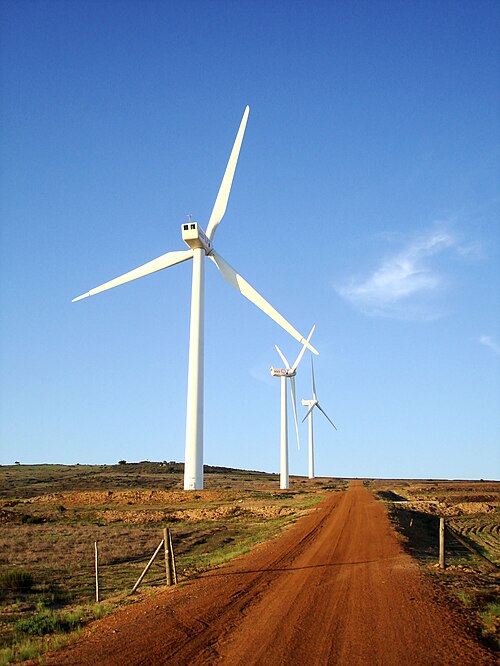
As of 2023, Europe had a total installed wind capacity of 255 gigawatts (GW).[20] In 2017, a total of 15,680 MW of wind power was installed, representing 55% of all new power capacity, and the wind power generated 336 TWh of electricity, enough to supply 11.6% of the EU's electricity consumption.[21]
In Q4 2023, wind power exceeded coal in European electricity generation for the first time, generating 193 TWh compared to coal's 184 TWh. Despite wind installation challenges, wind generation rose by 20% from 2022. New policies aim to further boost wind power in 2024.[22]

WindEurope (formerly known as The European Wind Energy Association) has estimated that 230 gigawatts of wind capacity will be installed in Europe by 2020, consisting of 190 GW onshore and 40 GW offshore. This would produce 14-17% of the EU's electricity, avoiding 333 million tonnes of CO2 per year and saving Europe €28 billion a year in fuel costs.[23][24]
Research from a wide variety of sources in various European countries shows that support for wind power is consistently about 80 per cent among the general public.[25]
By 2020, 56% wind power penetration was achieved in Denmark, 36% in Lithuania, 35% in Ireland, 23% in Portugal, 23% in Germany, 20% in Spain, 18% in Greece, 16% in Sweden, 15% (avg) in the EU.[26]
 Wind powerportal
:62が呼び出されましたが、定義されていません (ヘルプ ページを参照してください)。{{cite web}}: CS1 maint: タイトルとしてアーカイブされたコピー (リンク){{cite press release}}: CS1 maint: numeric names: authors list (link)