
Loading article…

Sir William Charles Hood (1824 – 4 January 1870) was a British medical doctor and psychiatrist of the Victorian era who pioneered the humane treatment of the mentally ill. As Superintendent at Bethlem Royal Hospital in London he reformed and civilised the hospital's regime.[1]
Hood was born at Lambeth in London, the son of Ann née Brown and William Chamberlain Hood (1790–1879), a surgeon, later a medical doctor.[2] He attended school in Brighton in Sussex before being admitted to Trinity College Dublin in 1841 aged 17. He obtained his professional training in medicine at Guy's Hospital, qualifying in 1845 before taking his M.D. at the University of St Andrews in 1846.[3] He became a Fellow of the Royal College of Physicians of Edinburgh (F.R.C.P. Edin.) in 1849, and a Member of the Royal Colleges of Surgeons (M.R.C.S. Eng.) in 1845. He was appointed Physician and Superintendent at Finnington House, a private asylum in Devizes. In 1851 Hood was appointed as Physician and the first Medical Superintendent at the newly opened Second Middlesex County Asylum.[3][4][5]
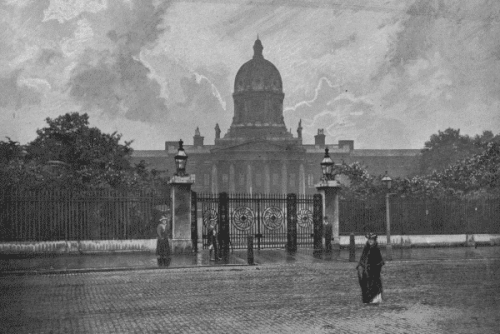
From 1852 to 1862[1][6] Hood was the resident Physician and Superintendent of Bethlem Royal Hospital, living there with his wife and family;[7] he "worked indefatigably for the improvement of the patients' conditions, and particularly for the segregation of the criminal insane".[3]
At Bethlem, Hood "carried out many excellent and necessary reforms",[8] including removing the bars from the windows, carpeting bedroom floors, replacing wooden benches and tables with armchairs and sofas, putting paintings on the walls and statues and busts in the wards,[9] abolishing forcibly restraining the patients and allowing some to go on supervised day visits to Kew Gardens[10] and the Crystal Palace.[7]
チャールズ・ディケンズの『ハウスホールド・ワーズ』に掲載されたヘンリー・モーリーの記事には、フッドがベスレムで行ったいくつかの変更点が記述されている。
入口の門をくぐり、芝生を回って建物に向かう途中、ふと横を見ると、何組かの患者が庭で静かに日光浴をしており、中には2、3人の楽しそうな小さな子供たちと芝生の上で遊んでいる子もいた。後で分かったのだが、彼らは常駐医師兼院長のフッド医師の子供たちだった。患者たちは彼らを心から信頼しており、彼らがそばにいることを大いに喜んでいる。小さな子供たちが遊びに来て、自信満々に耳元でしゃべり始めると、患者たちは自分たちが人間との交わりから切り離されているわけでも、厳しい不信の対象になっているわけでもないことを実感する。ベツレヘムには今や鎖も窮屈なチョッキもない。しかし、昔なら神経の強い大人がぞっとするような男たちが大多数を占める病棟の階段に、研修医の家族の一員である気高い少年が、明るい笑顔を浮かべて立っていた。その少年は、病院に迷い込んできた善意の化身のように見え、すべての憂鬱を追い払っていた。[ 7 ] [ 11 ]

フッドはロンドン医学外科協会のフェロー、病理学会のフェロー、ハンテリアン協会の会員であった。[ 4 ] 1862年、フッドはベスレム王立病院の職を辞し、大法官の精神病患者視察官に任命された。この職は、イングランドとウェールズ全土の裕福な大法官管轄の患者を定期的に診察することであった。 [ 8 ] [ 12 ] 1868年にはブライドウェル病院とベスレヘム病院の会計係に選出され、同年、医学への貢献によりウィンザー城でナイトの称号を授与された。 [ 13 ] [ 3 ]
1846年にジェーン・ウィレット(1822年 - 1866年)[ 14 ]と結婚し、9人の子供をもうけた。ドナルド・ウィリアム・チャールズ・フッド、アネット・ルイザ・ジェーン・フッド(1848年 - 1925年)、ウィレット・チャールズ・フッド(1850年 - 1857年)、ジェラルド・チャールズ・フッド(1852年 - 1891年)、フランシス・エドワード・チャールズ・フッド(1854年 - 1882年)、ゴッドフリー・チャールズ・フッド(1857年 - 1903年)、コリン・チャールズ・フッド(1857年 - 1915年)、フローレンス・メアリー・フッド・リカルド(1858年 - 1905年)、バジル・ウィレット・チャールズ・フッド(1864年 - 1917年)は劇作家で作家であり、両親の早世後、兄姉に育てられた。[ 15 ]
ウィリアム・チャールズ・フッド卿は1870年、45歳でブライデウェル病院の財務官邸で胸膜炎のため死去した。彼はサウス・メトロポリタン墓地に埋葬された。[ 16 ]