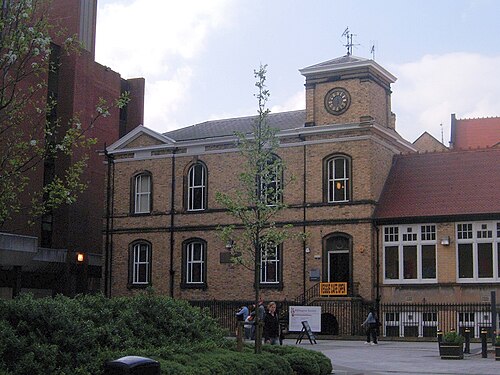
Manchester has a long and distinguished history of Chemistry. John Dalton founded modern Chemistry in 1803 with his atomic theory. William Henry (1774 – 1836) was a Manchester chemist who developed what is known today as Henry's Law. James Joule pioneered the science of thermodynamics in the 1840s while working in Manchester. In the basement of the Royal Manchester Institution, a laboratory was installed by Lyon Playfair, who worked there briefly as Professor of Chemistry after he left Thomson's of Clitheroe.[6] He was succeeded by Frederick Crace Calvert, who made phenol, which was used by Joseph Lister as an antiseptic. [7]Carl Schorlemmer,[8] was appointed the first UK Professor of Organic Chemistry in 1874.
The teaching of chemistry in Owens College began in 1851 in a house in St John Street and was later transferred to the main college building in Quay Street. When the college moved again to the present university site in 1873, the chemical laboratory was designed by Henry Roscoe. To this was added in 1895 the Schorlemmer laboratory for organic chemistry, and in 1904, three more laboratories were added; these were the Dalton and Perkin laboratories and the Schunck laboratory , which was brought from Kersal and rebuilt. The Morley laboratories (1909) provided further accommodation for organic chemistry.[9] In October 1909, Rona Robinson and two other women were arrested for dressing in full academic regalia and interrupting a speech by the chancellor of the university at the celebration of the opening of the new chemical laboratories. They were demanding that the chancellor speak out against the force-feeding of imprisoned suffragette alumni of Manchester who were on hunger strike. The police were particularly rough with the women that day and the chancellor was sufficiently moved by the women's protest to pressure the university into not pressing charges, thus preventing Rona from going to prison again.
After the 2nd World War three more laboratories were built further down Burlington Street; these were the Dixon Laboratory (1946), the Robinson Laboratory (1950), and the Lapworth Laboratory (1950);[10] all three were vacated in the 1960s when the present building in Brunswick Street was available. The architect for the present chemistry building was H. S. Fairhurst & Son.[11]
↑ Crellin, JK (2004). "Calvert, Frederick Crace- (1819–1873)" ( (購読または英国公共図書館会員資格が必要) )。Oxford Dictionary of National Biography (オンライン版)。 Oxford University Press。doi : 10.1093/ref:odnb/4419 。 2012年5月16日取得。(購読、ウィキペディアライブラリへのアクセス、または英国公共図書館の会員資格が必要です。)
↑ Smith, EF (1895). "有機化学の興隆と発展、カール・ショールレンマー、法学博士、王立協会フェロー著、アーサー・スミセルズ、理学士、リーズ・ビクトリア大学ヨークシャー・カレッジ化学教授による改訂および編集、マクミラン社、ニューヨーク。280ページ。価格1.60ドル" . Science . 1 (6): 163– 4. doi : 10.1126/science.1.6.163 . PMID 17789537 .
↑ Bawn, CEH; Taylor, Hugh; Tomlinson, Muriel; Hartley, Harold (1956 年 1 月 1 日). "訃報: Meredith Gwynne Evans, 1904–1952; James William McBain, 1882–1953; Sydney Glenn Preston Plant, 1896–1955; Humphrey Rivaz Raikes, 1891–1955; Ralph William Ewart Stickings, 1895–1955" . Journal of the Chemical Society (Resumed) : 1916– 1924. doi : 10.1039/JR9560001916 . ISSN 0368-1769 .