Loading article…

The Orion Arm, also known as the Orion–Cygnus Arm, is a minor spiral arm within the Milky Way Galaxy spanning 3,500 light-years (1,100 parsecs) in width and extending roughly 20,000 light-years (6,100 parsecs) in length.[2] This galactic structure encompasses the Solar System, including Earth. It is sometimes referred to by alternate names such as the Local Arm or Orion Bridge, and it was previously identified as the Local Spur or the Orion Spur. It should not be confused with the outer terminus of the Norma Arm, known as the Cygnus Arm.
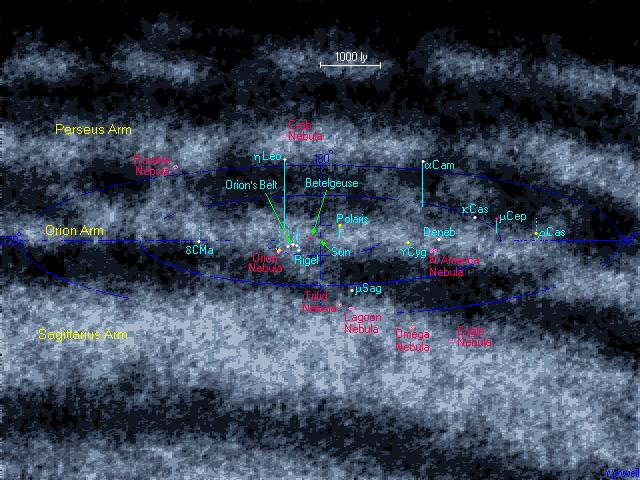
The arm is named after the Orion Constellation, one of the most prominent constellations of the Northern Hemisphere in winter (or the Southern Hemisphere in summer). Some of the brightest stars in the sky as well as other well-known celestial objects of the constellation (e.g. Betelgeuse, Rigel, the three stars of Orion's Belt, and the Orion Nebula) are found within it, as shown on Orion Arm's interactive map.
The Orion Arm is located between the Carina–Sagittarius Arm, the local portion of which projects toward the Galactic Center, and the Perseus Arm's local portion, which forms the main outer-most arm.
Scientists once believed the Orion Arm to be a minor structure, namely a "spur" between Carina-Sagittarius and Perseus, but evidence presented in 2013 suggests the Orion Arm to be a branch of the Perseus Arm or possibly an independent arm segment.[3]
The Solar System is close to its inner rim, about halfway along the arm's length, in a relative cavity in the arm's interstellar medium, known as the Local Bubble. It is approximately 8,000 parsecs (26,000 light-years) from the Galactic Center.
最近、BeSSeLサーベイ(棒状およびらせん状構造レガシーサーベイ)は、太陽から数キロパーセク以内の高質量星形成領域にある30個以上のメタノール(6.7GHz)および水(22GHz)メーザーの視差と固有運動を分析しました。その測定精度は±10%以上、さらには3%にも達します。HMSFR (高質量星形成領域)における星間メーザーの正確な位置は、ローカルアームがいて座アームとペルセウスアームの間のアームの孤立したセグメントであり、天の川の4分の1未満を巻き込んでいることを示唆しています。このセグメントの長さは約20,000光年、幅は約3,000光年で、ピッチ角は10.1°±2.7°から11.6°±1.8°です。これらの結果は、ローカルアームがこれまで考えられていたよりも大きく、そのピッチ角と星形成率が銀河の主要な渦状腕のそれらに匹敵することを示唆している。ローカルアームは、天の川銀河の 5 番目の特徴として適切に呼ばれている。[ 4 ] [ 5 ] [ 6 ] [ 7 ] [ 8 ]
いて座腕とペルセウス座腕の間の局所腕の形状を理解するために、90° ≤ l ≤ 270° の範囲で約 1 Gyr の年齢の特定の恒星群の恒星密度が Gaia DR2 を使用してマッピングされました。[ 9 ] 1 Gyr の恒星群が使用されたのは、局所腕をトレースする HMSFR のガスよりもはるかに進化した天体であるためです。局所腕に沿った恒星密度とガス分布の両方を比較する調査が行われました。研究者は、特に 90° ≤ l ≤ 190° の領域で、HMSFR と関連付けられる局所腕に近い腕のような恒星の過密度がわずかに有意であることを発見しました。[ 8 ]
研究者らは、局所腕セグメントはガスと星形成雲のみに関連しており、星の著しい過密状態を示していると結論付けた。また、恒星腕のピッチ角はガス定義腕よりもわずかに大きく、ガス定義腕と恒星腕の間にはずれがあることも発見した。恒星腕とHMSFR定義の渦状腕の間のピッチ角とずれのこれらの違いは、典型的な星形成時間スケールである10⁷〜10⁸年よりも長く続く渦状密度波において、星形成がガス圧縮に遅れているという予想と一致する。[ 10 ]
オリオン腕には、数多くのメシエ天体が存在する。