
Loading article…
メグナード・サハ(1893年10月6日 - 1956年2月16日)は、熱電離理論の考案に貢献したインドの天体物理学者であり政治家である。彼のサハ電離方程式により、天文学者は恒星のスペクトル型と実際の温度を正確に関連付けることができるようになった。 [ 1 ] [ 2 ] [ 3 ]

メグナード・サハは、1893年10月6日、ベンガル管区ダッカ地区(現在のバングラデシュ)のガジプールにあるシェオラタリ村で、ベンガル・ヒンドゥー教徒の家庭に生まれた。[ 4 ] [ 5 ]彼は、貧しい商店主ジャガンナート・サハと妻ブバネシュワリ・デヴィの8人の子供のうち5番目だった。[ 6 ]幼少期と職業生活でカースト制度に直面したサハは、幼い頃からカースト制度を憎むようになった。 [ 7 ]
若い頃、彼はスワデシ運動に参加したため、ダッカ・カレッジエイト・スクールを退学させられた。[ 8 ]その後、KLジュビリー・ハイスクール&カレッジに入学した。ダッカ・カレッジでインド学校証明書を取得した。[ 8 ]また、コルカタのプレジデンシー・カレッジとラジャバザール・サイエンス・カレッジCUにも在籍していた。サハはカーストのために他の学生から差別を受けた。エデン・ヒンドゥー・ホステルにいたとき、コミュニティの学生は彼が自分たちと同じ食堂で食事をすることに反対した。[ 1 ] [ 9 ]
彼は1923年から1938年までアラハバード大学の教授を務め、その後1956年に亡くなるまでカルカッタ大学の教授兼理学部長を務めた。1927年に王立協会のフェローとなった。 [ 10 ]彼は1934年にインド科学会議 の第21回会期の議長を務めた。[ 11 ]
サハのクラスメートには、サティエンドラ・ナス・ボース、ジュナン・ゴーシュ、ジュナンネンドラ・ナス・ムカルジーがいました。晩年はアミヤ・チャラン・バナジーと親しかった。[ 12 ] [ 13 ]

サハは元素の熱電離の研究から、サハ電離方程式として知られる式を定式化した。この方程式は、恒星のスペクトルを解釈するための基本的なツールの1つである。恒星のスペクトルを研究することで、恒星の温度を求めることができ、サハ方程式を用いて恒星を構成する元素の電離状態を決定することができる。この研究は、ラルフ・H・ファウラーとエドワード・アーサー・ミルンによって拡張された。サハは以前、この主題に関して次のような結論に達していた。
これまでのことから、恒星スペクトルの性質を決定する上で温度が主役であることは認められるだろう。提示された数値に過度に重要性を置くべきではない。なぜなら、この理論は高温で起こる物理過程を定量的に推定するための最初の試みにすぎないからである。我々には実際に指針となる実験データはないが、恒星スペクトルは、温度が3000 Kから40,000 Kまで連続的に変化するにつれて、物理過程が次々と起こり、途切れることなく展開していくものと考えることができる。[ 14 ]
サハはまた、太陽光線の重さと圧力を測定する装置も発明した。
メグナード・サハは、統一州(現在のウッタル・プラデーシュ州)のアラハバード大学の物理学部や、コルカタの核物理研究所(現在のサハ核物理研究所)など、いくつかの科学機関の設立に貢献した。彼は雑誌『サイエンス・アンド・カルチャー』を創刊し、亡くなるまで編集長を務めた。[ 15 ]彼は、国立科学アカデミー(1930年)、インド物理学会(1934年)、インド科学研究所(1935年)など、いくつかの科学協会の組織化において主導的な役割を果たした。彼は1953年から1956年までインド科学振興協会の理事を務めた。 1943年にコルカタに設立されたサハ核物理研究所は、彼の名にちなんで名付けられた。[ 16 ]
Saha stood as a candidate for North-West Calcutta in the 1951 Lok Sabha election. He ran as a member of the Union of Socialists and Progressives,[17][18][19] but maintained his independence from the party. His goal was to improve the planning of education, industrialisation, healthcare, and river valley development. He was up against Prabhu Dayal Himatsingka. Due to low funding for his campaign, Saha wrote to the publisher of his textbook Treatise on Heat to ask for an advance of ₹5000. He was elected by a margin of 16%.[20]
Saha participated in the areas of education, refugees, rehabilitation, atomic energy, multipurpose river projects, flood control, and long term planning. On the dust jacket flap of the book Meghnad Saha in Parliament, Saha is described as:
"Never unduly critical... forthright, so incisive, so thorough in pointing out lapses that the treasury bench was constantly on the defensive. This is brought out by the way he was accused of leaving his laboratory and straying into a territory not his own. But the reason why he was slowly drifting towards this public role (he was never a politician in the correct sense of the term) was the gradually widening gulf between his dream and the reality—between his vision of an industrialised India and the Government implementation of the plan."[21]
Saha was the chief architect of river planning in India and prepared the original plan for the Damodar Valley Project. His own observation with respect to his transition into government projects and political affairs was:
Scientists are often accused of living in the "Ivory Tower" and not troubling their mind with realities and apart from my association with political movements in my juvenile years, I had lived in ivory tower up to 1930. But science and technology are as important for administration now-a-days as law and order. I have gradually glided into politics because I wanted to be of some use to the country in my own humble way.[22]

In 1905, while the Banga-bhanga movement was underway, Saha had taken part in a movement protesting against the British Governor visiting his school; and was thus expelled. [23]
Saha married Radha Rani Saha on 16 June 1918. They had a total of 7 children: 3 sons and 4 daughters.[24]
サハは1956年2月16日、心臓発作を起こし病院へ向かう途中で亡くなった。彼はラシュトラパティ・バワンにある計画委員会の事務所へ向かっていた。亡くなる10ヶ月前から高血圧を患っていたと報じられている。 [ 27 ]彼の遺体は翌日、コルカタのケオラトラ火葬場で火葬された。 [ 28 ]


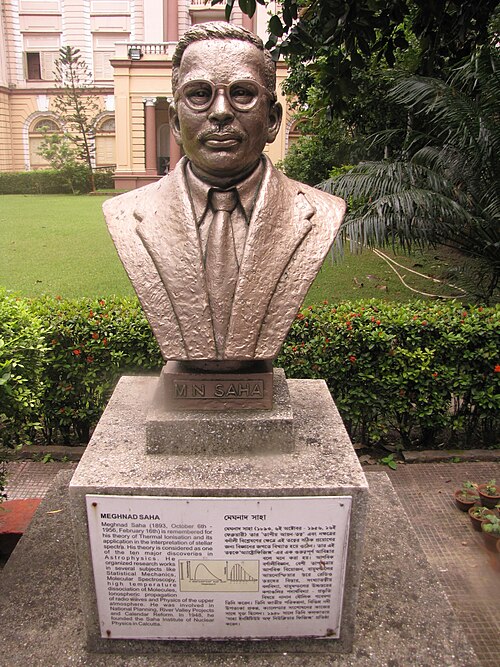
下層階級の家庭に生まれた彼は、博学者、政治家、そして物理学の世界に数々の重要な貢献をした先駆的な科学者となった。
植民地時代末期のインドにおける科学の広がりをある程度反映しているとは言えないものの、社会や地域の多様性の高まりを反映している。1924年から1944年の間に、王立協会は、東ベンガルの低カースト出身のメグナード・サハ、パンジャブ出身のSS・バトナガル(カヤスタ)とビルバル・サニ、ボンベイ出身のパールシーであるホーミ・バーバー、タミル・バラモンであるCV・ラーマン、彼の甥であるS・チャンドラセカール、そしてラーマンの同僚であり、パリット物理学教授の後継者で、同じく南インド出身のKS・クリシュナンをフェローに選出した。
Even though he later came to be known as an atheist, Saha was well-versed in all religious texts— though his interest in them was purely academic.