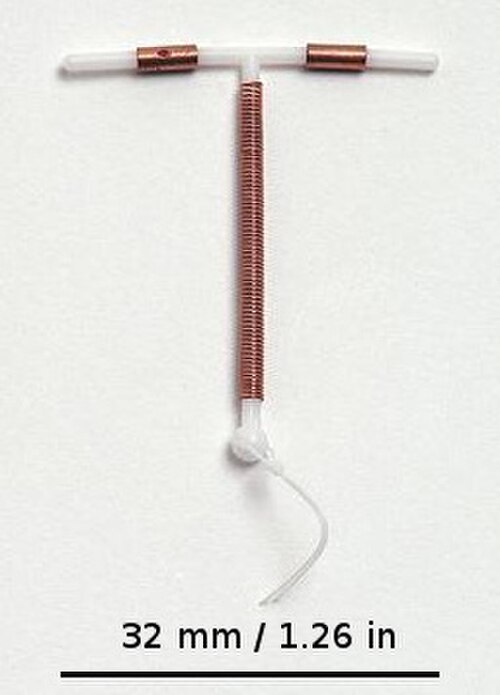
The most common side effects of non-hormonal or copper IUDs are increased pain and heavy bleeding during menstruation, and spotting between menstruation. Impacts on menstruation may decrease over the lifespan of the IUD, but spotting between menstruation may become more frequent over time. For some users, these side effects lead them to discontinue use.[23]
The most common side effect of the contraceptive implant is irregular bleeding, which includes both reduced and increased levels of bleeding.[24] Other side effects include mood changes and mild insulin resistance.[21]
Risks
IUD use carries some additional risks. Both hormonal and non-hormonal IUDs may lead to developing non-cancerous ovarian cysts.[21][25] It is also possible that an IUD may be expelled (fall out) from the uterus.[26] The IUD may also perforate (tear) the uterine wall. This is extremely rare and a medical emergency.[27]
Society and culture
Cost and benefit
All LARCs are designed to last for at least three years, with some options (Paraguard Copper IUD) lasting for at least ten years. Although they have higher up-front costs (out-of-pocket costs can range between $500 and $1300),[28] that cost purchases coverage for longer than other contraceptive methods, which are often purchased on a monthly basis (for hormonal birth control methods like pills, patches, or rings.) When accounting for upfront costs, failure rates, and side effects, researchers estimate that the most cost effective means of contraception are the Copper IUD, vasectomy, and the levonorgestrel IUD (such as a Mirena).[29] One researcher estimates that use of the levonorgestrel IUD can be up to 31% cheaper than using non-LARC methods such as birth control pills, patch, ring, or injectables. Regardless, the initial out of pocket cost is still too high for many patients, and is one of the biggest barriers to LARC use. Studies conducted in California and St. Louis have shown that rates of LARC usage are dramatically higher when the costs of the methods are either covered or removed.[30][31][32]
Guidelines released in 2009 by the American College of Obstetricians and Gynecologists (ACOG) state that LARC methods are considered to be the first-line option for birth control in the United States, and are recommended for the majority of women. According to the CDC Medical Eligibility Criteria for Contraceptive Use, LARC methods are recommended for the majority of women who have had their first menstruation, regardless of whether they have had any pregnancies. The American Academy of Pediatrics (AAP) in a policy statement and technical report published in October 2014 recommended LARC methods for adolescents.
In the years since ACOG made these recommendations, many researchers have evaluated the impact of the LARC-first model. Because it prioritized the importance of effectiveness of method in contraceptive counseling, patient preferences and priorities were not given adequate attention within contraceptive counseling.[43] Researchers have found that patients experience over-enthusiasm about a particular method as coercive.[44][45][46] ACOG practitioners have since come forward with an attempt at re-balancing recommendations to center patient needs and desires in contraceptive counseling.[43] The organization has also formally denounced coercive contraceptive practices, including those that incentivize use of contraception, incentivize use of a particular type of contraception, or make it harder to discontinue use of contraception.[47]
↑Stoddard, A.; McNicholas, C.; Peipert, J. F. (2011). "Efficacy and Safety of Long-Acting Reversible Contraception". Drugs. 71 (8): 969–980. doi:10.2165/11591290-000000000-00000. PMC3662967. PMID21668037.
↑Blumenthal, P. D.; Voedisch, A.; Gemzell-Danielsson, K. (2010). "Strategies to prevent unintended pregnancy: Increasing use of long-acting reversible contraception". Human Reproduction Update. 17 (1): 121–137. doi:10.1093/humupd/dmq026. PMID20634208.
1 2 Winner, Brooke; Peipert, Jeffrey F.; Zhao, Qiuhong; Buckel, Christina; Madden, Tessa; Allsworth, Jenifer E.; Secura, Gina M. (2012年5月24日). 「長期作用型可逆性避妊法の有効性」 . New England Journal of Medicine . 366 (21): 1998–2007 . doi : 10.1056/NEJMoa1110855 . ISSN 0028-4793 . PMID 22621627 .
↑Buck, Emily; McNally, Lauren; Jenkins, Suzanne M. (2024), "Menstrual Suppression", StatPearls, Treasure Island (FL): StatPearls Publishing, PMID37276279, retrieved 10 April 2024
↑Brown, Julie; Farquhar, Cindy (10 March 2014). Cochrane Gynaecology and Fertility Group (ed.). "Endometriosis: an overview of Cochrane Reviews". Cochrane Database of Systematic Reviews. 2014 (8). doi:10.1002/14651858.CD009590.pub2. PMC6984415. PMID24610050.
↑"Heavy menstrual bleeding - Symptoms and causes". Mayo Clinic. Retrieved 10 April 2024.
↑"Hormonal IUD (Mirena) - Mayo Clinic". www.mayoclinic.org. Retrieved 15 April 2024.
↑Hubacher, David; Chen, Pai-Lien; Park, Sola (May 2009). "Side effects from the copper IUD: do they decrease over time?". Contraception. 79 (5): 356–362. doi:10.1016/j.contraception.2008.11.012. PMC2702765. PMID19341847.
↑Mansour, Diana; Korver, Tjeerd; Marintcheva-Petrova, Maya; Fraser, Ian S. (January 2008). "The effects of Implanon® on menstrual bleeding patterns". The European Journal of Contraception & Reproductive Health Care. 13 (sup1): 13–28. doi:10.1080/13625180801959931. ISSN1362-5187. PMID18330814.
↑"Copper IUD (ParaGard) - Mayo Clinic". www.mayoclinic.org. Retrieved 15 April 2024.
↑Anthony, Mary S.; Zhou, Xiaolei; Schoendorf, Juliane; Reed, Susan D.; Getahun, Darios; Armstrong, Mary Anne; Gatz, Jennifer; Peipert, Jeffrey F.; Raine-Bennett, Tina; Fassett, Michael J.; Saltus, Catherine W.; Ritchey, Mary E.; Ichikawa, Laura; Shi, Jiaxiao M.; Alabaster, Amy (December 2022). "Demographic, Reproductive, and Medical Risk Factors for Intrauterine Device Expulsion". Obstetrics & Gynecology. 140 (6): 1017–1030. doi:10.1097/AOG.0000000000005000. ISSN0029-7844. PMC9665953. PMID36357958.
↑Reed, Susan D; Zhou, Xiaolei; Ichikawa, Laura; Gatz, Jennifer L; Peipert, Jeffrey F; Armstrong, Mary Anne; Raine-Bennett, Tina; Getahun, Darios; Fassett, Michael J; Postlethwaite, Debbie A; Shi, Jiaxiao M; Asiimwe, Alex; Pisa, Federica; Schoendorf, Juliane; Saltus, Catherine W (June 2022). "Intrauterine device-related uterine perforation incidence and risk (APEX-IUD): a large multisite cohort study". The Lancet. 399 (10341): 2103–2112. doi:10.1016/s0140-6736(22)00015-0. ISSN0140-6736. PMID35658995.
↑"Intrauterine Devices (IUDs): Access for Women in the U.S."KFF. 9 September 2020. Retrieved 23 April 2024.
↑Trussell, James; Lalla, Anjana M.; Doan, Quan V.; Reyes, Eileen; Pinto, Lionel; Gricar, Joseph (January 2009). "Cost effectiveness of contraceptives in the United States". Contraception. 79 (1): 5–14. doi:10.1016/j.contraception.2008.08.003. PMC3638200. PMID19041435.
↑Postlethwaite, Debbie; Trussell, James; Zoolakis, Anthony; Shabear, Ruth; Petitti, Diana (November 2007). "A comparison of contraceptive procurement pre- and post-benefit change". Contraception. 76 (5): 360–365. doi:10.1016/j.contraception.2007.07.006.
↑ Secura, Gina M.; Allsworth, Jenifer E.; Madden, Tessa; Mullersman, Jennifer L.; Peipert, Jeffrey F. (2010年8月) 「避妊選択プロジェクト:長期作用型可逆避妊の障壁を減らす」 . American Journal of Obstetrics and Gynecology . 203 (2): 115.e1–115.e7. doi : 10.1016/j.ajog.2010.04.017 . PMC 2910826 . PMID 20541171 .