↑Operations resumed in 2002, but the new name may not have been applied until the after the 2003 defense reforms were promulgated.
↑Little is known about the Taliban regime's air force establishment.
↑The pro-Soviet regime collapsed in late April 1992 and was succeeded by the UN-sponsored government, the "Islamic State of Afghanistan", led by Burhanuddin Rabbani until overthrown by the Taliban in September 1996.
↑Official establishment occurred in 1924, but the AMAA received its first aircraft in 1921 (aside from some captured in 1919).
↑As in most cases, Argentina's air arms began as an Army formation. Following a period of service unification, the Army Aviation Command was reformed on 27 November 1956, but did not gain independence from the Air Force until 3 November 1959.
↑The indicated roundel was introduced in 1937 – according to Иван Бориславов и Румен Кирилов, "Самолетите на България", част втора, София, 1996, стр. 246–253 (in Bulgarian; in English: Ivan Borislavov and Rumen Kirilov, "The Airplanes of Bulgaria", part two, Sofia, 1996, pages 246–253).
↑The indicated version of the German Cross was slightly modified and introduced in 1915 as most widespread Bulgarian aviation sign during the First World War along with the less employed St. Andrew's Cross – according to Иван Бориславов и Румен Кирилов, "Самолетите на България", част втора, София, 1996, стр. 246–253 (in Bulgarian; in English: Ivan Borislavov and Rumen Kirilov, "The Airplanes of Bulgaria", part two, Sofia, 1996, pages 246–253).
↑Initially operated balloons. In 1912 Bulgaria received its first airplane Bleriot XXI, with which on 13 August 1912 Simeon Petrov flew to become the first Bulgarian to pilot an airplane over Bulgaria.
↑The KPAF's name was changed to "Cambodian People's Air Force" in 1989, following the restoration of the nation's former name of Cambodia. In 1992, the PKAF was briefly resurrected as the "State of Cambodia Air Force", but it never actually became operational under that title.
↑The Vietnamese invasion of 1979 resulted in the forcible disbandment of the AFKLA; formation of a successor force did not begin until 1984.
↑The Cape Verde Coast Guard received its first aircraft in November 1992; its actual date of formation is unknown at this time.
↑When Chile's unified national air force was dissolved in 1953, the Army did not regain an air arm of its own. Disappointment with this outcome led to the founding of the Club Aéreo del Personal del Ejército (Army Personnel Aero Club) in 1959. Although never formally established as an air arm, it nevertheless served as an important and foundational predecessor to the modern CAEC.
↑On 28 February 1930, the Red Army captured a Nationalist Chinese O2U-4 Corsair reconnaissance aircraft that had been forced to land due to having run out of fuel; given a red star and named after Lenin, it was later used against the Nationalist government. This may have been the first aircraft in the Red Army. Small numbers of captured aircraft were also used against the Japanese during World War II, but the first regular Communist Chinese air force would be organized as the Nanyuan Flying Group in 1949.
↑Information on the organization of Chinese military aviation prior to 1925, when the Kuomintang began establishing its Aviation Bureaus around China, is very spotty as many records have been lost during the conflicts raging from 1931–1949 and the subsequent Cultural Revolution; in fact, during most of these earlier years, China fielded multiple air forces, most being the personal air arms of various warlords – some allied with the national government and some not. During World War II (which began for the Chinese with the Japanese invasion of Manchuria in 1931), the Japanese established a number of puppet governments, several of which were permitted to field small air forces.
↑Although a formal aviation arm was not stood up until 1979, the ROC Army created an Aviation Section for each of its two corps and an Aviation Platoon for its General Headquarters in 1956.
↑Full formal name is the Cuban Air Defense and Revolutionary Air Force (Defensa Anti-Aérea y Fuerza Aérea Revolucionaria).
↑Established by Fidel Castro in 1958, but operations with a captured Aviación Naval aircraft began the previous year.
↑Split off from the Cuban air force in 1934, but remerged in 1952 reorganization.
↑In early 1948, Army aviation became an independent and separate service as the Dominican Military Aviation Corps (DMAC) El Cuerpo de Aviación Militar Dominicana (CAMD/AMD). The Army regained an air arm of its own in 2001.
↑At the beginning of 1951, the Navy was authorized to establish its own aviation arm, but it was absorbed into the Air Force the following year. The Navy regained an air arm of its own in 2003.
12From 1958–1961, the Egyptian and Syrian air forces were unified as the United Arab Republic Air Force
↑The Ethiopian Air Force effectively ceased to exist in 1991, following the victory of the Eritrean People's Liberation Front (EPLF) in the civil war; it was reestablished in 1995.
↑Also used the ordinary French roundel: with the Cross of Lorraine as a fin flash.
↑Also used a variant of the ordinary French roundel with bars like the USAAF insignia:
↑The Gambia formed the nucleus of an air force in 2002 and sent personnel to Ukraine for a four-year pilot training course. The Gambia bought its first aircraft, a single Su-25 from Georgia in the first half of 2003. However, by 2007, the government had yet to announce its air force's formal establishment.
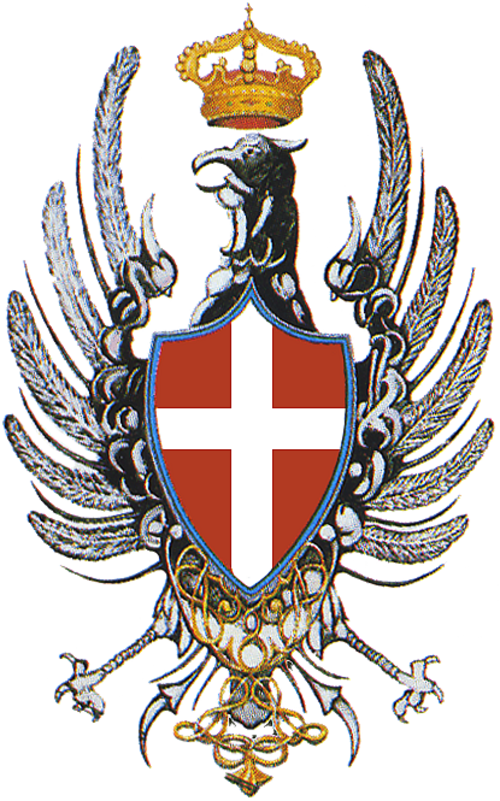
↑Conglomerate of the Aviazione della Regia Marina and Corpo Aeronautico Militare. Tailfin insignia (click to enlarge): , flank roundel (click to enlarge):
↑Edwards, Paul M. (2010). "Korean People's Air Force (KPAF)". Historical Dictionary of the Korean War (2nded.). Lanham: Scarecrow Press. p.151. ISBN978-0-8108-7461-9.
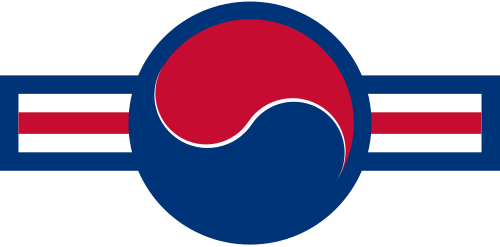
↑The first ROKAF roundel was simply a red-blue Taegeuk, later, a roundel resembles that of the USAF was used until the 2000s (click to enlarge):
↑For some time LPLAAF also used this roundel (clik to enlarge): (www.acig.org)
↑Pathet Lao insurgents operated their own small air arm from 1960–1975; it became part of the LPLAAF.
↑Following a failed attempt at a coup d'état, the Kong Le rebel faction also briefly operated a small air arm from 1960–1963, when it was re-incorporated into the RLAF.
↑The Malawi Young Pioneers (MYP) was a paramilitary adjunct of the League of Malawi Youth activist organization of the ruling Malawi Congress Party (MCP). Established in 1963, the first militarily trained cadres appeared in 1964, and the MYP obtained aircraft beginning in 1970.
↑Although founded in 1926, aircraft were not supplied until the following year.
↑On the flanks are used also the national flag, it seems to be used also this roundel:
↑The yellow variant of the soyombo roundel is also reported: .
↑The Serbian-Montenegrin union of Yugoslavia was dissolved in 2006 and the former nation's military assets were divided between them.
12Montenegro voted to secede from the FRY in 2006 and the union with Serbia was dissolved, with FRY military assets being divided between the (now) two nations.
↑After World War I, Serbia was united with other Balkan states into the Kingdom of Yugoslavia.
↑Russia provided Tajikistan with several helicopters in 1993 and began to organize an indigenous air force by no later than 1994; however, most sources express doubts as to its operational effectiveness.
↑"Japanese use of Type 45 Siamese Mauser?". forums.gunboards.com. 18 February 2010. Archived from the original on 14 August 2014. Retrieved 6 September 2013.
↑Admin (10 March 2017). "Tonga Defence Services". Aeroflight. Aeroflight Publishing. Archived from the original on 13 September 2018. Retrieved 13 September 2018.
↑Although some aircraft were obtained after independence in 1960 and further aircraft were supplied by France in 1963, the air force was not formally established until 1964.

 with the Cross of Lorraine as a fin flash.

 , flank roundel (click to enlarge):


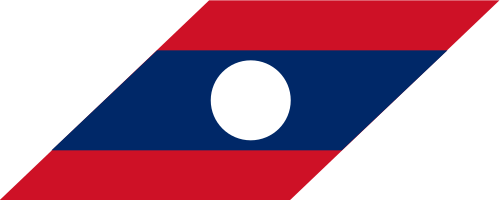 (www.acig.org)
 .
.