
Loading article…
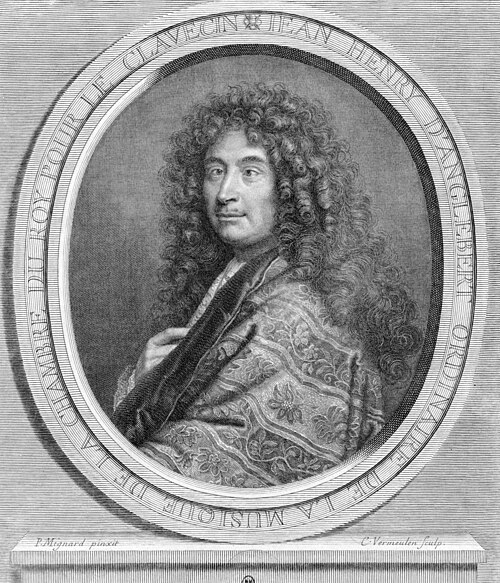
ジャン=アンリ・ダングルベール( 1629年4月1日洗礼- 1691年4月23日没)は、フランスの作曲家、チェンバロ奏者、オルガン奏者。彼は当時を代表する鍵盤楽器作曲家の一人であった。
ダングルベールの父クロード・アンリ(通称アングルベール)[ 1 ]は、バール公国のバール・ル・デュックで裕福な靴職人だった。作曲家の幼少期や音楽教育については何も分かっていない。彼がいつフランスに移住したのかも不明である。かつてジャック・シャンピオン・ド・シャンボニエールのために墓碑銘を作曲したことから、シャンボニエールが彼の師であったか、少なくともダングルベールが深く尊敬していた友人であった可能性もある。ダングルベールの音楽が収められた現存する最古の写本は1650年から1659年のものである。この写本にはルイ・クープランとシャンボニエールの音楽も含まれており、おそらく彼らの身近な人々の間で生まれたものだろう。したがって、1650年代半ばにはすでにダングルベールは当時のフランスで最も著名なチェンバロ奏者たちと密接な関係にあったに違いない。ダングルベールに関する最古の記録は、1659年10月11日付の結婚契約書に見られる。ダングルベールは、オルガン奏者フランソワ・ロベルデーの義理の妹であるマドレーヌ・シャンパーニュと結婚した。契約書の中で彼は「パリのブルジョワ」と記されており、1659年までに既にパリで確固たる地位を築いていたことがうかがえる。彼がどのようにしてバール=ル=デュックを離れ、パリに定住したのかは不明である。
ダングルベールのパリでのキャリアは、1660年1月時点で彼がオルガニストを務めていたサン・オノレ通りのジャコバン派教会で始まったに違いない。1660年8月、彼は国王の弟であるオルレアン公フィリップ1世のチェンバロ奏者としてアンリ・デュモンの後任となった。彼は少なくとも1668年までその地位にあったが、その間の1662年、宮廷で最近失脚したシャンボニエールからチェンバロ奏者の地位を買い取った。シャンボニエールは給料は受け取ったものの、ダングルベールが職務を引き継いだ。彼は王室のチェンバロ奏者として仕え、1674年に息子のジャン=バティスト=アンリが後継者となった。1679年以降、ダングルベールは1690年に亡くなったバイエルン公爵夫人マリア・アンナ・ヴィクトリアに仕えた。ダングルベールは翌年の4月23日に亡くなった。彼の唯一の出版作品である『クラヴサン曲集』は、そのわずか2年前の1689年に出版された。彼のその他の作品(主にチェンバロ曲だが、5つのフーガとオルガン四重奏曲も含む)は写本として残っている。

D'Anglebert's principal work is a collection of four harpsichord suites published in 1689 in Paris under the title Pièces de clavecin. The volume is dedicated to Marie Anne de Bourbon, a talented amateur harpsichordist who later studied under François Couperin. Apart from its contents, which represents some of the finest achievements of the French harpsichord school (and shows, among other things, D'Anglebert's thorough mastery of counterpoint and his substantial contribution to the genre of unmeasured prelude), Pièces de clavecin is historically important on several other counts. The collection was beautifully engraved with utmost care, which set a new standard for music engraving. Furthermore, D'Anglebert's table of ornaments is the most sophisticated before Couperin's (which only appeared a quarter of a century later, in 1713). It formed the basis of J.S. Bach's own table of ornaments (Bach copied D'Anglebert's table ca. 1710), and provided a model for other composers, including Rameau. Finally, D'Anglebert's original pieces are presented together with his arrangements of Lully's orchestral works. D'Anglebert's arrangements are, once again, some of the finest pieces in that genre, and show him experimenting with texture to achieve an orchestral sonority.
Most of D'Anglebert's other pieces survive in two manuscripts, one of which contains, apart from the usual dances, harpsichord arrangements of lute pieces by composers such as Ennemond Gaultier, Denis Gaultier, and René Mesangeau. They are unique pieces, for no such arrangements by other major French harpsichord composers are known. The second manuscript contains even more experimental pieces by D'Anglebert, in which he tried to invent a tablature-like notation for keyboard music to simplify the notation of style brisé textures.
D'Anglebert's only surviving organ works are five fugues and a quatuor (an old French term for a four-voice contrapuntal organ piece). The fugues all elaborate on variations of the same subject, thus forming an extended ricercare (or a miniature The Art of the Fugue). The quatuor, one of the few surviving pieces of its kind, is built around three themes derived from the Kyrie Cunctipotens; it is to be played on three keyboards and the pedal keyboard.