
Loading article…
Franz Ulrich Theodor Aepinus (13 December 1724 –10 August 1802) was a German mathematician, scientist, and natural philosopher residing in the Russian Empire. Aepinus is best known for his researches, theoretical and experimental, in electricity and magnetism.
He was born at Rostock in the Duchy of Mecklenburg-Schwerin. He was descended from Johannes Aepinus (1499–1553), the first to adopt the Greek form (αἰπεινός) of the family name Hugk or Huck, and a leading theologian and controversialist at the time of the Protestant Reformation.[1]
After studying medicine for a time, Franz Aepinus devoted himself to the physical and mathematical sciences, in which he soon gained such distinction that he was admitted a member of the Prussian Academy of Sciences. In 1755, he was briefly the director of the Astronomisches Rechen-Institut. In 1757, he settled in St Petersburg as member of the Russian Academy of Sciences and professor of physics, and remained there till his retirement in 1798.
The rest of his life was spent at Dorpat.[2] He enjoyed the favor of Empress Catherine II of Russia, who appointed him tutor to her son Paul,[1]:53 and endeavored, without success, to establish normal schools throughout the empire under his direction.[2] In 1760, Aepinus was elected a foreign member of the Royal Swedish Academy of Sciences.[1]:49
In 2009, Aepinus crater on the Moon was named in his honor.[3]
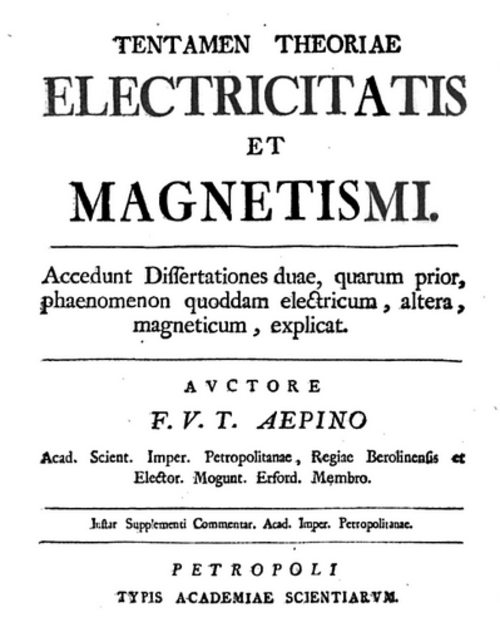
彼の主要な著作である『電気と磁気の理論の試み』(Tentamen Theoriae Electricitatis et Magnetismi )は、1759年にサンクトペテルブルクで出版され、これらの主題に数学的推論を適用した最初の体系的な試みであった。 [ 4 ]また、1761年には『地球における熱の分布について』(De Distributione Caloris per Tellurem )という論文を発表し、サンクトペテルブルクとベルリンの学術団体の雑誌に掲載された、天文学、力学、光学、純粋数学のさまざまな主題に関する論文の著者でもあった。
彼が太陽面を通過する惑星の視差の影響について論じた論文は、18世紀に起こった金星の2回の太陽面通過の間に(1764年に)発表されたため、大きな関心を集めた。 [ 2 ]

アエピヌスは、電気の遠隔作用の理論が、現在静電誘導として知られる実験結果を簡単に説明できることを初めて示し、静電気学の基礎を築きました[ 5 ]: 52彼の理論は、説明のつかない遠隔作用に依存している点で、ニュートンの重力へのアプローチに似ていました[ 1 ] 。また、ニュートンと同様に、アエピヌスは力の伝達には接触が必要だと考えていました[ 6 ]。これらの矛盾しているように見える点は、物理現象の近似モデルという現代の科学的概念を反映しています。
ヘンリー・キャベンディッシュは、本質的に同じ電気理論を考案したが、この二人の哲学者の間には何の交流もなかった。アエピヌスはキャベンディッシュの理論より約10年前に自身の理論を発表していた。これらの理論は、最終的に二つの流体が存在するという考えを否定するに至った。