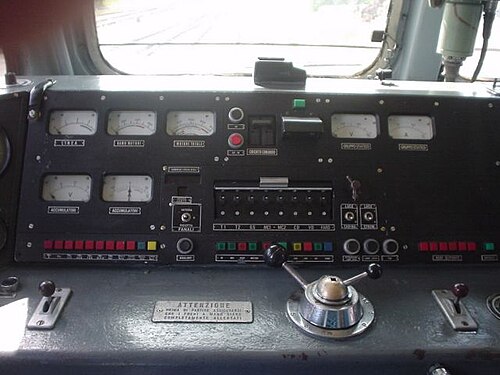
The following components form the auxiliary systems:
two W242 compressors used for air production;
an asynchronous 17kW three-phase motor that is used to activate the four groups of motor-cooling fans, 7 groups for rheostat cooling and 2 fans for cabin air conditioning;
a 3 kVA transformer used to recharge the 24 V batteries, plus another four for cabin heating and another one for glass defrosters.
They are fed in various ways, depending on the series:
on 1st and 3rd series by two 125 kVA motoalternators, activated by a double-collector 95kW 3000 V motor;
on 2nd and 4th series by a single 3000 V DC/450 V AC 60Hz 180 kVA static converter;
on 5th and 6th series two 3000 V DC/450 V AC 60Hz 120 kVA static converters.
Motor cooling fans are automatically activated when the reverser is in non-neutral position, while rheostat fans activate when the temperature into the rheostat's resistors reaches 65°C (149°F) or they are manually activated by the driver via an apposite button.
Significant units
E.655.200 had been fitted with two ARSA static converters for testing purposes.
E.656.458 and E.656.468 mount digital Octopus control units, which allow remote command of two or more locomotives from a single driving cabin. These units also have four weakening field shunts in Parallel and SuperParallel combinations as sixth series' units.
Accidents and incidents
The E.655.403 (previously E.656.403), the unit involved in the Roma Casilina accident.The E.655.175, the unit involved in Viareggio train derailment the morning after.
November 21, 1980 Curinga train disaster: Units 075 and 280 are written off. Both scrapped in July 1983
14 March 1995 near Chiusi-Città della Pieve train E.656.542 missed a stop signal, crashing into E.656.181
5 July near Cuzzago, E.656.272 impact against another train, causing 2 death and 51 injured.
20 August 1996 near Bologna San Ruffillo E.656.225 derail into a closed rail, 2 injured.
2 August 1997 near Roma Casilina, E.656.403 traction hook broke, causing derailment of its passenger car. Four were seriously injured. The accident was caused by velocity: the train was going at 90km/h instead 30km/h.
4 June 2000 near Solignano a cargo train crashed intoanother cargo train; four deaths and one injury.