
Loading article…
ツクミ公国(グルジア語: ცხუმის საერისთავო)は、中世のジョージアの公国(サエリスタヴォ)でした。シェルヴァシゼ家によって統治されたこの公国は、8 世紀から 14 世紀までジョージア北西部に存在し、現在のジョージア州スフミ周辺の領土を構成していました。

ツフミ公国は、おそらく古代アプシレスの地にレオン2世の治世中に独立した封建領地として形成された。アブハジア王国の8つの公国の1つを形成し、ラジカからアナコピアとアラニアまでの領土を包含していた。[ 1 ]バグラット城はツフミのエリスタヴィの拠点として機能した。
1033年、バグラット4世の異母兄弟デメトレは兄を退位させることを目的に陰謀を企てた。バグラットの統治に反対する一部の有力貴族が、デメトレの王位への野望を利用しようとしたが失敗に終わった。バグラットに脅かされたアルダ王太后はビザンツ帝国に寝返り、アナコピアを皇帝ロマノス3世に明け渡した。皇帝は彼女の息子デメトレにマギストロスの地位を与えた。[ 2 ]グルジア年代記の年代記作者の言葉によれば、バグラット王は敵の連合軍を破り、アナコピアを包囲した後、アブハジアのエリスタフ・オタゴ・チャチャスゼとその軍隊に要塞の管理を任せて引き返した。アブハジアのエリスタフの積極的な支援のおかげで、バグラット4世はアナコピア要塞をグルジアに返還することに成功した。
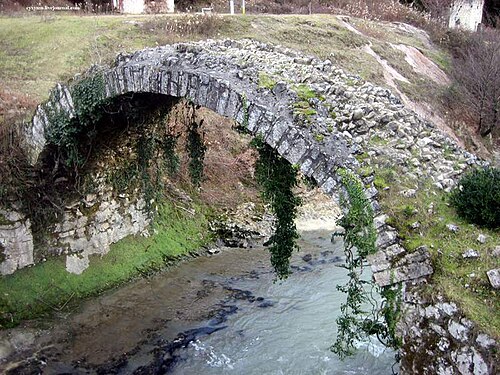
In the 12th century, King David the Builder appointed the son of shahShirvan Otagho as a viceroy of Abkhazia, who later became the founder of House of Shervashidze. The city of Tskhumi (Sukhumi) became the summer residence of the Georgian kings. According to Russian scholar V. Sizov, it became an important "cultural and administrative center of the Georgian state.[3] The historian Yuri Voronov also conjectured that the castle might have hosted the queen-regnant Tamar of Georgia during her stays in Abkhazia in the early 13th century. During this period, the Eristavi (Duke) of Tskhumi was Otagho Shervashidze.[4]
In the 1240s, Mongols divided Georgia into eight military-administrative sectors (Tumens), the territory of contemporary Abkhazia formed part of the duman administered by Tsotne Dadiani of Odishi.[3]Vakhushti notes that the Duchy started to decline in the 14th century after consolidation of power in western Georgia by dukes of Odishi. During the civil war between the successors of Imeretian King David Narin — Constantine and Michael, Duke of Odishi, Giorgi I Dadiani, subjugated much of the duchy of Tskhumi and expanded his possessions up to Anakopia, while the Shervashidze entrenched in Abkhazia, from that time on Georgian monarchs were recognizing Tskhumi as a feudal domains of House of Dadiani.
In the 12th–13th centuries, Tskhumi became a center of traffic with the European maritime powers. The Republic of Genoa established its short-lived trading factory at Tskhumi (Sebastopolis) early in the 14th century. Tskhumi served as the capital of the Odishi-Megrelian rulers. It was in this city that Vamek I (c. 1384-1396), the most influential Dadiani, minted his coins. Documents of the 15th century clearly distinguished Tskhumi from Principality of Abkhazia.[5] The Ottoman navy occupied the town in 1451, but for a short time. Later contested between the princes of Abkhazia and Mingrelia, Tskhumi (Suhum-Kale) temporarily fell into Ottoman hands in 1578.