
Loading article…
| ロンドンの人口統計 | |
|---|---|
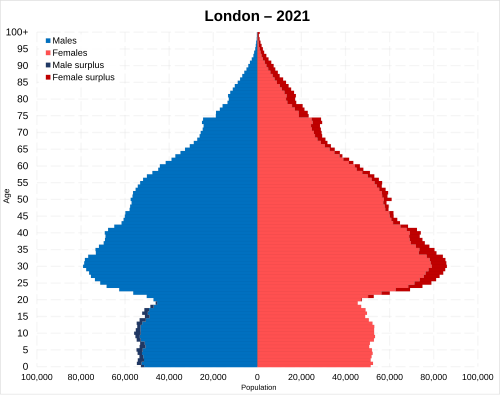 | |
| 人口 |  8,799,800 (2021) 8,799,800 (2021) |
| 密度 | 5,854/km 2 (15,160/平方マイル) (2020年推定) [1] |
| 成長率 | 7.7% (2011 - 2021) [2] |
| 平均寿命 | |
| • 男 |  80.3 (2018-2020) [3] 80.3 (2018-2020) [3] |
| • 女性 |  84.3 (2018-2020) 84.3 (2018-2020) |
| 出生率 | 1.52(2021)[4] |
| 乳児死亡率 |  出生数1,000人あたり死亡数3.4人(2018-2020年)[5] 出生数1,000人あたり死亡数3.4人(2018-2020年)[5] |
| 国籍 | |
| 国籍 | イギリス |
| 主要民族 | 白人:53.8%(2021年)
|
| 少数民族 | |
| 言語 | |
| 話し言葉 | イギリス英語(主要言語:78.4%) |
ロンドンの人口統計は 国家統計局によって分析されており、グレーター・ロンドンの各区、シティ・オブ・ロンドンと32のロンドン特別区、インナー・ロンドンとアウター・ロンドンの統計サブ地域、ロンドンの各選挙区、そしてグレーター・ロンドン全体のデータが作成されています。さらに、グレーター・ロンドン都市圏のデータも作成されています。人口の規模と地理的内訳、出入国者数、各人口統計サブグループの人数に関する統計情報が作成されています。2021年現在のロンドンの総人口は8,799,800人です。[6]
歴史
グレーターロンドンの創設 - 1965年
1963年のロンドン政府法により、グレーターロンドン地域は1965年に正式に設立されました。[7]
移住ブーム - 1991年から現在まで
1997年以降、ロンドンでは都市の人口構成が劇的に変化し、それまで進行していた人口減少を相殺する結果となった[要出典]。1991年には、都市の21.7%が外国生まれだったが、2011年には36.7%にまで増加した。
2011年には歴史的な転換点が訪れ、2011年の国勢調査では、以前は多数派だった白人イギリス人人口が、もはや市の人口の多数派ではなくなったことが示されたが、依然として圧倒的に最大の民族グループであることに変わりはなかった。[8]
人口

統計地域としてインナーロンドンとアウターロンドンに分けられた現在のグレーターロンドン地域の過去の人口は次のとおりです。
年

- ロンドンの各自治区の人口ピラミッド
-
 バーキング・アンド・ダゲナム
 -
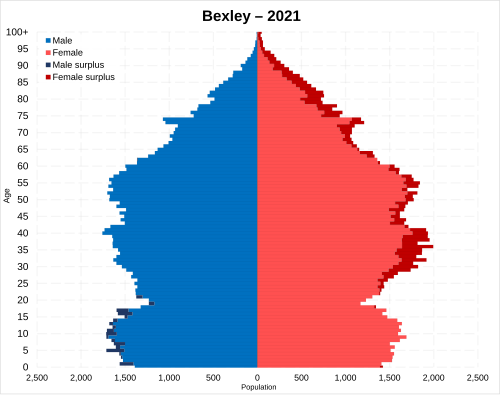 ベクスリー
ベクスリー -
 ブレント
ブレント -
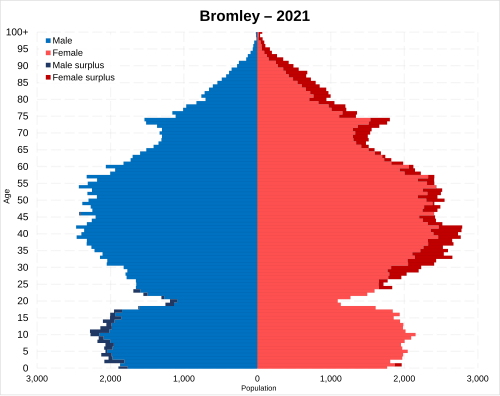 ブロムリー
ブロムリー -
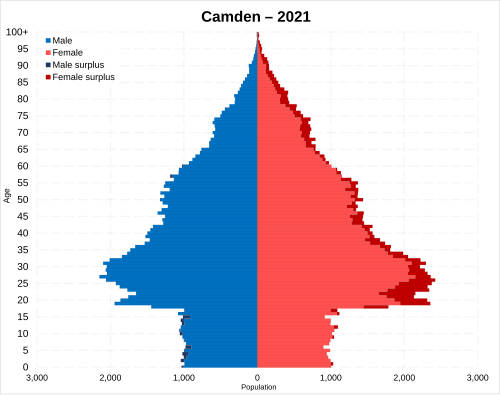 カムデン
カムデン -
 シティ・オブ・ロンドン
 -
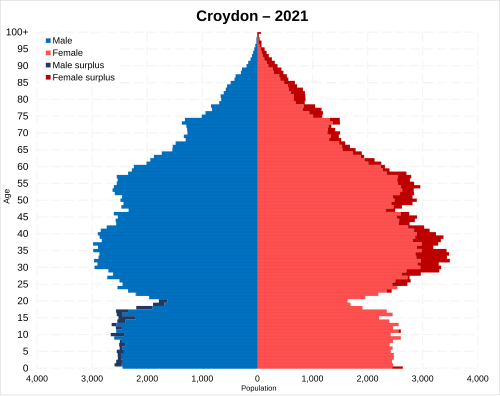 クロイドン
クロイドン -
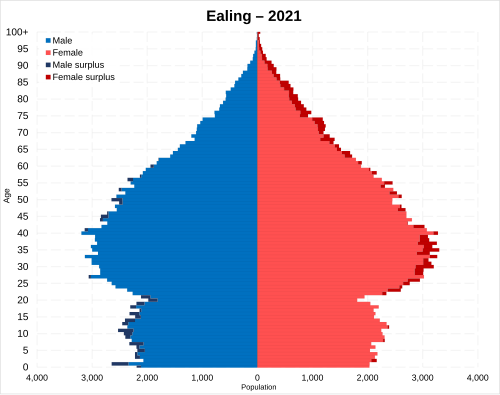 イーリング
イーリング -
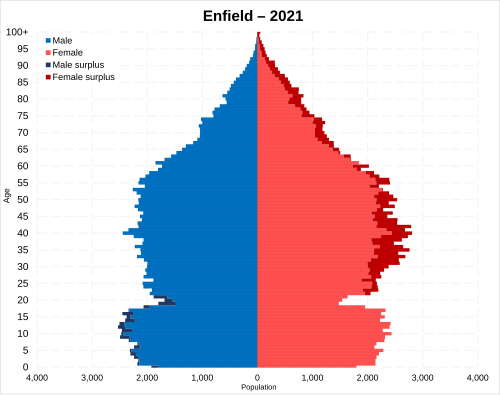 エンフィールド
 -
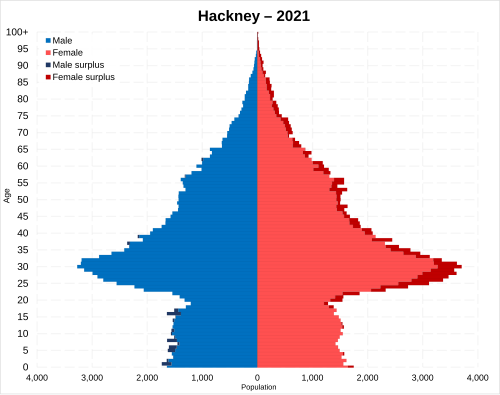 ハックニー
ハックニー -
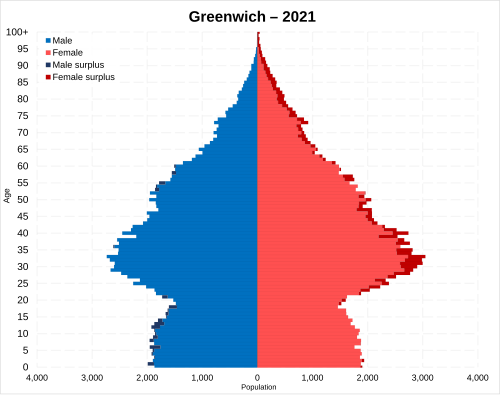 グリニッジ
グリニッジ -
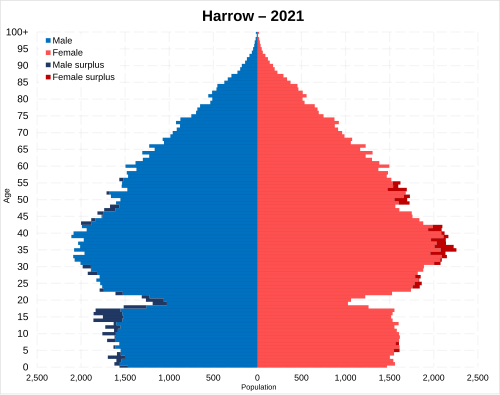 ハロー
ハロー -
 ハマースミス・アンド・フラム
 -
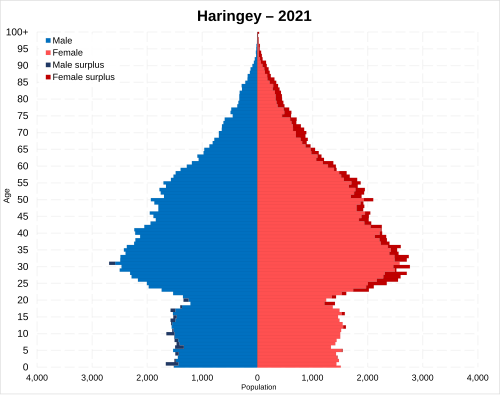 ハリンゲイ
ハリンゲイ -
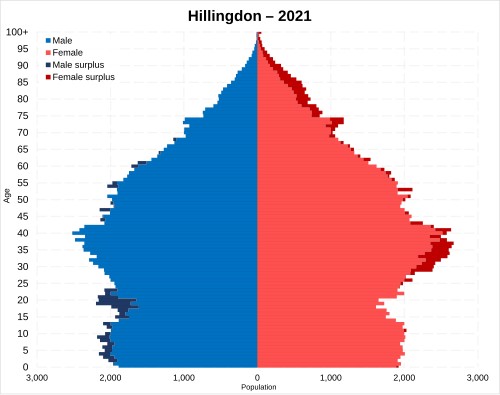 ヒリンドン
ヒリンドン -
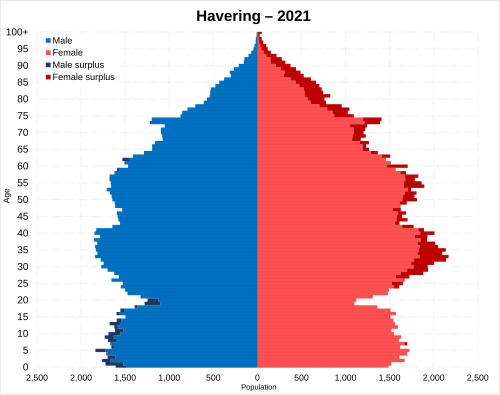 ハーヴェリング
 -
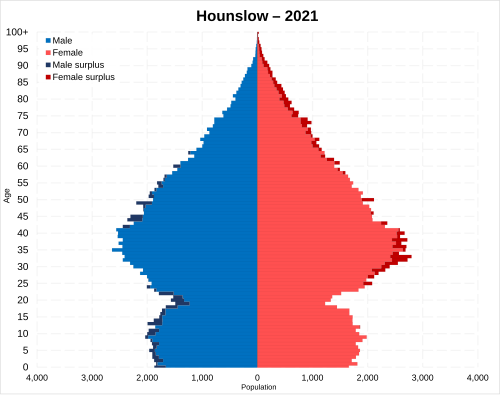 ハウンズロー
 -
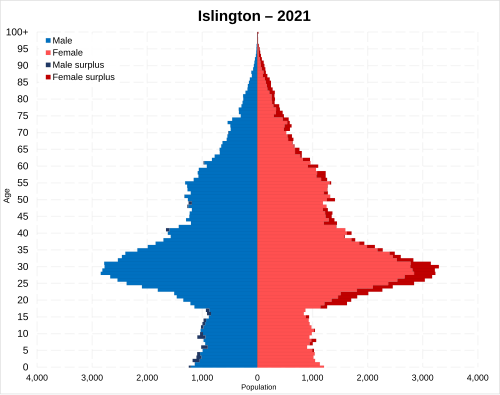 イズリントン
 -
 ケンジントン&チェルシー
 -
 キングストン・アポン・テムズ
 -
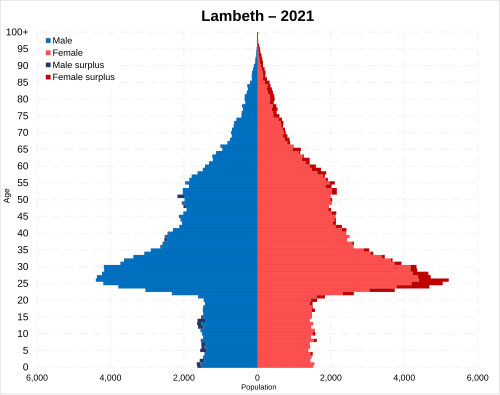 ランベス
ランベス -
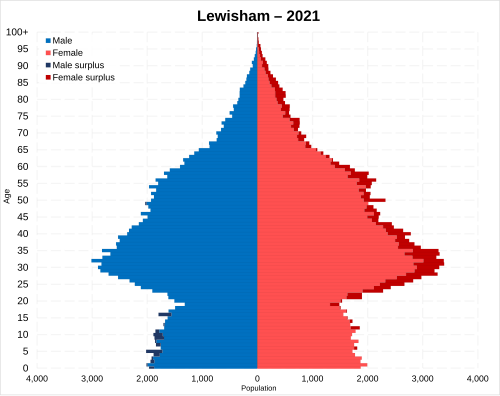 ルイシャム
ルイシャム -
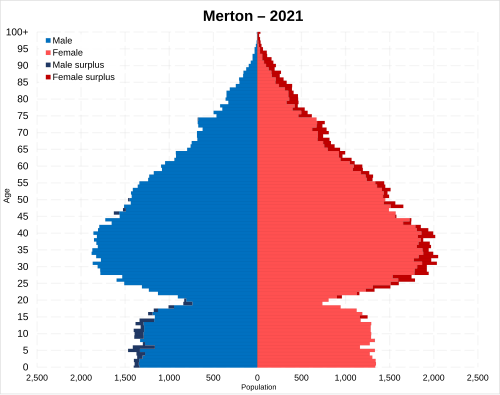 マートン
マートン -
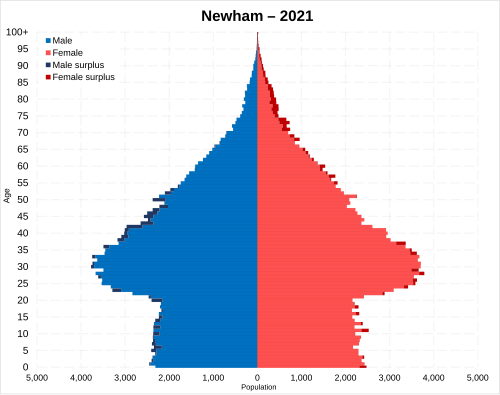 ニューハム
ニューハム -
 レッドブリッジ
 -
 リッチモンド・アポン・テムズ
 -
 サザーク
サザーク -
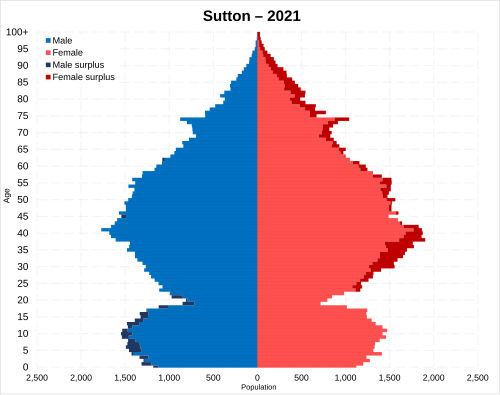 サットン
サットン -
 ウォルサムフォレスト
 -
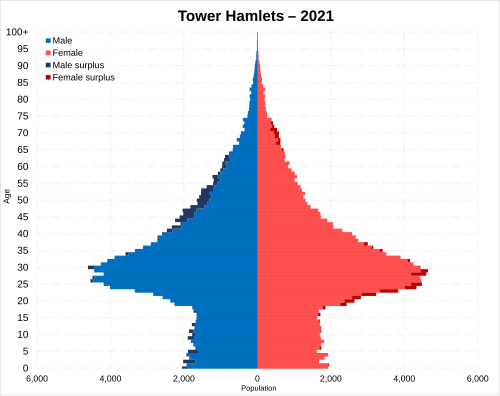 タワーハムレッツ
 -
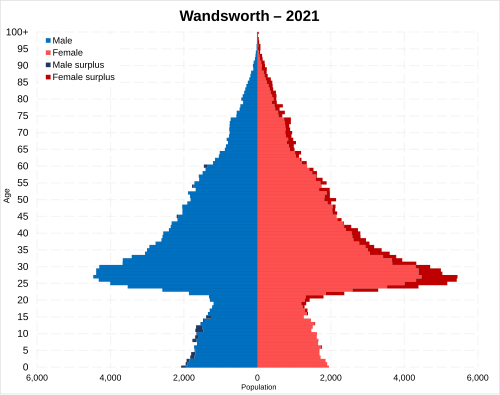 ワンズワース
 -
 ウェストミンスター
- 年齢層別の人口の割合
-
 ロンドンの15歳未満
 -
 15歳から64歳
 -
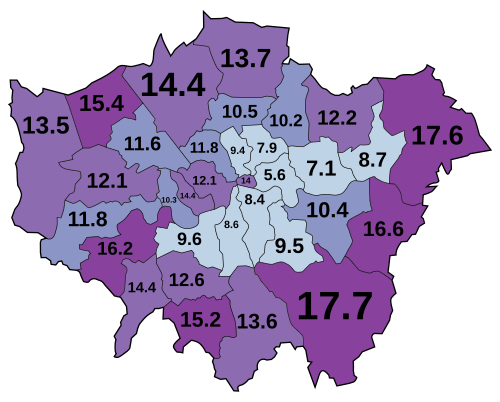 64歳以上
64歳以上
_in_London.svg/500px-15_to_64_year_olds_(working_age_population)_in_London.svg.png)
生殖能力

2021年、市内では合計110,961人の出生がありました。[13] 2021年のロンドンの出生率は1.52で、人口置換水準を下回っています。[4]
- ロンドンの出生統計
-
 ロンドンの10代の妊娠率
人口密度

2011年のロンドンの人口密度は1km2あたり5,727人であった。[14]
都市部と首都圏
2001年の国勢調査では、グレーター・ロンドン都市圏の人口は8,278,251人だった。[15]このエリアにはグレーター・ロンドン内の外れ値は含まれないが、隣接するサウス・イースト・イングランドとイースト・オブ・イングランド地域まで広がっている。2004年、ロンドン市長のロンドン計画では、人口1,800万人の大都市圏が定義された。 [16]ユーロスタットは、欧州連合内の大都市圏を比較するための統一基準を開発しており、ロンドン大都市圏の人口は11,917,000人で、面積は8,920平方キロメートル(3,440平方マイル)である。別の定義では、大都市圏の人口は13,709,000人となっている。[17]
民族
ロンドンの歴史の大半において、同市の人口は民族的に均質であり、人口の大部分は白人系英国人であった。[18]少数民族の小さな集団、例えばユダヤ人は、特にイーストエンドの地域に存在した。1948年以降、特に1990年代以降、人口は国際的に見て多様化が加速した。[18] 2011年には、初めて白人系英国人がロンドン内で少数派になったことが報告され、ロンドンが国内で少数派が多数派を占める都市であることが確立された。[8] 2005年のロンドンの民族的・宗教的多様性に関する調査では、ロンドンには300以上の言語が話されており、50の非先住民コミュニティがあり、人口は1万人を超えていると主張した。[19]
民族全体


次の表は、1971 年の推定値とグレーター ロンドンの 1991 ~ 2021 年の国勢調査における回答者の民族グループを示しています。
- ^ abc 2001年の国勢調査で新たに作成されたカテゴリ
- ^ ab 2011年の国勢調査で新たに作成されたカテゴリ
- ^ 2001年には「その他の民族」の見出しの下にリストされました。
2021年国勢調査におけるグレーター・ロンドンの民族グループの分布
-
 ホワイト(2021)
 -
 ホワイト・ブリティッシュ(2021)
 -
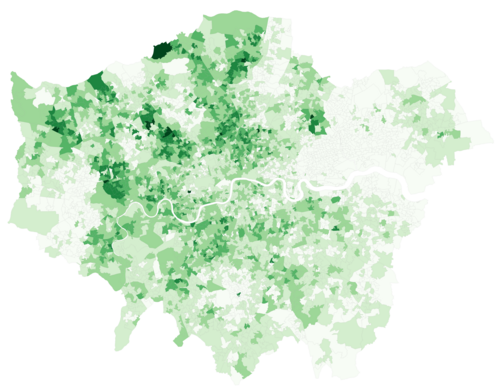 ホワイトアイリッシュ(2021)
 -
 ホワイト-その他のホワイト (2021)
 -
 アジア (2021)
 -
 アジア系バングラデシュ人(2021)
 -
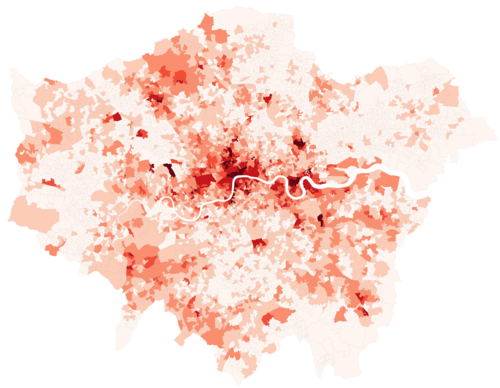 アジア系中国人(2021)
 -
 アジア系インド人(2021)
 -
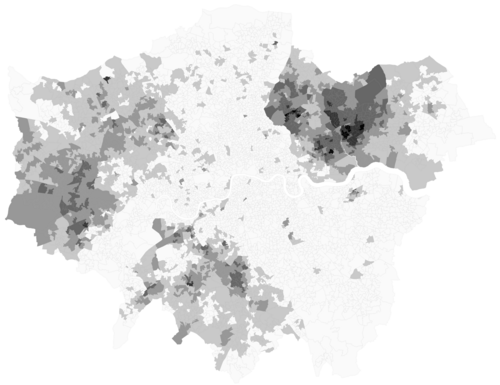 アジア系パキスタン人(2021)
 -
 ブラック(2021)
 -
 黒人アフリカ人(2021)
 -
 ブラック・カリビアン(2021)
 -
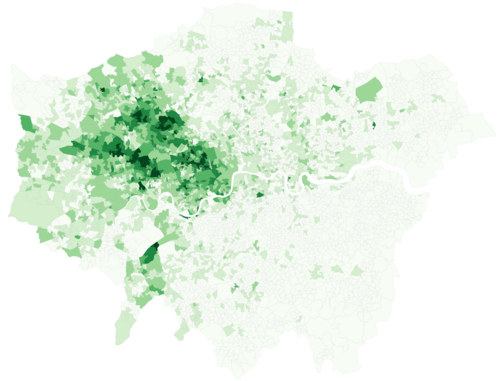 その他-アラブ (2021)
 -
 その他 - その他の民族グループ (2021)

- ロンドンの各民族の人口ピラミッド
-
 白:合計
白:合計 -
 白人イギリス人
 -
 ホワイトアイリッシュ
 -
 ホワイト その他
 -
 アジア: 合計
 -
 アジア系バングラデシュ人
 -
 アジア系インド人
 -
 アジア系パキスタン人
 -
 アジア系中国人
 -
 その他のアジア
 -
 黒:合計
黒:合計 -
 黒:カリブ海
 -
 黒人:アフリカ人
 -
 その他黒
その他黒 -
 混合: 合計
 -
 その他: 合計
 -
 その他: その他の民族
 -
 その他: アラブ人
生徒の民族
- 2021/2022年度の各自治区の学校人口に占める生徒数の割合
-
 白:合計
白:合計 -
 ホワイト:イギリス人
出生民族
- 2021 年の総出生数に占める出生民族の割合
-
 白人(49.6%、記載なしを含む)
 -
 白人:イギリス人(24.9%、記載なしを含む)
 -
 アジア人(22.1%)
 -
 黒(12.2%)
 -
 混合(11.3%)
自治区の民族性
この表は、 2021年の国勢調査で判明した、ロンドン自治区別のさまざまな多民族グループの割合を示しています。
- 白人多民族グループの変化
-
 1991年(79.8%)
 -
 2001年(71.2%)
 -
 2011年(59.8%)
 -
2021年(53.8%)
- アジアの多民族集団の変遷
-
 1991年(10.3%)
 -
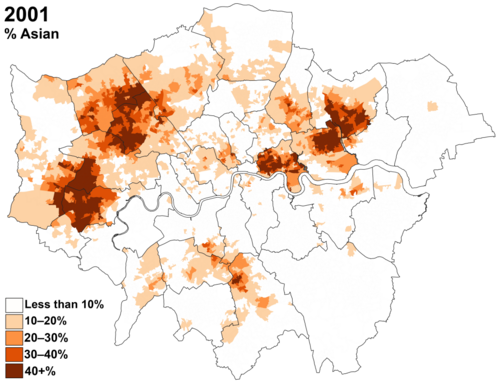 2001年(13.2%)
 -
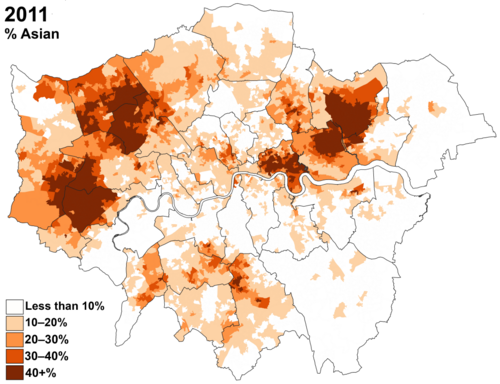 2011年(18.5%)
 -
2021年(20.8%)
- 黒人多民族グループの変遷
-
 1991年(8%)
 -
 2001年(10.9%)
 -
 2011年(13.3%)
 -
2021年(13.5%)
出生国


2021年の国勢調査によると、ロンドンの人口の40.7%にあたる3,575,740人が外国生まれ(非ヨーロッパ諸国生まれの27.9%を含む)となっている。[36]
注意: 各大陸に含まれるサブカテゴリは、その地域からの出生国が最も多いもののみを表示するため、それぞれの合計数と一致しない場合があります。
- ロンドン州で生まれた外国人(画像内のアイルランド生まれは除く)
-
 1901年(アイルランド生まれを含む全体の5%)
 -
 1911年(アイルランド生まれを含む全体の5%)
 -
 1921年(アイルランド生まれを含む全体の4%)
 -
 1931年(アイルランド生まれを含む全体の5%)
 -
 1951年(アイルランド生まれを含む全体の8%)
- ロンドンで生まれた外国人の変遷
-
 1961年(9.8%)
 -
 1971年(15.3%)
 -
 1981年(18.2%)
 -
 1991年(21.7%)
 -
 2001年(27.1%)
 -
 2011年(36.7%)
 -
 2021年(40.7%)
- 外国生まれの母親のもとに生まれた
-
 2007
2007 -
 2014
2014 -
 2021
2021
- 2021年の出生国別人口ピラミッド
-
 イギリス生まれ
 -
 外国生まれ: 合計
言語

2011年の国勢調査によると、ロンドンの3歳以上の人口の77.9%にあたる608万3420人が英語を主要言語として話し、さらに140万6912人(19.8%)が英語を第2言語として、あるいは上手にまたは非常に上手に話していました。[46] 27万1693人(3.5%)は英語を上手に話せず、4万7917人(0.6%)はまったく英語を話せませんでした。[46] 2456人(0.1%未満)はその他の英国の少数派言語を話し、最も一般的なのはウェールズ語で、2926人(0.1%未満)はイギリス手話を使用していました。[47]これは、TfLやその他の政府サービスに大きな課題があることも示しています。たとえば、ほとんどの券売機は英語、フランス語、および最大2つの他の西ヨーロッパ半球の言語のみを使用していますが、以下に示すように、ほとんどの需要はインドの言語、ポーランド語など です。
2011年と2021年の国勢調査によると、グレーター・ロンドンで最も多く話されている主要言語は以下の通りです。[48]
主な言語
英語能力
宗教

ロンドンの宗教的状況は、過去 20 年間で大きく変化しました。2001 年にはキリスト教徒が 58.23% で多数派を占めていましたが、2021 年にはこの割合は 40.66% に減少しました。一方、無宗教の人口は大幅に増加し、2001 年の 15.76% から 2021 年には 27.05% に上昇しました。この変化は、ロンドンの世俗化の傾向が高まっていることを示唆しています。[出典が必要]
イスラム教徒の人口も顕著な増加を遂げ、2001年の8.46%から2021年には14.99%に増加しました。宗教を明言しないことを選択した人の数は、この間わずかに変動し、2001年の8.66%から2021年には7.00%になりました。
ヒンズー教は着実に成長し、2001年には人口の4.07%を占め、2021年には5.15%に増加しました。ユダヤ教コミュニティは比較的安定していましたが、同じ期間に2.09%から1.65%にわずかに減少しました。シク教も、2001年の1.45%から2021年の1.64%へと、控えめながらも成長しました。仏教を含む他の宗教は、全体としては小さいながらも変動する割合を占めており、具体的には仏教は2001年の0.76%から2021年の0.88%の範囲です。
これらの変化は、移民、世代の態度、より広範な社会の傾向など、さまざまな要因の影響を受けます。[引用が必要]
2011 年の国勢調査によるグレーター ロンドンの宗教の分布。
-
 キリスト教
キリスト教 -
 イスラム教
イスラム教 -
 ヒンズー教
ヒンズー教 -
 ユダヤ教
ユダヤ教 -
 シク教
シク教 -
 仏教
仏教 -
 その他の宗教
 -
 無宗教
無宗教

- ロンドンの各宗教グループの人口ピラミッド
-
 キリスト教徒
 -
 無宗教
無宗教 -
 記載なし
記載なし -
 イスラム教徒
 -
 ヒンズー教
ヒンズー教 -
 仏教徒
仏教徒 -
 シーク教徒
シーク教徒 -
 ユダヤ人
ユダヤ人 -
 その他の宗教
宗教による民族
- ^ 2011年の国勢調査で新たに作成されたカテゴリ
社会問題
結婚と離婚
2019年にはロンドン内で合計29,139件の結婚が行われました。[56]
中絶
2020年には市内で妊娠の27.7%が中絶された。[57]
- ロンドンでの中絶
-
 2020年にロンドンの各自治区で中絶された妊娠の割合
 -
 ロンドンの年齢層別中絶率
性的指向と性自認
健康
2021年の自殺率は全体で10万人あたり6.6人だった。[60]男性では9.9人、女性では3.4人だった。[60]
- グラフで見る健康問題の多様性
-
 ロンドンの自殺率
 -
 ロンドンの薬物乱用率
 -
 2020年のロンドンの6年生の肥満率
 -
 2020 年の就学年齢児童の肥満率
一般的な健康状態
障害
所得と産業
ロンドンの人々の大半はサービス部門で働いています。[68]
- 画像で見るロンドンの収入と産業
-
 ロンドンの雇用率
 -
 ロンドンの失業率
 -
 2020年のロンドン全体の総可処分世帯所得(GDHI)
 -
 ロンドンの公共部門または民間部門での雇用
業界

通勤手段
注: 2021 年に在宅勤務をする人の割合は、COVID-19 パンデミックに関連する規則によって歪められています。
週の労働時間
通勤距離
注: 2021 年に在宅勤務をする人の割合は、COVID-19 パンデミックに関連する規則によって歪められています。
国民的アイデンティティ

注:国民アイデンティティに関する国勢調査の質問の選択肢の順序は、2011年と2021年の間で変更されました。2011年には「英語のみ」が最初のグループでしたが、2021年には「英国のみ」が最初にリストされました。[89]
- 2021年のアイデンティティ集団の人口ピラミッド
-
 英語のみのID
 -
 イギリス人と英国のアイデンティティ
 -
 英国人のみのアイデンティティ
 -
 英国と非英国アイデンティティ
 -
 英国外限定の身分証明書
ハウジング
2021年の国勢調査によるロンドンの居住地
出生国別の在職期間
教育
資格レベル
See also

- Demographics of the United Kingdom
- Demographics of England
- Demographics of Birmingham
- Demographics of Greater Manchester
- Religion in London
- Religion in England
- List of English cities by population
- List of English districts by population
- List of English districts and their ethnic composition
- List of English districts by area
- List of English districts by population density
References
- ^ "Land Area and Population Density, Ward and Borough – London Datastore". Retrieved 13 December 2022.
- ^ "Population and household estimates, England and Wales - Office for National Statistics". www.ons.gov.uk. Retrieved 13 December 2022.
- ^ "Life expectancy for local areas of the UK - Office for National Statistics". www.ons.gov.uk. Retrieved 13 December 2022.
- ^ a b "Births and Fertility Rates, Borough – London Datastore". Retrieved 10 December 2022.
- ^ "Infant mortality". Trust for London. Retrieved 13 December 2022.
- ^ "Population and household estimates, England and Wales: Census 2021 - Office for National Statistics". www.ons.gov.uk. Retrieved 18 July 2022.
- ^ "A Beginners Guide to UK Geography (2021) v1.0". geoportal.statistics.gov.uk. p. 12. Retrieved 15 May 2023.
- ^ a b "Why have the white British left London?". BBC News. 20 February 2013. Retrieved 12 December 2022.
- ^ "London through time: Population Statistics: Total Population". A vision of Britain through time. Great Britain Historical GIS. Retrieved 19 November 2009.
- ^ "Outer London through time: Population Statistics: Total Population". A vision of Britain through time. Great Britain Historical GIS. Retrieved 19 November 2009.
- ^ "Inner London through time: Population Statistics: Total Population". A vision of Britain through time. Great Britain Historical GIS. Retrieved 19 November 2009.
- ^ "Archived copy" (PDF). Archived from the original (PDF) on 21 October 2014. Retrieved 6 June 2014.
{{cite web}}: CS1 maint: archived copy as title (link) - ^ "Births in England and Wales: summary tables - Office for National Statistics". www.ons.gov.uk. Retrieved 11 December 2022.
- ^ "Demography, London's Population & Geography - Trust For London". Trust for London. Retrieved 10 December 2022.
- ^ "KS01 Usual resident population: Census 2001, Key Statistics for urban areas". Office for National Statistics. Archived from the original on 11 March 2005.
- ^ Mayor of London. "The London Plan". Greater London Authority.
- ^ "British urban pattern: population data" (PDF). ESPON project 1.4.3 Study on Urban Functions. European Spatial Planning Observation Network. March 2007. p. 119. Archived from the original (pdf) on 24 September 2015. Retrieved 22 February 2010.
- ^ a b c Goodhew, David; Cooper, Anthony-Paul (2018), "The Desecularisation of the City: London's Churches, 1980 to the Present", The Desecularisation of the City, pp. 3–38, doi:10.4324/9781351167765-1, ISBN 9781351167765, S2CID 240171114, retrieved 4 December 2022
- ^ Benedictus, Leo (25 January 2005). "Every race, colour, nation and religion on earth". The Guardian. Retrieved 22 August 2009.
- ^ Lee, Trevor R. (30 June 2010). "Immigrants in London: Trends in distribution and concentration 1961–71". Journal of Ethnic and Migration Studies. 2 (2): 145–158. doi:10.1080/1369183x.1973.9975191. ISSN 1369-183X.
- ^ Collins, Charles (1971). "Distribution of Commonwealth immigrants in Greater London". Ekistics. 32 (188): 12–21. ISSN 0013-2942. JSTOR 43617773.
- ^ "Ethnic minorities in Britain". search.worldcat.org. p. 42. Retrieved 15 June 2024.
- ^ Jones, P. N. (1978). "The Distribution and Diffusion of the Coloured Population in England and Wales, 1961-71". Transactions of the Institute of British Geographers. 3 (4): 515–532. Bibcode:1978TrIBG...3..515J. doi:10.2307/622127. ISSN 0020-2754. JSTOR 622127. PMID 12157820.
- ^ Ethnicity in the 1991 census: Vol 3 - Social geography and ethnicity in Britain, geographical spread, spatial concentration and internal migration. Internet Archive. London : HMSO. 1996. ISBN 978-0-11-691655-6.
{{cite book}}: CS1 maint: others (link) - ^ Ethnicity in the 1991 census: Vol 3 - Social geography and ethnicity in Britain, geographical spread, spatial concentration and internal migration. Internet Archive. London : HMSO. 1996. ISBN 978-0-11-691655-6.
{{cite book}}: CS1 maint: others (link) - ^ "1991 census - local base statistics - Nomis - Official Census and Labour Market Statistics". www.nomisweb.co.uk. Retrieved 18 June 2023.
- ^ "Office of National Statistics; 2001 Census Key Statistics". webarchive.nationalarchives.gov.uk. Retrieved 7 September 2021.
- ^ "2011 Census: Ethnic Group, local authorities in England and Wales". webarchive.nationalarchives.gov.uk. Retrieved 15 December 2021.
- ^ "Ethnic group - Office for National Statistics". www.ons.gov.uk. Retrieved 29 November 2022.
- ^ "School and pupil characteristics". webarchive.nationalarchives.gov.uk. Retrieved 8 November 2022.
- ^ "Schools, pupils and their characteristics, Academic Year 2021/22". explore-education-statistics.service.gov.uk. Retrieved 9 September 2022.
- ^ "MINORITY ETHNIC PUPILS IN MAINTAINED SCHOOLS BY LOCAL EDUCATION AUTHORITY AREA IN ENGLAND - JANUARY 1999 (PROVISIONAL)" (PDF). Archived from the original (PDF) on 3 September 2000.
- ^ "Births and infant mortality by ethnicity, England and Wales". Retrieved 31 January 2022.
- ^ Coleman, David (1 January 1983). "Some problems of data for the demographic study of immigration and of immigrant and minority populations in Britain". Ethnic and Racial Studies. 6 (1): 103–110. doi:10.1080/01419870.1983.9993401. ISSN 0141-9870.
- ^ "Live births by ethnicity and local authority, 2020 to 2021 - Office for National Statistics". www.ons.gov.uk. Retrieved 10 May 2023.
- ^ a b "Country of birth (extended)". www.ons.gov.uk. Office for National Statistics. Retrieved 28 March 2023.
- ^ 1951 census - Table 19 - BIRTHPLACES AND NATIONALITIES OF ALL POPULATION and 20 - BIRTHPLACES of ENGLAND AND WALES RESIDENTS born outside the United Kingdom, Islands of the British Seas and the Irish Republic
- ^ As UK Census data past 2001 is unavailable through the ONS website, it has been recommended to use archival census collection websites to obtain data. Taken from Casweb UK Data Service from the 1971 UK wide Census. SAS08 of Country of Birth of England > Greater London.
- ^ Registrar General for England and Wales; General Register Office Scotland (2002): 1971 Census aggregate data. UK Data Service. DOI: http://dx.doi.org/10.5257/census/aggregate-1971-1 This information is licensed under the terms of the Open Government Licence [1]
- ^ As UK Census data past 2001 is unavailable through the ONS website, it has been recommended to use archival census collection websites to obtain data. Taken from Casweb UK Data Service from the 1981 UK wide Census. Table 4 of Country of Birth in England > Inner and Outer London.
- ^ Office of Population Censuses and Surveys; Registrar General for Scotland (2000): 1981 Census aggregate data (Edition: 2000). UK Data Service. DOI: http://dx.doi.org/10.5257/census/aggregate-1981-1 This information is licensed under the terms of the Open Government Licence [2]
- ^ "1991 census - local base statistics". Nomis: Official Census and Labour Market Statistics. Retrieved 14 June 2023. Tables L01 to L18: Demographic and economic characteristics > L07 Country of birth
- ^ "UV008: Country of birth". Nomis: Official Census and Labour Market Statistics. Retrieved 30 August 2013.
- ^ "QS213EW: Country of birth (expanded)". Nomis: Official Census and Labour Market Statistics. Retrieved 26 March 2013.
- ^ "Parents' country of birth - Office for National Statistics". www.ons.gov.uk. Retrieved 8 May 2023.
- ^ a b "Proficiency in English, 2011 (QS205EW)". Office for National Statistics. Archived from the original on 12 November 2013. Retrieved 17 April 2013.
- ^ "Main Language (detailed), 2011 (QS204EW)". Office for National Statistics. Archived from the original on 4 March 2016. Retrieved 17 April 2013.
- ^ "Download:local authorities: county / unitary". NOMIS. Retrieved 5 September 2014.
- ^ "QS205EW (Proficiency in English) - Nomis - Official Census and Labour Market Statistics". www.nomisweb.co.uk. Retrieved 7 May 2023.
- ^ "TS029 - Proficiency in English - Nomis - Official Census and Labour Market Statistics". www.nomisweb.co.uk. Retrieved 7 May 2023.
- ^ a b c d e "A PROFILE OF BRITISH JEWRY - 1995" (PDF). p. 12.
- ^ "2001 census – theme tables". Retrieved 5 September 2014.
- ^ "Religion by measures". NOMIS. Retrieved 2 September 2014.
- ^ "Religion". Office for National Statistics. Retrieved 30 November 2022.
- ^ "Ethnic group and religion - 2021 census". ONS.
- ^ "Marriages in England and Wales - Office for National Statistics". www.ons.gov.uk. Retrieved 11 December 2022.
- ^ "Conceptions in England and Wales - Office for National Statistics". www.ons.gov.uk. Retrieved 11 December 2022.
- ^ "TS077 - Sexual orientation - Nomis - Official Census and Labour Market Statistics". www.nomisweb.co.uk. Retrieved 7 May 2023.
- ^ "TS078 - Gender identity - Nomis - Official Census and Labour Market Statistics". www.nomisweb.co.uk. Retrieved 7 May 2023.
- ^ a b "Suicides in England and Wales - Office for National Statistics". www.ons.gov.uk. Retrieved 11 December 2022.
- ^ "KS008 - Health and provision of unpaid care - Nomis - Official Census and Labour Market Statistics". www.nomisweb.co.uk. Retrieved 7 May 2023.
- ^ "QS302EW (General health) - Nomis - Official Census and Labour Market Statistics". www.nomisweb.co.uk. Retrieved 7 May 2023.
- ^ "TS037 - General health - Nomis - Official Census and Labour Market Statistics". www.nomisweb.co.uk. Retrieved 7 May 2023.
- ^ "1991 census - local base statistics - Nomis - Official Census and Labour Market Statistics". www.nomisweb.co.uk. Retrieved 8 May 2023.
- ^ "KS008 - Health and provision of unpaid care - Nomis - Official Census and Labour Market Statistics". www.nomisweb.co.uk. Retrieved 8 May 2023.
- ^ "QS303EW (Long-term health problem or disability) - Nomis - Official Census and Labour Market Statistics". www.nomisweb.co.uk. Retrieved 8 May 2023.
- ^ "TS038 - Disability - Nomis - Official Census and Labour Market Statistics". www.nomisweb.co.uk. Retrieved 8 May 2023.
- ^ "Five facts about... The UK service sector - Office for National Statistics". www.ons.gov.uk. Retrieved 30 September 2022.
- ^ "ST05 (Industry (10% Sample) [1961 census]) - Nomis - Official Census and Labour Market Statistics". www.nomisweb.co.uk. Retrieved 8 May 2023.
- ^ "1981 census - small area statistics - Nomis - Official Census and Labour Market Statistics". www.nomisweb.co.uk. Retrieved 8 May 2023.
- ^ "1991 census - local base statistics - Nomis - Official Census and Labour Market Statistics". www.nomisweb.co.uk. Retrieved 8 May 2023.
- ^ "KS011a - Industry of employment - Nomis - Official Census and Labour Market Statistics". www.nomisweb.co.uk. Retrieved 8 May 2023.
- ^ "QS605EW (Industry) - Nomis - Official Census and Labour Market Statistics". www.nomisweb.co.uk. Retrieved 8 May 2023.
- ^ "TS060 - Industry - Nomis - Official Census and Labour Market Statistics". www.nomisweb.co.uk. Retrieved 8 May 2023.
- ^ "1981 census - small area statistics - Nomis - Official Census and Labour Market Statistics". www.nomisweb.co.uk. Retrieved 7 May 2023.
- ^ "1991 census - local base statistics - Nomis - Official Census and Labour Market Statistics". www.nomisweb.co.uk. Retrieved 7 May 2023.
- ^ "UV037 - Method of travel to work - Nomis - Official Census and Labour Market Statistics". www.nomisweb.co.uk. Retrieved 7 May 2023.
- ^ "QS701EW (Method of travel to work) - Nomis - Official Census and Labour Market Statistics". www.nomisweb.co.uk. Retrieved 7 May 2023.
- ^ "TS061 - Method used to travel to work - Nomis - Official Census and Labour Market Statistics". www.nomisweb.co.uk. Retrieved 7 May 2023.
- ^ "1991 census - local base statistics - Nomis - Official Census and Labour Market Statistics". www.nomisweb.co.uk. Retrieved 8 May 2023.
- ^ "UV041 - Hours Worked - Nomis - Official Census and Labour Market Statistics". www.nomisweb.co.uk. Retrieved 8 May 2023.
- ^ "QS604EW (Hours worked) - Nomis - Official Census and Labour Market Statistics". www.nomisweb.co.uk. Retrieved 8 May 2023.
- ^ "TS059 - Hours worked - Nomis - Official Census and Labour Market Statistics". www.nomisweb.co.uk. Retrieved 8 May 2023.
- ^ "UV035 - Distance travelled to work - Nomis - Official Census and Labour Market Statistics". www.nomisweb.co.uk. Retrieved 8 May 2023.
- ^ "QS702EW (Distance travelled to work) - Nomis - Official Census and Labour Market Statistics". www.nomisweb.co.uk. Retrieved 8 May 2023.
- ^ "TS058 - Distance travelled to work - Nomis - Official Census and Labour Market Statistics". www.nomisweb.co.uk. Retrieved 8 May 2023.
- ^ "KS202EW (National identity) - Nomis - Official Census and Labour Market Statistics". www.nomisweb.co.uk. Retrieved 8 May 2023.
- ^ "TS027 - National identity - UK - Nomis - Official Census and Labour Market Statistics". www.nomisweb.co.uk. Retrieved 8 May 2023.
- ^ "Ethnic group, national identity, language, and religion quality information for Census 2021". Office for National Statistics. Retrieved 31 May 2023.
- ^ イギリス。一般登録局 (1966)。1961 年国勢調査、イングランドおよびウェールズ: グレーター ロンドン表。ウェルカム ライブラリー。ロンドン: HMSO
- ^ 「1981年国勢調査 - 小地域統計 - Nomis - 公式国勢調査および労働市場統計」www.nomisweb.co.uk 。 2023年12月21日閲覧。
- ^ 「1991年国勢調査 - 地方ベース統計」。
- ^ 「KS018 - Tenure - Nomis - Official Census and Labour Market Statistics」。www.nomisweb.co.uk 。 2023年12月21日閲覧。
- ^ 「KS402EW (Tenure) - Nomis - Official Census and Labour Market Statistics」。www.nomisweb.co.uk 。 2023年12月21日閲覧。
- ^ 「TS054 - Tenure - Nomis - Official Census and Labour Market Statistics」。www.nomisweb.co.uk 。 2023年12月21日閲覧。
- ^ 「出生国と世帯の所有権」ONS。
- ^ 「KS013 - 資格と学生 - Nomis - 公式国勢調査および労働市場統計」。www.nomisweb.co.uk 。 2023年5月7日閲覧。
- ^ 「KS501UK - 資格と学生」NOMIS。
- ^ 「TS067 - 最高レベルの資格 - Nomis - 公式国勢調査および労働市場統計」。www.nomisweb.co.uk 。 2023年5月7日閲覧。