
Loading article…
DAF Daffodilは、オランダの自動車メーカーDAFが1961年から1967年まで製造した経済的な小型ファミリーカーです。[ 1 ]同時に発売されたDAF 750とともに、DAF 600の後継車となりました。DAF 750は基本的に同じ車でしたが、外装の豪華な装備やクロームメッキの装飾がさらに少なくなっていました。Daffodilと750はどちらも、Variomaticオートマチックトランスミッションシステムを標準装備しており、これが市場に出回っている他のほとんどの小型で安価な車との違いでした。
ダフォディルは750の輸出バージョンとして構想されました。市場の反応により、750は1963年に生産を終了しましたが、ダフォディルは度重なるマイナーチェンジを経て1967年まで生産が続けられました。ダフォディルの後継モデルは、非常によく似ているものの若干パワフルなDAF 33でした。
「ダフォディル」という名称は一部の市場では好評でしたが、ドイツではDAF 750のより豪華な装備バージョンはDAF 30として知られていました。1963年と1965年の改良では、 DAF 31とDAF 32に名称が変更されました。これらの市場では、1967年のDAF 33の発売は既存ラインの論理的な継続でした。
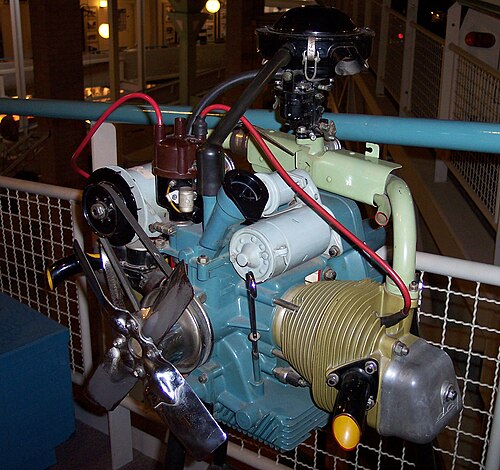
746ccの4ストローク空冷2気筒ボクサーエンジンは、600と同じストロークを採用していたが、ボアは76mmから 85.5mmに拡大された 。公称出力も22bhp(16kW)から30bhp (22kW )に向上し、最高速度は105km /h(65mph )とされている。米国消費者組合のテストによると、 0-50mph(80km/h)加速は29秒だった。
DAF 600は、革新的なDAF Variomaticシステムという無段変速機(CVT)を搭載した最初の量産車でした。 [ 2 ]同じシステムは、750、Daffodil、およびその派生モデルにも引き継がれました。これらの車には従来のギアボックスは用意されておらず、これらのエコノミーカーはすべてこの自動変速機システムを標準装備していました。
The Variomatic employs centrifugal weights to control the drive ratio of the transmission and is enhanced by the engine manifold vacuum. The action of the bob weights and inlet vacuum combined to pull together the cheeks of two variable-diameter driving pulleys, driven directly from the engine. These were connected, by rubber 'V' belts, to two similar driven pulleys, connected to the drive wheels. The cheeks of the driven pulleys were held together by spring tension, which was progressively overcome as the drive pulleys expanded and the tension of the belts increased.
The DAF Variomatics were thereby the only cars ever produced which went faster by the simple expedient of gently and gradually releasing the accelerator once top engine speed had been reached, because the increased vacuum took over from the reducing bob weight speed. The Variomatic also permitted increased engine braking by operating a switch on the dashboard to reverse the action of the vacuum on the pulley's diaphragm, seeking a lower ratio with increased manifold vacuum.
Two separate transmissions underneath the rear seat ran the two driving wheels – one on each wheel, eliminating the need for a differential, since belt slippage allowed for differing speeds of the inner and outer wheels in corners. Strictly speaking, this system worked like a rear transaxle, yielding a favorable weight distribution. The duplication also provided redundancy – if one belt broke, the vehicle would still be driven by one wheel.
An incidental feature was that in reverse (at least for earlier examples) the system allowed the same top speed to be driven as going forwards. Later cars locked the transmission in the lowest ratio when reverse was selected.
Between 1961 and 1967 the mechanical aspects of the car were not significantly changed.
1963 marked the withdrawal of the 750 and 30 badges, and the DAF 30 was replaced by the DAF 31. The exterior of the car was modestly reworked with input from Giovanni Michelotti which involved sharpened angles and more prominent fins: the interior was also significantly upgraded.
In 1965 the DAF 32 replaced the DAF 31. This upgrade was marked by further limited changes to the body panels, again involving Michelotti whose influence would continue to be seen on DAF passenger cars until the Limburg car assembly business was acquired by Volvo.[3]
DAFダフォディルは、1960年代のスパイドラマシリーズ『ザ・バロン』に登場し、コーディリア(スー・ロイド)が運転していた。また、1980年代後半から1990年代初頭にかけてマンチェスターで活動したインディーズバンド、ザ・ニュー・ファスト・オートマチック・ダフォディルズの名前の由来にもなった。このバンド名は、同車の広告に「新登場、高速ダフォディル - 完全オートマチック」と書かれていたことに由来する。