
Loading article…
Claude Louis Hector de Villars, Prince of Martigues, Marquis then (1st) Duke of Villars, Viscount of Melun (French pronunciation:[klodlwiɛktɔʁdəvilaʁ], 8 May 1653 – 17 June 1734) was a French military commander and an illustrious general of Louis XIV.[1] He was one of only six Marshals to have been promoted Marshal General of France. Villars is considered one of the great military commanders produced by his time.[2]
Villars was born at Moulins (in the present-day département of Allier)[3] in a noble but poor family, his father was the diplomat[3]Pierre de Villars. He entered the French army through the corps of pages in 1671 and distinguished himself at the age of twenty in the Siege of Maastricht in 1673 during the Franco-Dutch War where contemporaries such as John Churchill and Boufflers were also present and again at the bloody Battle of Seneffe. A year later he was promoted on the field to mestre de camp (colonel) of a cavalry regiment.[3]
The next promotion would take time in spite of a long record of service under Turenne, The Great Condé and Luxembourg, and of his aristocratic birth, as he had incurred the enmity of the powerful Louvois. He was finally made maréchal de camp in 1687.
In the interval between the Dutch wars and the formation of the League of Augsburg, Villars, who combined with his military gifts the tact and subtlety of a diplomat, was employed in an unofficial mission to the court of Bavaria, and there became the constant companion of Elector Maximilian II Emanuel.
Villars was also in charge of commanding Bavarian forces during the Battle of Mohács in 1687 where contemporaries such as the Duke of Berwick and Eugene of Savoy were present.[4]
He returned to France in 1690 and was given a command in the cavalry of the army in Flanders, but towards the end of the War of the Grand Alliance, in 1698, he went to Vienna as ambassador and served from 1698 to 1701.[3][5]
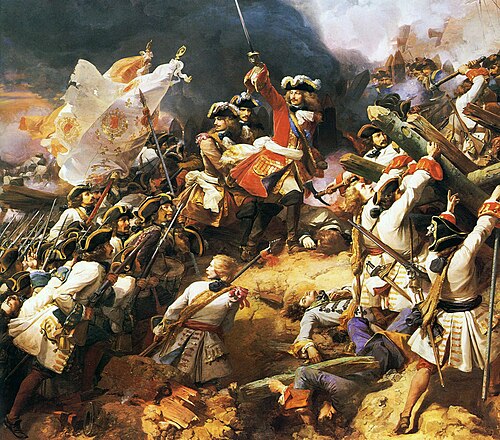
It was Villars' part in the next war, beginning with Friedlingen (1702) and Hochstadt (1703) and ending with Denain (1712), that has made him most famous. For his part in the battle of Friedlingen he received the marshalate, and for the pacification of the insurgentCévennes he received the Saint-Esprit order and the title of duke. Friedlingen and Hochstadt were barren victories, and the campaigns of which they formed were characterised by lost opportunities. Villars' career culminated from 1709 onwards when France, close to total defeat, managed to survive.[3]
In that year he was called to command the main army opposing Prince Eugène of Savoy and Marlborough on the northern frontier.[3] During the famine of the winter he shared the soldiers' rations. When the campaign opened the old Marshal Boufflers volunteered to serve under him, but they were unable to prevent the Allies from capturing Tournai and Mons.[6] After the Battle of Malplaquet in September 1709, in which Villars was gravely wounded (by a musketball to the knee), he was able to tell the king: "If God grants us the grace to lose such a battle again, Your Majesty can count on all of his enemies being destroyed".[7]
Two more campaigns passed without a battle and with scarcely any advance on the part of the invaders, but at last Marlborough manoeuvred Villars out of the famous Ne plus ultra lines, and the power of the defence seemed to be broken. But Louis made a last effort, the English contingent and its leader were withdrawn from the enemy's camp, and Villars, though still recovering from his Malplaquet wounds, outmanoeuvred and decisively defeated Eugène at Denain.[3] The French followed up this success by retaking several lost fortresses, culminating in the Siege of Bouchain (1712).
この勝利はフランスを救ったが、戦争はさらに1年間続き、ヴィラールはライン川方面作戦(1713年)を指揮し、ランダウを占領し、フライブルクの突撃を指揮し、ウジェーヌ王子とラシュタット条約とバーデン条約[ 8 ]を交渉した[ 3 ]。
ヴィラールは、ヴィラール元帥にちなんで名付けられ、ルイ15世の治世中にアリエ県ムーランに建てられました。18世紀の歴史的建造物であるヴィラールは、騎兵隊の兵舎として使用されていました。[ 9 ] [ 10 ] [ 11 ] [ 12 ]第二次世界大戦中に一部が破壊されましたが[ 9 ]、歴史的建造物建築家フランソワ・ヴォワンシェによって修復され、現在は国立衣装センター博物館となっています。[ 13 ]
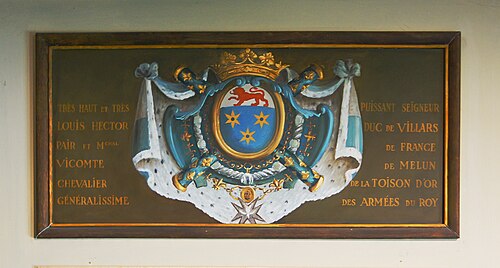
ヴィラールは、摂政時代の政治において、デュボワ枢機卿の主要な反対者として目立った役割を果たし、モンモランシーの反乱の記憶がなければ、フランス大元帥に任命されていたであろう。彼は、かつてテュレンヌが務めていた国王軍総司令官の称号で、ポーランド継承戦争(1734年)で最後の戦場に立った。しかし、この時点で彼は80歳を超えており、精力的に戦役を開始した後、 1734年6月17日にトリノで死去した。[ 3 ]
1702年2月1日、彼はジャンヌ・アンジェリク・ロックと結婚し、彼女との間に息子をもうけた。
ヴィラールの回想録からは、ヴォルテールが言うところの「名誉に満ちた大言壮語家」像が浮かび上がってくる。確かに彼は自慢屋で、名誉と富を貪欲に欲していた。しかし、彼は道徳的にも肉体的にも高い勇気を持つ名誉ある人物であり、間違いなく非常に熟練した兵士でもあったと評されている。オルレアン公爵夫人が手紙に書いているように、彼は若い男性を愛することで有名だった。 [ 14 ]
この回想録は、一部が1734年に出版され、その後信頼性の低い版で何度も再出版されたが、1884年から1892年にかけてヴォギュエ侯爵によって初めて完全に編集された。