Loading article…
| Calothamnus accedens | |
|---|---|
科学的分類 | |
| 王国: | 植物 |
| 系統群: | 胚植物 |
| 系統群: | 維管束植物 |
| 系統群: | 種子植物 |
| 系統群: | 被子植物 |
| 系統群: | 真正双子葉植物 |
| 系統群: | バラ類 |
| 注文: | ミルテイルズ |
| 家族: | フトモモ科 |
| 属: | カロタムヌス |
| 種: | C. accedens |
| 二名法名 | |
| Calothamnus accedens | |
| 同義語[ 1 ] | |
一般的にピアワニングクローフラワーとして知られるCalothamnus accedens [ 2 ]は、フトモモ科( Myrtaceae)の植物で、西オーストラリア州南西部に固有です。1984年に初めて正式に記載され、1992年に絶滅したと宣言され、2004年に再発見され、2013年に「絶滅」リストから削除され、2015年には少なくとも25,000個体の個体群があることが判明しました。密集した毛深い葉と赤い花を持つ、小さな直立した低木です。2014年にCraven 、Edwards、Cowleyは、この種をMelaleuca accedensに改名することを提案しました。 [ 3 ]
Calothamnus accedens は高さ約1.8 メートル (6フィート)まで成長し、幹は 1 本で、樹皮は紙のような質感の場合もありますが、枝が密に分かれています。葉は枝の先端に密集しており、硬くて針状で、長さは主に10 ~ 15 ミリメートル (0.4 ~ 0.6インチ) 、幅は0.8 ~ 1.0 ミリメートル (0.03 ~ 0.04インチ)です。最初は長い白い毛で覆われていますが、成長するにつれて無毛になり、はっきりとした油腺があります。[ 2 ] [ 4 ]
花は濃いピンクから深紅の色合いで、4~10個の房状に、主に茎の片側に咲きます。花弁は長さ6.5~8ミリメートルで、中央に目立つ脈があります。雄しべは爪のような束になっていて、1束あたり15~21本の雄しべがあります。開花は2月に起こり、その後、長さ5~6ミリメートル、直径6.2~9ミリメートルの木質のカップ状または円筒形の蒴果が実ります。[ 2 ] [ 4 ]
Calothamnus accedens was first formally described in 1984 by Trevor J. Hawkeswood from a specimen found on a roadside between Piawaning and Wongan Hills.[4][5] The population in that area was apparently destroyed during roadwork in the 1980s and the species declared extinct in 1992.[2][6] In 2004 a specimen was collected in a botanical survey, then other populations were located so that by 2007, the population size was estimated at more than 25,000 and the species was removed from the endangered list.[2] The specific epithet (accedens) is derived from "Latin, meaning approximating or resembling." The name refers to this species' close relationship to C. brevifolius and C. hirsutus.[4]
Calothamnus accedens occurs in the area between Perth and 420 kilometres (300 mi) to the north of Perth[2] in the Avon Wheatbelt, Geraldton Sandplains, Jarrah Forest and Swan Coastal Plain biogeographic regions.[7] It grows in sandy soils over laterite.[4]
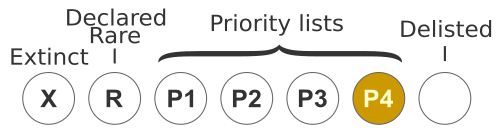
This species was removed from the extinct list on 6 March 2013 and is recommended for removal from all lists under the Australian Government Environment Protection and Biodiversity Conservation Act 1999. Although some populations are in areas outside protected zones, it is estimated that at least 20,000 individual plants are in a national park.[2] It is classified as "Priority Four" by the Western Australian Government Department of Parks and Wildlife[7] meaning that is rare or near threatened.[8]