Loading article…

The Brothers Dalziel (pronounced /diːˈɛl/ⓘdee-ELL) was a prolific wood-engraving business in Victorian London, founded in 1839 by George Dalziel.
In 1840, George (1 December 1815 – 4 August 1902) was joined in the business by his brother Edward Dalziel (1817–1905)[1] and in subsequent years they were joined by their sister Margaret (1819–1894), brother John (1822–1869), and brother Thomas Dalziel (1823–1906).[1] Along with at least three older brothers and one younger, they were children of the artist Alexander Dalziel of Wooler in Northumberland.[2][3]
George Dalziel trained under the wood-engraver Charles Gray[3] in London from around 1835.

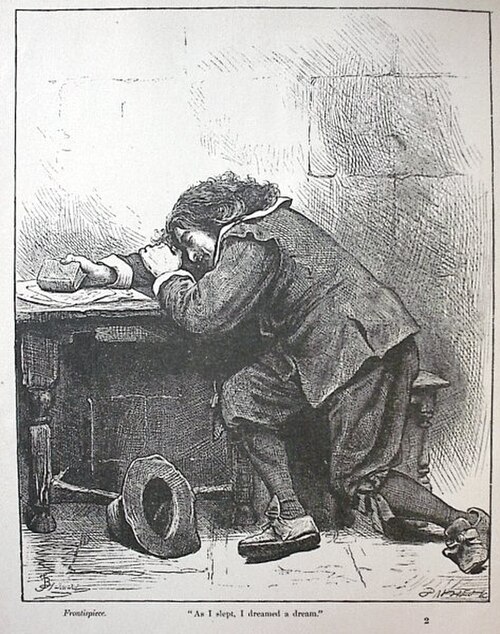
The Dalziel Brothers worked with many important Victorian artists, producing illustrations for the burgeoning magazine and book market of the period.

Among the artists they worked with were Arthur Boyd Houghton, Richard Doyle, Myles Birket Foster, John Gilbert, William Holman Hunt, John Everett Millais, John Proctor, Dante Gabriel Rossetti and James McNeill Whistler. They cut the illustrations to Edward Lear's Book of Nonsense (1862); Lewis Carroll's Alice in Wonderland and Through the Looking-Glass.
They also produced independent ventures, most notably The Parables of Our Lord and Saviour Jesus Christ (London: Routledge, 1864), illustrated by Millais, and contributed humorous cartoons to magazines such as Fun, which George and Edward acquired in 1865.
Until the advent of photo-mechanical processes c. 1880, they were pre-eminent in their trade. Examples of their work can be seen in the Victoria and Albert Museum in London.
19世紀末、彼らは自分たちの仕事の自伝的要約を共同で執筆した。メシュエン社から出版された『ダルジエル兄弟、仕事の記録、1840年~ 1890年』である。[ 3 ]
ジョージ・ダルジールはハイゲート墓地のエジプシャン・アベニューにある家族墓に埋葬されている。エドワード・ダルジールはハイゲート墓地のサークル・オブ・レバノンにある家族墓に埋葬されている。