
Loading article…
ローレンス・ゲルハルト・マリヌス・バース・ベッキング(1895年1月4日、デフェンテル生まれ- 1963年1月6日、オーストラリア、キャンベラ没)は、オランダの植物学者、微生物学者である。彼はバース・ベッキング仮説で知られており、当初は「すべてはどこにでもあるが、環境が選択する」と定式化した。[ 1 ]
バース・ベッキングは1895年1月4日にデフェンテルで生まれた。[ 2 ]バース・ベッキングはデルフト工科大学で微生物学を学んだ後、ユトレヒト大学で植物学を専攻して生物学を学んだ。[ 3 ]ユトレヒトでの研究を終え、論文を提出するまでの間、バース・ベッキングはアメリカ合衆国のトーマス・ハント・モーガンの研究室で働いた。1923年、バース・ベッキングはスタンフォード大学の教授の職に就き、経済植物学と植物生理学を教えた。[ 2 ]
バース・ベッキングのスタンフォード大学での研究は、極限環境微生物の研究を紹介することで、後の彼の研究に大きな影響を与えた。彼はパシフィック・グローブにあるジャック・ローブ海洋研究所の所長として、自らその研究を行った。[ 2 ]特に、バース・ベッキングはカリフォルニアの塩湖とメタンを豊富に含む貯水池を研究した。[ 3 ]
バース・ベッキングは1930年にライデン大学の一般植物学教授[ 2 ]およびライデン植物園の園長(所長)としてオランダに帰国した。バース・ベッキングが自身の名で知られる仮説を提唱したのはライデンであった。1934年、ハーグのプルクリ・スタジオでの一連の講義の後、彼は『地球生物学』 [ 1 ]を出版した。1940年にライデンに滞在中、彼はジャワ島の現在のボゴールにある国営のブイテンゾルグ植物園の園長に任命され、植物園をかつての栄光に復元しようとした[ 4 ]。彼の指導の下、 1941年にプルウォダディの町に乾燥熱帯植物の新しい植物園分園が開設された[ 5 ]。
Although his family moved to Java in 1940, the Battle of the Netherlands prevented his leaving, and he remained in the Netherlands during the five-year occupation. During this time, he was twice imprisoned for trying to escape to England. During his imprisonment, Baas Becking studied the typhoid fever spreading through his prison camp.[4]
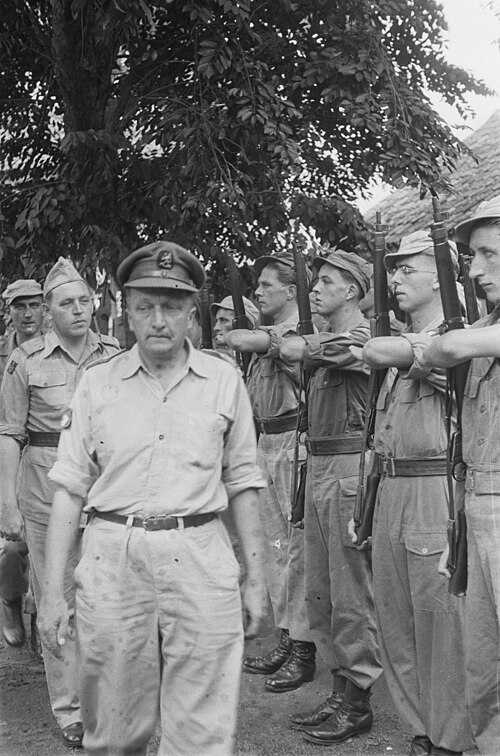
After World War II, Baas Becking was initially prevented from beginning his work in Bogor due to the Indonesian Revolution. Until November 1946 he was head, with the rank of colonel, of the mobile units of the Red Cross. He moved to New Caledonia in 1948, after being appointed president of the scientific council of the South Pacific Commission.[4]
Baas Becking later worked for the Commonwealth Scientific and Industrial Research Organisation in Cronulla and Canberra. The Bureau of Mineral Resources in Canberra recognized Baas Becking's contributions by opening the Baas Becking Geobiological Laboratory.[4]
Baas Becking became member of the Royal Netherlands Academy of Arts and Sciences in 1932 and resigned in 1942. In 1945 he once again became member, in 1949 he became foreign member.[6]
Based on his research in California's salt lakes, as well as work by others on salt lakes worldwide, Baas Becking (1934)[1] concluded, "Everything is everywhere, but the environment selects".[7] Baas Becking attributed the first half of this hypothesis to his colleague Martinus Beijerinck (1913).[8][9] Some years before, Schewiakoff (1893) also theorized about the cosmopolitan habitat of free-living protozoans.[10]
The application of this hypothesis to microorganisms, specifically to the dependence of their geographic distribution over the earth on their metabolic properties, formed the basis of Baas Becking's research program at the Hortus Botanicus Leiden.[4]
Baas Becking presented a series of lectures on the subject to the Diligentia in The Hague, which he published as a book titled Geobiology in 1934.[4]
バース・ベッキングの仮説はしばしば誤って引用され、「しかし」が欠落したり、「そして」に置き換えられたりする。[ 11 ]