複素数要素を持つ2 つの行列AとBは、 B = U * AUとなるようなユニタリ行列Uが存在する場合、ユニタリ同値であると言われます。[ 2 ]ユニタリ同値な 2 つの行列は相似でもあります。相似な 2 つの行列は同じ線形写像を表しますが、基底が異なります。ユニタリ同値とは、正規直交基底から別の正規直交基底への変換に対応します。
AとBがユニタリ同値であれば、tr AA * = tr BB *が成り立ちます。ここで、trはトレースを表します(つまり、フロベニウスノルムはユニタリ不変量です)。これはトレースの巡回不変性から導かれます。B = U * AUの場合、tr BB * = tr U * AUU * A * U = tr AUU * A * UU * = tr AA * が成り立ちます。ここで、2番目の等式は巡回不変性です。[ 3 ]
したがって、tr AA * = tr BB * はユニタリ同値性の必要条件ではあるが、十分条件ではない。スペクトの定理は、無限に多くの必要条件を与え、それらの条件は同時に十分条件でもある。この定理の定式化では、次の定義を用いる。2つの変数、例えばxとyの語は、次の形式の式である。
ここで、 m 1、n 1、m 2、n 2、 …、m pは非負整数です。この単語の次数は
Specht's theorem: Two matrices A and B are unitarily equivalent if and only if tr W(A, A*) = tr W(B, B*) for all words W.[4]
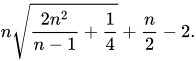
The theorem gives an infinite number of trace identities, but it can be reduced to a finite subset. Let n denote the size of the matrices A and B. For the case n = 2, the following three conditions are sufficient:[5]
For n = 3, the following seven conditions are sufficient:
Đoković, Dragomir Ž.; Johnson, Charles R. (2007), "Unitarily achievable zero patterns and traces of words in A and A*", Linear Algebra and Its Applications, 421 (1): 63–68, doi:10.1016/j.laa.2006.03.002, ISSN0024-3795.
Freedman, Allen R.; Gupta, Ram Niwas; Guralnick, Robert M. (1997), "Shirshov's theorem and representations of semigroups", Pacific Journal of Mathematics, 181 (3): 159–176, doi:10.2140/pjm.1997.181.159, ISSN0030-8730.
ホーン、ロジャー A.、ジョンソン、チャールズ R. (1985)、『行列解析』、ケンブリッジ大学出版局、ISBN978-0-521-38632-6。
Pappacena、Christopher J. (1997)、「有限次元代数の長さの上限」、Journal of Algebra、197 (2): 535–545、doi : 10.1006/jabr.1997.7140、ISSN 0021-8693。