Loading article…
| ||||||
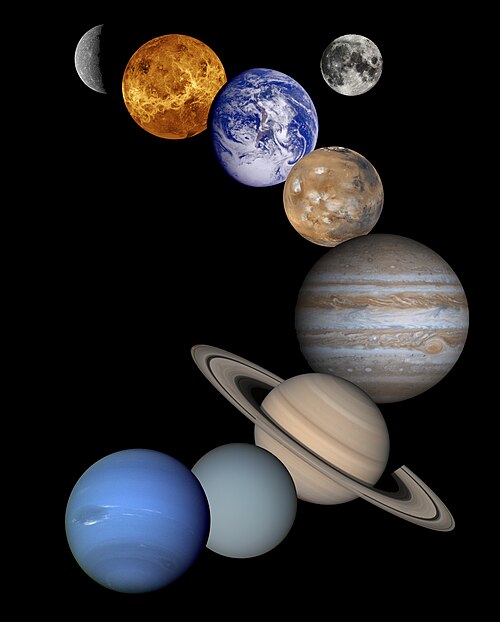
| 撮影された 15 個の太陽系外天体の集大成。最初の画像は、いくつかの最大の太陽系外天体の大きさ、色、アルベドを比較したものです。 |

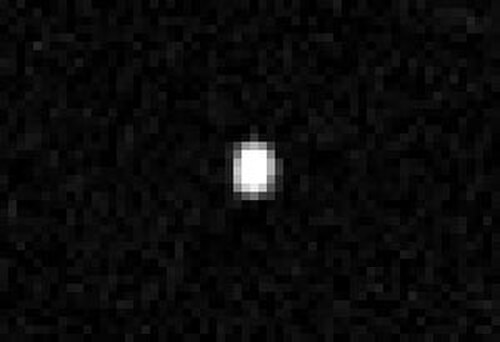


_1996_TO66_imaged_by_NTT_cut_out.jpg/500px-(19308)_1996_TO66_imaged_by_NTT_cut_out.jpg)

.png/500px-225088_Gonggong_and_Xiangliu_by_Hubble_(2010).png)
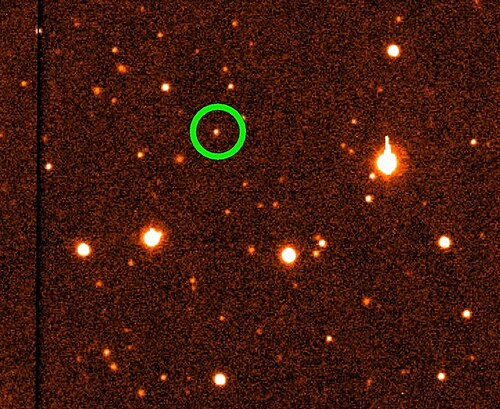


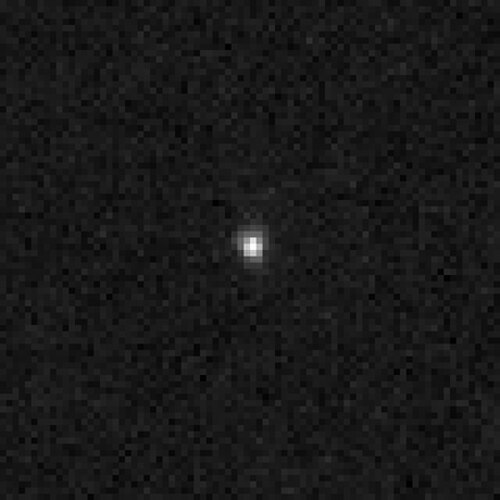


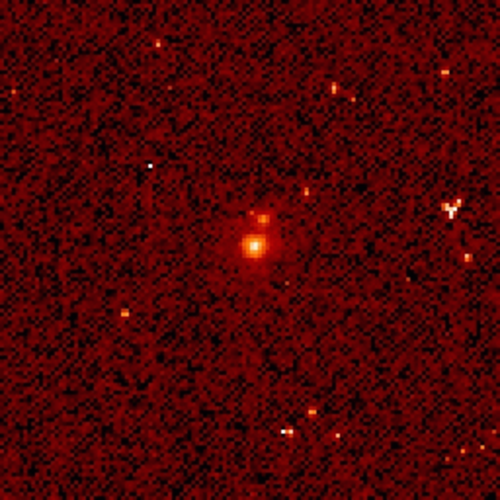
これは太陽系の小惑星で、平均して海王星よりも長い距離を公転している、つまり軌道長半径が30.1天文単位(AU)を超える太陽系外天体(TNO)のリストです。カイパーベルト、散乱円盤、オールトの雲は、この空間体積の3つの慣例的な区分です。[1] [注1] 2022年4月現在、小惑星のカタログには901個の番号付きTNOが含まれています。さらに、 1993年以降に観測された番号なしのTNOが3,000個以上あります。 [3] [4] [5][update]
このリストには、すべてのタイプのTNOサブグループが含まれています。「キュベワノ」としても知られる古典的なカイパーベルト天体、主共鳴サブグループと高次共鳴サブグループを持つ共鳴太陽系外縁天体、散乱円盤天体(SDO)、および少なくとも150 AUの長半径と海王星よりも大きな近日点(太陽に最も近づく距離)を持つESDO 、EDDO、セドノイドを含む極端太陽系外縁天体です。 [6]また、オブジェクトの軌道が十分に大きな長半径(a)を持つ場合、リストにはいくつかのケンタウルス族も含まれます。ケンタウルス族は、近日点(q)が海王星の軌道の十分に内側にあるが、最も遠い点(遠日点、Q)が非常に遠い不安定な軌道を持っています。
最初に発見された太陽系外惑星は1930年の冥王星である。冥王星は、プルティノと呼ばれる共鳴天体の大きなグループの名前の由来となった(別の共鳴サブグループとしてツーティノがある)。2番目の太陽系外惑星であるアルビオン(暫定的に1992 QB1と呼ばれていた)が1992年に発見されるまでに60年以上を要した。最大の既知の太陽系外惑星は冥王星とエリスであり、続いてハウメア、マケマケ、ゴンゴン、クワオアー、セドナ、オルクスであり、ゴンゴン、セドナ、オルクスを除いてすべてIAUによって準惑星として正式に認められている。サラシア、(307261)2002 MS 4、バルダ、イクシオン、ヴァルナなど、準惑星の可能性があるものも多数ある。ほとんどの TNO はアルベドが低く、通常は約 0.09 です。色は青灰色から非常に赤い色までさまざまです (BB、BR、IR、RR クラス)。次のリストには、オブジェクトの完全な指定、平均直径 (D)、発見状況 (日付、発見者、発見場所)、および軌道傾斜角( i ) と離心率 (e) も示されています。
リスト
このリストには、太陽からの海王星の平均軌道距離である30.1天文単位(AU)を超える長半径を持つ、番号が付けられた太陽系外縁天体がすべて含まれています。データはMPCの「太陽系外縁天体リスト」と「ケンタウルス族と散乱円盤天体リスト」から取得され、ジョンストンのアーカイブからの注釈と情報(直径、クラス、連星、アルベド、スペクトル分類、B-R色指数)が追加されています。[3] [4] [5]
back to top
Unnumbered TNOs
There are more than 3,000 unnumbered trans-Neptunian objects, defined here as minor planets with a semi-major axis larger than 30.1 AU (Neptune's average orbital distance from the Sun). The data is sourced from MPC's "List of Trans Neptunian Objects" and "List Of Centaurs and Scattered-Disk Objects", completed with information from Johnston's Archive (diameter, class, binary status, etc.).[3][4][5] For the list of numbered TNOs, see § List.
Trans-Neptunian satellites
A growing number of TNOs are revealed to be binary systems with a minor-planet moon orbiting its primary. There are also several multiple systems with more than one satellite.
Diagram: orbital classes

- plutinos (3∶2 res.): 538 (13.1%)
- Haumeids: 12 (0.3%)
- twotinos (2∶1 res.): 132 (3.2%)
- other resonances: 377 (9.2%)
- cold classical: 733 (17.8%)
- hot classical: 667 (16.2%)
- SDOs: 565 (13.7%)
- sednoids: 4 (0.1%)
- ESDOs: 10 (0.2%)
- EDDOs: 10 (0.2%)
- damocloids: 71 (1.7%)
- centaurs: 212 (5.2%)
- unclassified TNOs: 782 (19.0%)
4140 TNOs (a > 30.1 AU) from Johnston's archive grouped by orbital subclasses.[5]
Trans-Neptunian objects colorized by their orbital subclass and plotted in the orbital parameter space (eccentricity and inclination versus semi-major axis). The plot for the entire region contains 1418 objects including plutinos (#185), twotinos (#36), other resonant objects (#124), cubewanos (#420), inner (#40) and outer classical objects (#6), SDOs (#289), sednoids (#11), centaurs (#101) and other TNOs (#206).[5]
Full region on a logarithmic scale from 30 to 1000 AU: inclination (left) and eccentricity (right) vs. a
See also
- Lists of astronomical objects
- List of centaurs (small Solar System bodies)
- List of minor planets
- List of the brightest Kuiper belt objects
- List of Solar System objects by greatest aphelion
- List of Solar System objects most distant from the Sun
- Planet Nine
Notes
- ^ The treatments vary and a few objects such as Sedna do not fit easily into any division. The literature is inconsistent in the use of the phrases "scattered disc" and "Kuiper belt". For some, they are distinct populations; for others, the scattered disk is part of the Kuiper belt, in which case the low-eccentricity population is called the "classical Kuiper belt". Authors may even switch between these two uses in a single publication.[2] This lists shows all minor planets with a semi-major axis larger than 30.1 AU, irrespective whether they are dynamically categorized as TNOs (resonant and classical), SDOs, centaurs or damocloids
References
- ^ a b Remo, John L. (February 2007). Classifying Solid Planetary Bodies. AIP Conference Proceedings – New Trends in Astrodynamics and Applications III. Vol. 886. pp. 284–302. Bibcode:2007AIPC..886..284R. doi:10.1063/1.2710063.
- ^ Weissman and Johnson, 2007, Encyclopedia of the solar system, footnote p. 584
- ^ a b c d "List Of Transneptunian Objects". Minor Planet Center. 16 April 2022.
- ^ a b c d "List Of Centaurs and Scattered-Disk Objects". Minor Planet Center. 16 April 2022.
- ^ a b c d e f "List of Known Trans-Neptunian Objects". Johnston's Archive. 2 January 2022. Retrieved 16 April 2022.
- ^ a b de la Fuente Marcos, C.; de la Fuente Marcos, R. (September 2014). "Extreme trans-Neptunian objects and the Kozai mechanism: signalling the presence of trans-Plutonian planets". Monthly Notices of the Royal Astronomical Society: Letters. 443 (1): L59–L63. arXiv:1406.0715. Bibcode:2014MNRAS.443L..59D. doi:10.1093/mnrasl/slu084.
- ^ Levine, Stephen E.; Zuluaga, Carlos A.; Person, Michael J.; Sickafoose, Amanda A.; Bosh, Amanda A.; Collins, Michael (April 2021). "Occultation of a Large Star by the Large Plutino (28978) Ixion on 2020 October 13 UTC". The Astronomical Journal. 161 (5): 210. Bibcode:2021AJ....161..210L. doi:10.3847/1538-3881/abe76d. S2CID 233545793.
- ^ B. E. Morgado; et al. (8 February 2023). "A dense ring of the trans-Neptunian object Quaoar outside its Roche limit". Nature. 614 (7947): 239–243. Bibcode:2023Natur.614..239M. doi:10.1038/S41586-022-05629-6. ISSN 1476-4687. Wikidata Q116754015.
back to top
External links
- How many dwarf planets are there in the outer solar system?, Michael Brown, Caltech
- OSSOS TNODB by the Outer Solar System Origins Survey
- Minor Planet Center: List of Transneptunian Objects
- Minor Planet Center: List of Centaurs and Scattered-Disk Objects
- Johnston's Archive: List of Known trans-Neptunian Objects
- Johnston's Archive: Trans-Neptunian Objects
- Known extreme outer solar system objects, Scott Sheppard, Carnegie Science Center