Loading article…
In mathematics, the Lehmer–Schur algorithm (named after Derrick Henry Lehmer and Issai Schur) is a root-finding algorithm for complex polynomials, extending the idea of enclosing roots like in the one-dimensional bisection method to the complex plane. It uses the Schur-Cohn test to test increasingly smaller disks for the presence or absence of roots.
This algorithm allows one to find the distribution of the roots of a complex polynomial with respect to the unit circle in the complex plane.[1][2][3] It is based on two auxiliary polynomials, introduced by Schur.[4]
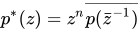
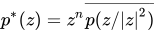
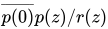
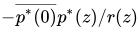
For a complex polynomial of degree its reciprocal adjoint polynomial is defined by and its Schur Transform by
where a bar denotes complex conjugation.
So, if with , then , with leading zero-terms, if any, removed. The coefficients of can therefore be directly expressed in those of and, since one or more leading coefficients cancel, has lower degree than . The roots of , , and are related as follows.
Let be a complex polynomial and .
For we have and, in particular, for . Also implies . From this and the definitions above the first two statements follow. The other two statements are a consequence of Rouché's theorem applied on the unit circle to the functions and , where is a polynomial that has as its roots the roots of on the unit circle, with the same multiplicities. □
For a more accessible representation of the lemma, let , and denote the number of roots of inside, on, and outside the unit circle respectively and similarly for . Moreover let be the difference in degree of and . Then the lemma implies that if and if (note the interchange of and ).
Now consider the sequence of polynomials , where and . Application of the foregoing to each pair of consecutive members of this sequence gives the following result.
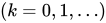
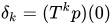
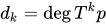
Let be a complex polynomial with and let be the smallest number such that . Moreover let for and for .
, for , and .
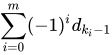
for and .
より一般的には、多項式の根の分布複素平面上の任意の円、例えば中心が半径は、「シフトおよびスケーリングされた」多項式にシュール・コーン検定を適用することによって見つけることができる。定義される。
ただし、すべてのスケーリング係数が許容されるわけではなく、Schur-Cohn テストは多項式に適用できます。以下の等式のいずれも成立しない場合に限る。一部の人にとってまたはその間. さて、多項式の係数はは多項式であるそして、上記の等式は、次の多項式方程式をもたらします。したがって、これは有限個の値に対してのみ成り立つ。したがって、任意の値に近い場合でも、適切なスケーリング係数を常に見つけることができます。。
レーマーの方法は以下のとおりである。 [ 5 ] 与えられた複素多項式に対してSchur-Cohnテストでは、すべての根を含むのに十分な大きさの円盤が見つかる。次に、このディスクを、重なり合う小さなディスクのセットで覆うことができます。そのうちの1つは同心円状に配置され、残りのディスクはまだ覆われていない環状領域に均等に分布します。このセットから、再びテストを使用して、根を含まないディスクは、取り外すことができます。残りの各ディスクで、この覆いと取り外しの手順を何度でも繰り返すことができ、その結果、すべてのルートを含む任意のサイズのディスクのセットが得られます。。
この手法の利点は、単一の手順を繰り返すだけで済むこと、そして実数根、複素数根、単根、多根、クラスター根など、すべての根を同時に見つけることができる点です。また、既に見つかった根の削除(デフレーション)は不要で、すべてのテストは完全な精度を持つ元の多項式から始まります。さらに驚くべきことに、この多項式を評価する必要は一切ありません。
しかし、ディスクが小さくなるほど、対応する「スケーリングされた」多項式の係数の相対的な大きさが異なってしまいます。これにより、コンピュータの計算がオーバーフローまたはアンダーフローを起こし、ディスクの半径が下から制限され、計算された根の精度が低下します。 [ 2 ] [ 6 ]極端 なスケーリングを避けるため、または単に効率のために、まず同心円状のディスクをいくつかテストして含まれる根の数を調べ、根が発生する領域を狭い同心円状の環状領域に縮小することができます。この手順を別の中心で繰り返し、結果を組み合わせると、その領域はそのような環状領域の交点の和集合になります。 [ 7 ]最後に、単一の根を含む小さなディスクが見つかった場合、その根はニュートン法 などの他の方法を使用してさらに近似することができます。