
Loading article…
統合国際深海掘削計画(IODP)は、2003年から2013年まで実施された国際的な海洋研究プログラムでした。このプログラムでは、船舶に搭載された大型掘削装置を使用して、海底下の環境を監視およびサンプリングしました。この研究により、IODPは環境変化、地球のプロセスと影響、生物圏、固体地球のサイクル、および地球力学を記録しました。[ 1 ]
科学的な海洋掘削は、地球科学分野における最も長く続き、最も成功した国際協力事業であった。科学的な海洋掘削は1961年に始まり、アメリカ海軍の改造バージ船CUSS 1号で最初の海洋地殻サンプルが採取された。アマチュア海洋学者でもあったアメリカ人作家ジョン・スタインベックは、LIFE誌のためにモホール計画を記録した。
1966年6月に設立された深海掘削計画(DSDP)は、グロマー・チャレンジャー号を運用し、大西洋、太平洋、インド洋、地中海、紅海で掘削およびコア採取作業を行った。グロマー・チャレンジャー号のコア採取作業により、DSDPは、大西洋中央海嶺から離れた横断線上の基底堆積物の年代測定を行い、海底拡大に伴うプレートテクトニクスの仮説を検証する上で、次の知的ステップを踏み出すことができた。
1970年6月、グロマー・チャレンジャー号のDSDP(深海掘削計画)エンジニアたちは、ニューヨーク沖の大西洋、水深3,000メートル(10,000フィート)の海域で、摩耗したドリルビットを交換し、掘削孔に再び進入してより深い掘削を行う方法を考案した。これには、ソナー探査装置と大型の再進入コーンの使用が必要だった。
Process-oriented Earth studies continued from 1985 until 2003 aboard JOIDES Resolution, which replaced Glomar Challenger in January 1985 as DSDP morphed into the Ocean Drilling Program (ODP). JOIDES Resolution is named for the 200-year-old HMS Resolution which explored the Pacific Ocean and Antarctica under the command of Captain James Cook.
The Ocean Drilling Program contributed significantly to increased scientific understanding of Earth history, climate change, plate tectonics, natural resources, and geohazards. ODP discoveries included validation of:
National consortia and government funding agencies supported IODP science and drilling platform operations. Participation in IODP was proportional to investment in the program.
The European Consortium for Ocean Research Drilling (ECORD) was established in December 2003 with 13 European countries to represent the European contribution in IODP. The consortium grew into a collaborative group of 17 European nations (Austria, Belgium, Denmark, Finland, France, Germany, Iceland, Ireland, Italy, The Netherlands, Norway, Poland, Portugal, Spain, Sweden, Switzerland and the United Kingdom) and Canada that together comprise an IODP-funding agency. Working alongside Japan and the United States, ECORD provided the IODP scientific community with access to mission-specific platforms, which chosen to fulfill specific scientific objectives. These platforms have limited space on board for labs and scientists, and require an onshore science meeting to describe, process, and analyze the sediment samples collected immediately following a drilling expedition.
In April 2004, the People's Republic of China joined IODP as an Associate Member through sponsorship of China's Ministry of Science and Technology (MOST). China's participation in IODP has given the Chinese marine science community a new impetus and increased their opportunity for deep-sea research. Chinese scientists participated in research expeditions and represent China's interests in the IODP Science Advisory Structure.
The Republic of Korea joined IODP as an Associate Member in June 2006 through the sponsorship of the Korea Institute of Geoscience and Mineral Resources (KIGAM). South Korea's memorandum of understanding with the lead agencies created the Interim Asian Consortium.
Ministry of Earth Sciences (MoES), Government of India joined the IODP in 2008 as an Associate member. Since then, the National Centre for Antarctic and Ocean Research (NCAOR), Goa has been designated by India to look after all IODP related activities in India (IODP-India). In this direction, an international workshop on IODP drilling in Indian Ocean was organized in Goa during 17–18 October 2011. The workshop was co-hosted by IODP Management International and ANZIC.
Hundreds of international Earth and ocean scientists participated in IODP on a voluntary basis. Participation took many forms: submission of a drilling proposal; sailing on an expedition; participation in an advisory capacity; attendance at a planning workshop or topical symposium. The program's central management office, IODP Management International, coordinated an integrated work plan between and among all IODP organizational partners. An annual program plan was written each fiscal year and included objectives and tasks necessary for drilling vessel operation, from science coordination to publications, data management, and outreach.
IODP distinguishes itself from its legacy programs by employing multiple drilling technologies/platforms and science/drilling operators to acquire sediment and rock samples and to install monitoring instrumentation beneath the seafloor. Samples and data collected during IODP drilling expeditions are available to scientists and teachers on an open-access basis, once members of the expedition parties have completed their initial studies.
Drilling proposals originated with science proponents, often researchers in geology, geophysics, microbiology, paleontology, or seismology. Once submitted to IODP, the proposal was carefully evaluated by the Science Advisory Structure (SAS), a group of technical review panels. Only those proposals judged as the greatest value based on scientific and technical merit were scheduled for implementation.
SAS panels provided advice on drilling proposals to both proponents and IODP management. Drilling proposals were accepted twice a year, in April and October, and could be submitted to IODP electronically via their website.
A ten-year program plan called the Initial Science Plan (ISP) guided IODP investigation. Specific scientific themes were emphasized in the ISP:
As described in the ISP, IODP sought to develop better understandings of:
これらの目標達成に不可欠なツールには、ライザー付き掘削船、ライザーなし掘削船、任務に応じた探査に適した追加プラットフォーム、強化された坑内計測装置、および長期モニタリング機器が含まれていた。
2007年4月に開始された技術提案提出プロセスは、IODP運用で使用される既存または潜在的な技術の取得を促進した。
掘削作業は、IODP実施機関3団体によって実施・管理された。
各掘削調査は、共同主任科学者2名が率い、科学者チームがスタッフ科学者のサポートを受けて実施された。各実施機関は、技術、運用、財務管理、記録、実験室、コア保管庫、データ管理、出版といった複数のサービスを提供した。各実施機関は、自らのプラットフォームの運用と性能に責任を負ったが、科学調査活動は主導機関から資金提供を受けた。
オペレーターはIODP中に以下の探査を実施した:[ 3 ]
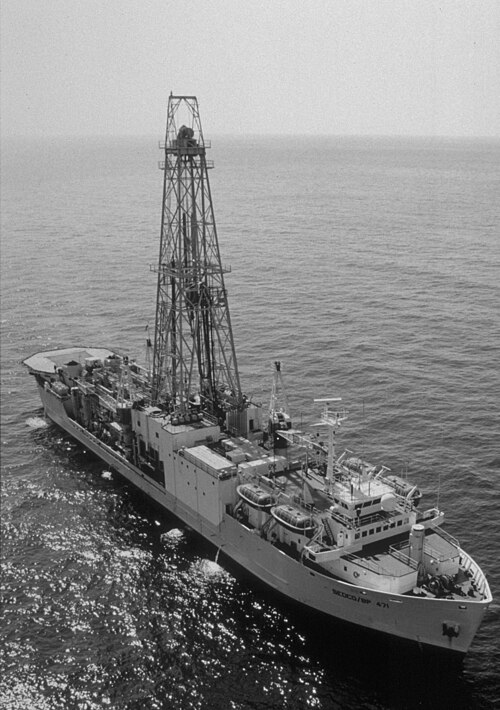
IODPは2隻の専用掘削船を運用し、それぞれが主導機関の資金提供を受け、それぞれの実施機関によって管理された。
米国が資金提供した掘削船は、海洋掘削計画とIODPの第1フェーズを通して運用された。その後、船は改修され、実験室スペースの拡大、掘削、コア採取、サンプリング能力の向上、船内の健康、安全、環境保護システムの強化が可能になった。[ 4 ]
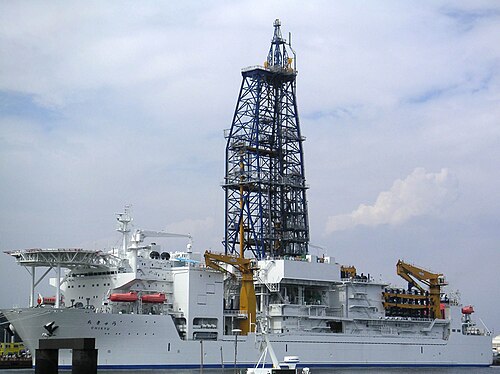
日本は2001年に地球のマントルに到達し、活発な地震発生帯を掘削することを目的とした最先端の科学掘削船の建造を開始しました。その結果建造された掘削船「地球」は、ライザー掘削システム、ダイナミックポジショニングシステム、掘削中の坑井崩壊を防ぐための高密度泥循環システムなどを備えています。「地球」は150人を収容でき、12ノット(22 km/h、14 mph)で航行し、水深2,000 m(6,600フィート)を超える海域で海底から7,000 m(23,000フィート)以上掘削できます。「地球」は2011年3月11日の津波で損傷し、数ヶ月間運用停止となりました。[ 5 ]「地球」は2012年4月に海洋掘削に復帰しました。
ECORDは、特定の科学的要件と環境に応じて、探査ごとに船舶を発注した。ECORDは、北極海コアリング探査(2004年)のために3隻の砕氷船、タヒチ(2005年)とオーストラリア(2010年)の浅瀬で使用するための潜水掘削船(科学者たちは最終氷期以降の世界的な海面上昇を調査するために化石サンゴ礁を採取した)、そしてニュージャージー浅海棚(2009年)でサンプリングを行うためのリフトボートを契約した。任務固有の探査には、相当な柔軟性が求められた。
海洋掘削調査に従事する科学者の数を増やすため、情報や資源の共有を支援する出版物、データ管理、オンラインツール、データベースなどが開発されている。
IODPの出版物はオンラインで無料で入手可能であり、データ管理システムは、3つの実施機関と2つのIODPレガシープログラムによって収集されたコアデータと実験データを統合しています。ウェブベースの検索システムは、最終的には探査後のデータと関連出版物を集約する予定です。データとサンプルのリクエストはオンラインで行うことができます。
ウェブベースのサイト調査データバンクにより、提案者は評価対象となる掘削候補地の記録に必要な大量のデータにアクセスし、登録することが可能になった。このデータは、IODP探査が目的を達成し、安全および環境要件を遵守できることを確認するために精査された。
ドイツのブレーメン(IODPブレーメン・コア・リポジトリ)、テキサス州カレッジステーション(IODPガルフコースト・リポジトリ) 、日本の高知にある3つのIODPコア保管施設は、地理的起源に基づいてコアを保管しています。研究者は、現地調査のためにいずれかの施設を訪問したり、分析や教育目的でコアの貸し出しを依頼したりすることができます。保管されているコアには、IODPのサンプルだけでなく、IODPの2つのレガシープログラム(DSDPとODP)で採取されたサンプルも含まれています。