
Loading article…

厩務員(厩務員、厩務助手)とは、馬の管理や厩舎自体の維持管理の一部または全部を担当する人のことです。この用語は、多くの場合、厩舎のオーナーに雇われている人を指しますが、馬のオーナー自身が厩務員の職務を担うこともあります。特に、オーナーが所有する馬が数頭しかない場合はその傾向が顕著です。
この単語は、1225 年頃に英語でgromeとして登場し、「少年、子供、少年、若者」を意味していました。その語源は不明です。他のゲルマン語派の言語には既知の同族語はありません (例えば、オランダ語やドイツ語ではStal(l)knecht「厩務員」などの複合語、または後述する同義語の同等語が使用されています)。おそらく、古英語の語根gromaに由来し、growan「成長する」または古フランス語のgrommet「召使い」に関連していると考えられます (1229 年以降記録されている中世英語のgromet「船員見習い」と比較してください)。 [ 1 ]
この言葉は元々はもっと格式の高い意味合いを持っており、例えば「花婿」や、イギリス王室における社会的地位の高い役職などを指していた。
「馬の世話をする男性使用人」という意味は1667年から使われており[ 2 ]、女性や少女が馬丁を務めることもよくあります。動詞としては1809年に初めて確認され、「身なりを整える」という意味は1843年から、比喩的な「候補者を準備する」という意味は1887年から使われており、元々はアメリカの政治で使われていました[ 3 ] 。


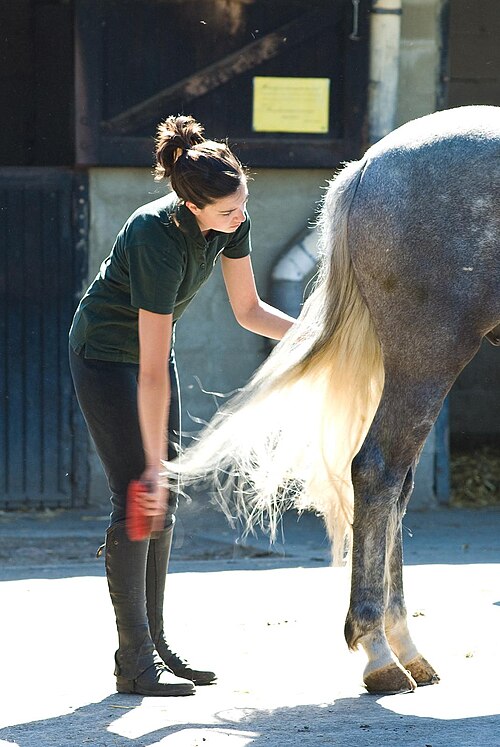
馬丁は、個人の住居や、厩舎、預託施設、乗馬学校などの専門的な馬の訓練施設で雇用されることがある。
厩務員は通常、厩舎の清掃(馬房の掃除)、馬への餌やり、運動、そして馬の手入れを行います。
A groom in private service is expected to be 'on call' during specified hours in case any member of the employer's family wishes to ride.
Grooms whose employers are involved in horse sports or horse racing are often required to travel with their employers to provide support services during competitions. The services required vary with the type of competition and range from simply ensuring that the horse is ready for the start of the competition to warming the horse up beforehand.
In competition, the term may have a distinct meaning. At a horse show, grooms outside of the ring perform standard grooming tasks, but if utilized inside the show ring are generally defined as an individual called in to assist an exhibitor with a horse while in competition. In combined driving the groom is the passenger and at speed is required to shift their weight to balance the carriage.

Stablehand is a more old-fashioned term; the variation stableman usually applies to an experienced adult, the lowest rank stableboy (corresponding to the first origin of groom) rather to a minor and/or trainee.
The historical synonym [h]ostler has meanwhile developed (in the United States) a new meaning of "rail employee".
Large establishments may employ several grooms under the management of the head groom or stablemaster. In many cases the head groom has complete responsibility for the horses including devising training schedules, choosing feeds for optimum nutrition and ensuring the horses are shod, wormed, inoculated and provided with timely veterinary care.
Several other words originally denoting other (often much higher) titles, notably Constable, Equerry and Marshal, have developed into terms for those working with horses.
In African or Asian contexts, English-speakers sometimes use the Arabic/Hindustani word sais or syce instead of "groom".[5]
実際には見開きページの右半分に過ぎず、ティムールがシャー・ルフをサマルカンドの総督に任命した後、シャー・ルフがヒッジャ月796年(西暦1394年9月)にサマルカンドに凱旋入城した様子を描いている。