
Loading article…
総督官邸は、バハマのナッソーにあるバハマ総督の公邸です。植民地時代に建設され、バハマ総督の住居として使われていました。1973年にイギリスから政治的に独立した後も、総督の公邸および執務室としての役割を継続しています。
マウント・フィッツウィリアムとして知られる丘の上に建てられ、1806年に完成したデューク・ストリートにあるこの堂々とした漆喰塗りの珊瑚岩の建物は、バハマ諸島におけるジョージアン植民地時代の建築様式の最も優れた例である。[ 1 ] 1814年、スペインの学者で軍人であったドン・アントニオ・デ・アルセド大佐は、その効果を称賛して書き記した。[ 2 ] 1825年のオリエンタル・ヘラルド紙は、「町を見下ろす尾根の中央に建つ新しい総督官邸は、議会が財務省の資金から承認した金額で建設され、2万ポンド以上の費用がかかった。ヨーロッパ様式の建築で建てられており、西インド諸島全体でこの種の建物の中で最高であると広く考えられている」と述べている。[ 3 ]
建物の元々の新古典主義的な外観と石造りの構造は、1780年代にアメリカ南部からロイヤリストが到着したことに直接影響を受けている。それ以前のバハマの建物のほとんどは塗装された木材で建てられていた。 [ 4 ]しかし、典型的なバハマの要素としては、ルーバー付きの木製シャッターと、この場合は鮮やかなコンクピンク色の明るい塗装の外壁が挙げられる。4本の頑丈なイオニア式円柱に支えられたペディメント付きの入り口を中心とした正面は、1929年のハリケーンの後、建物が改築された1930年代のものである。
この場所に最初に建てられた総督官邸は、リチャード・フィッツウィリアム総督の住居として1737年に完成しました。その建物は、1803年から1806年の間に建てられた新古典主義の建物に取って代わられ、チャールズ・キャメロンが最初にそこに住んだ総督でした。[ 5 ]この2階建ての建物は全長100フィート以上あり、港を見下ろす正面には、10本の柱で支えられた全長にわたる上階ギャラリーがありました。[ 6 ]
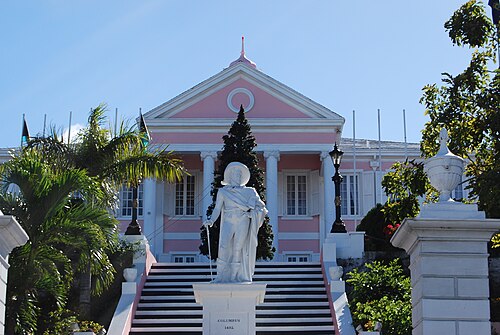
The statue of Christopher Columbus that stands at the harbourside entrance of the building was reportedly designed in London by an aide to American novelist Washington Irving, a Columbus biographer. The 12-foot-tall representation was placed in front of Government House by Governor James Carmichael Smyth in 1830 and is "notable for its size rather than its artistry".[7][8] As another observer wrote of the statue, "It is fortunate that the statue is labeled, for otherwise no one would ever guess that the swaggering, piratical-looking figure, with a slouch hat cocked rakishly on its head and a toga over its shoulder, is intended to represent Columbus".[9]

In 1909 the east wing was added; the west wing is commonly known as the Windsor Wing, named for the Duke of Windsor, who was governor from 1940 to 1945.
Government House was seriously affected by the hurricane of 1929. As a history recounts, "[T]he eastern wing of the Government House was unroofed on three sides and damaged to the extent that it was not fit for occupancy so major repair work had to be done to the roof and buildings".[10] This restoration work, which included the removal of the original gallery and its replacement by the current temple-like entrance and cupola-topped roof, was completed in 1932.[11][6]
From late 1940 through 1941, Government House, then described as "a cracked and flaking edifice ... with about as much warmth and atmosphere as Wellington Barracks", was renovated by the Duchess of Windsor, whose husband, the Duke, formerly King Edward VIII of Great Britain, served as Governor of the Bahamas from 1940 to 1945.[12] During the renovation of the interiors—which suffered from an excess of high-gloss blue paint and worn Victorian furniture—the Windsors occupied Sigrist House, the residence of Sir Frederick Sigrist, a British aviation magnate, "who offered to let them use it while repairs and redecorations were in progress".[13][14] The couple's term at the Sigrist house ended when they agreed to move to Westbourne, the mansion of industrialist Harry Oakes.[15]
総督官邸の改修を担当した建築家は、主にフロリダ州パームビーチで活動していたアメリカ人のシドニー・ニールでした。[ 16 ]構造的な修復に加え、建物は配管と配線がやり直され、ウィンザー家のスタッフとオフィス用に新しい棟も建設されました。(いわゆるウィンザー棟は現在、バハマ王立国防軍によって使用されています。)[ 17 ] [ 18 ]総督官邸のインテリアデザイナーは、公爵夫人の友人で社交界の著名人であるイザベル・T・ブラッドリー(ウィンスロップ・カーティス・ブラッドリー夫人)でした。[ 19 ] [ 20 ]公爵夫人は1940年9月の手紙で叔母のベシー・メリーマンに、「私たちは一緒にこの小屋を改装して、少なくともここで地元の恐ろしい人たちに尋ねることを恥ずかしく思わないようにするつもりです」と伝えています。[ 21 ]クライアントと装飾家は、このプロジェクトのために米国から通信販売で家具を購入した。完成した装飾は「リージェンシー様式を取り入れた、率直に言ってスマートでモダンな」と評され、天然ラタン製の幅木のある部屋や、公爵夫人の署名の3フィートのレプリカで表面が飾られたテーブルなどが含まれていた。[ 22 ] [ 23 ]公爵夫人は「ニューヨークの壁紙を導入し、お気に入りのフェイスパウダーと全く同じ色で1つの部屋を塗装した」。[ 24 ] [ 19 ] [ 25 ] [ 26 ]
改修予算は議会によって6,000ドルに設定されていたが、最終的な費用は21,000ドルとなり、その大部分はウィンザー家が支払った。しかし、その結果は「今ではとても魅力的で、ウィンザー公爵夫人は歴代総督夫人全員から祝福されている」[ 12 ] [ 27 ] 。しかし、公爵夫人が提案した改善点の1つは却下された。 1941年に発行されたライフ誌に掲載されたウィンザー家の長編記事には、「総督官邸の近代化にあたり、公爵夫人は、古い総督官邸の遺物であり、1929年の有名な嵐を含むあらゆるハリケーンに耐えてきた正面玄関を取り外したいと考えていた。その玄関は公爵夫人の意向にも耐え、公爵夫人は傷んだ木製ドアの上半分を黒いガラスパネルで覆うことを許可された。そのパネルには、公爵のガーター勲章の有名な紋章である「Honi soit qui mal y pense」(悪意ある者に災いあれ)が白で適切に印刷されている」と記されている。[ 28 ]このガラスの銘板はフランスのウィンザー家の邸宅から送られ、現在もその場所に設置されている。[ 27 ]
公式サイト