Loading article…
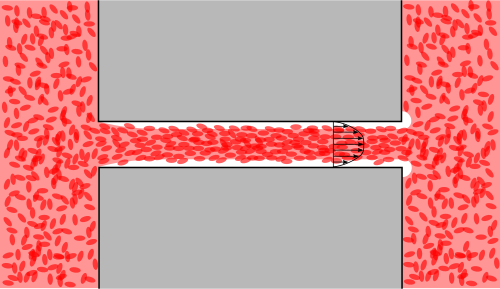
ファールス効果(/fɑːˈreɪ.əs/ far - AY -əs )とは、血液が流れるガラス管の直径が小さくなるにつれて、ヒトの血液中の赤血球の平均濃度が減少する現象です。言い換えれば、直径が500マイクロメートル未満の血管では、毛細血管の直径が小さくなるにつれてヘマトクリット値が低下します。ファールス効果は、血液の見かけの粘度が毛細血管のサイズに依存することを示すファールス・リンドクヴィスト効果に確実に影響を与えますが、前者は後者の唯一の原因ではありません。[ 1 ]
Robin Fåhræus was a pathologist at the University of Uppsala in Sweden, and his interest in the suspension stability of blood and later in hemorheology was motivated by the desire to understand the clinical effects of abnormalities in the aggregation and flow behavior of the formed elements. The aim was to ascertain whether blood obeyed the law of Poiseuille (Hagen–Poiseuille equation). It was Hess in 1915 who proved that blood obeys the poiseuille law at high flow and low shear. The non-Newtonian effects were due to the elastic deformation of red blood cells. Fahraeus entered the scene in 1917 through his observation that sedimentation velocity of red corpuscles increases during pregnancy. He used the concept of buffy coat as the starting point of his work on red cell sedimentation and the more general problem of suspension stability of blood. He pointed out that fibrinogen was the principal protein involved in red cell aggregation leading to the formation of regular rouleaux and that the process was quite distinct from blood coagulation. He applied colloid principles to describe the stability of the suspension and more relevant to modern circulatory psychology was the study of aggregation of streaming blood and the relation between blood cell distribution, its velocity and apparent viscosity. He concluded the following results: (a) In high flow rates in tubes of diameter (< 0.3 mm) the concentration of red cells is lower than large feed tube, the reason being that, red cells are distributed in the axial core and their mean velocity is therefore more than the mean velocity of blood. There is an inverse relationship between tube hematocrit and mean velocity of blood. (b) Viscosity in smaller tubes of < 0.3 mm is lower than that of large tube and decreases with decreasing diameter. (c) The migration of blood cells from the tube wall to the axis depends on the particle size and not on the particle density. (d) At low flow rates, the red cells aggregate into rouleaux and these being the largest particles in the suspension migrate to the axis forming a core that displaces the white cells to periphery. Therefore, the concentration of white cells will be greater than that of feed tube and their mean velocity will be lower than that of red cells and the plasma.
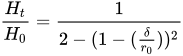
Considering steadylaminar fully developed blood flow in a small tube with radius of , whole blood separates into a cell-free plasma layer along the tube wall and enriched central core. As a result, the tube hematocrit is smaller than the out flow hematocrit ファールス効果の単純な数学的処理は、Sutera ら (1970) によって示されました。[ 2 ] これは最も初期の分析のようです。
どこ:
また、チューブヘマトクリットを表すために、Pries ら (1990) [ 3 ]によって次の式が開発されました。退院時のヘマトクリット値の関数として、、およびチューブの直径。
どこ: