
Loading article…
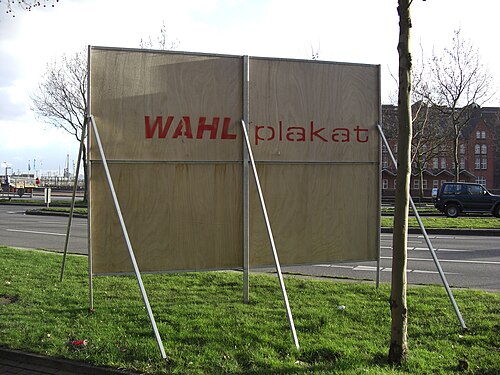

選挙ポスターは、政党が選挙運動中に、特に選挙日に関して、自己宣伝や情報発信のために使用する媒体です。選挙ポスターには通常、各政党の代表者1名または複数名の写真、政党のロゴ、そして簡潔なスローガンが掲載されます。選挙ポスターには、有権者向けの追加情報源(選挙イベント、政党のウェブサイトなど)へのリンクが含まれていることもよくあります。ポスターは大きく分けて、大型ポスターと小型ポスターに分類できます。

大型ポスターは、国または州の政党協会によって制作されます。[ 3 ]選挙運動中は、移動式の大型看板が使用され、これは選挙運動期間中のみ設置されます。鋼管構造が、2.90メートル×3.70メートルの耐候性合板パネルを支えており、これは「ウェッセルマン」(壁掛けポスター)とも呼ばれます。[ 4 ]
選挙のおよそ6週間前から、スクリーンは主に主要道路や大きな広場に設置される予定です。[ 5 ]フォーマットによっては、地方議会の許可が必要になる場合があります。[ 6 ]例えば、2025年のドイツ連邦選挙では、レーゲンスブルク市議会は選挙ポスターの掲示期限を3か月と定めました。[ 7 ]
ポスターは通常政党から提供され、選挙運動中に3~4回交換されるのが一般的です。選挙後、約28,000台ある移動式看板は保管されます。選挙運動以外では、商業的にも使用されます。[ 8 ]

Small-format posters are often produced by local, district, or state associations to address local issues and introduce direct candidates. National motifs are also often covered with local slogans, event announcements, and the like.[9] Frame posters are also frequently used. These are posters printed with party logos but without any advertising messages. These empty spaces are then individually filled with local slogans or invitations to campaign events using stickers.[10]


In Germany, “disruptors” are additional stickers (usually highlighted in color) attached to the actual posters, which are often attached diagonally in the corners of the poster. These stickers visually disrupt the overall impression and draw attention to an additional message. For example, they can be used to change the message of the poster shortly before the election. They also offer the opportunity to react to changes at short notice. Typical statements from disruptors are “Go vote!” or “Both votes for party XY.” After the election, a disruptor sticker is often attached saying “Thank you for your trust,” with which the party thanks its voters for their support.

Traditionally, campaign posters are made of paper, usually in A1 or A2 format, glued to hardboard and attached to poles, or in A0 or A1 format, glued to poster stands.[11] These poster stands are usually boards with two slatted feet or triangular stands composed of three such elements, and are placed around lampposts or other poles.
Since the mid-1990s, polypropylene hollow-wall posters have also been increasingly used. These consist of weatherproof multi-wall sheets (hollow-wall sheets) that can be printed directly, eliminating the need to glue paper posters to the substrate. The printed sheets can then be attached to poles, for example, with cable ties.
Klaus Staeck is considered one of the most distinguished poster artists in Germany.[12]
選挙ポスターは、第三者によって繰り返し破損または撤去されています。[ 13 ]多くの場合、描かれた人物の画像を歪めたり、政党のスローガンを変更したりする落書きが見つかります。いわゆる「選挙ポスターの破壊行為」は、ますます広まっている現象です。法律的には、これは他人の財産の損害または窃盗に分類され、警察によって起訴される可能性があります。
公共の場所にポスターを掲示するには、特別な使用許可が必要です。[ 14 ]許可手続きは、責任当局がポスターの場所、期間、範囲を把握し、予見可能な混乱を防止または合理的な範囲内に抑え、道路利用者の異なる、時には相反する使用意図を調整できるようにすることを目的としています。
民主主義国家と政党にとって選挙が重要であることから、政党による選挙ポスター掲示の許可に関する当局の裁量は厳しく制限され、原則として政党は許可を得る権利を有する。選挙における視覚的な広告は「今日、政党の選挙運動手段の一つ」であり、「今日の民主主義における選挙準備の重要な要素となっている」。もう一つの側面は、憲法で求められている政党への機会均等である。特定の政党に対する選択的な承認は認められていない。
一部の自治体では、自立式のポスター掲示を禁止し、その代わりに政党にポスター掲示場所を提供するようになった(図参照)。これらのポスターは、地域の景観を損なわないよう、選挙運動期間外には自治体によって撤去される。
ドイツでは、どの政党の選挙運動ポスターに肖像写真が掲載されているかにかかわらず、それらの写真の配布は、ドイツの著作権法および現行の判例(2021年時点)に基づくパノラマの自由の対象とはならない。なぜなら、それらは永続的なものではないからである。したがって、著作者および写真家の同意なしに配布・公開したり、画像を一般に公開したりすることは許されない。
2024年の英国総選挙では、誤情報を拡散するために作られた偽の選挙ポスターが報告された。[ 15 ] [ 16 ]
{{cite journal}}:ジャーナルを引用するには|journal=(ヘルプ)