
Loading article…
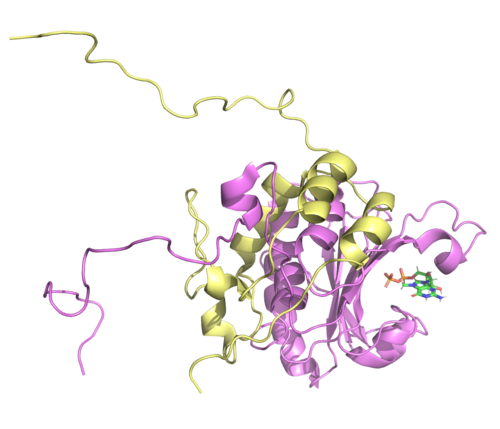
Eukaryotic initiation factor 4F (eIF4F) is a heterotrimeric protein complex that binds the 5' cap of messenger RNAs (mRNAs) to promote eukaryotic translation initiation. The eIF4F complex is composed of three non-identical subunits: the DEAD-boxRNA helicaseeIF4A, the cap-binding protein eIF4E, and the large "scaffold" protein eIF4G.[2][3] The mammalian eIF4F complex was first described in 1983, and has been a major area of study into the molecular mechanisms of cap-dependent translation initiation ever since.[3]
eIF4F is important for recruiting the small ribosomal subunit (40S) to the 5' cap of mRNAs during cap-dependent translation initiation. Components of the complex are also involved in cap-independent translation initiation; for instance, certain viral proteases cleave eIF4G to remove the eIF4E-binding region, thus inhibiting cap-dependent translation.[3]
Structures of eIF4F components have been solved individually and as partial complexes by a variety of methods, but no complete experimental structure of eIF4F is available as of 2015.[4]
In 2020, a cryo-electron microscopy structure of a human 48S translation preinitiation complex resolved eIF4A and 4G clearly, with a blurry blob that matches the previously known shape of 4E; this is among the first experimental structures of the complete complex.[5] In 2024, a cryo-electron microscopy structure of the human 48S PIC in the "scanning" state resolved eIF4A and 4G to a resolution of 5.9 Å but did not see eIF4E, suggesting that unlike the two other parts of eIF4F, eIF4E does not stay attached to the ribosome during scanning.[6]
哺乳類では、eIF4E・G・A三量体複合体は細胞から直接精製できるが、酵母細胞からはeIF4E・Gの2つのサブユニットしか精製できない。これは、酵母におけるeIF4AとeIF4Gの相互作用がそれほど安定していないことを示唆している。[ 3 ] eIF4Eはm7G 5 'キャップとeIF4G足場に結合し、mRNAの5'末端を他の開始因子とmRNAのハブに連結する。eIF4G・Aの相互作用は、 eIF4AのRNAヘリカーゼ活性を介して、43Sプレ開始複合体(43S PIC)のための1本鎖RNAランディングパッドの形成を誘導すると考えられている。[ 3 ]
eIF4Fタンパク質は様々な結合パートナーと相互作用し、ヒトゲノムにはeIF4A、eIF4E、eIF4Gの複数の遺伝子アイソフォームが存在する。哺乳類では、eIF4FはeIF4Gを介してeIF3によって40Sリボソームサブユニットに架橋されるが、出芽酵母にはこの結合がない。[ 3 ] eIF4GとPABPの相互作用はmRNA粒子の環状化を媒介し、翻訳を刺激すると考えられる「閉ループ」を形成すると考えられている。[ 7 ]
ヒトタンパク質の概算分子量。
注目すべき点として、この複合体は異なるアイソフォームによって様々な組み合わせが可能となる。
eIF4F三量体を構成する主要タンパク質に加えて、eIF4F複合体は、eIF4BやeIF4Hなどのタンパク質と機能的に相互作用し、これらのタンパク質はどちらも4Aに結合してそのヘリカーゼ活性を刺激することができる。[ 11 ] eIF4Gの異常に短いアイソフォームであるeIF4G2またはDAP5(PABPおよびeIF4Eに結合する部分を持たない)も、非標準的な翻訳機能を果たすようである。[ 11 ]
ほとんどの研究対象となった真核細胞では、4A/E/Gサブユニット間の化学量論比は1:1:1とは程遠く、Aサブユニットは他の2つに比べて10倍以上過剰に存在することが多い。これは、eIF4Fに結合しているものと自由に交換できる「遊離」eIF4Aのプールが存在することを示唆している。[ 11 ]
PDCD4の各分子はeIF4Aの2分子と結合できるが、生理的な複合体は1:1である。そうすることでPDCD4の形成が阻害され、翻訳が抑制される。[ 11 ]
eIF4FのeIF4Eサブユニットは、eIF4E結合タンパク質(4E-BP)を介したmTORシグナル伝達の重要な標的である。[ 3 ] mTORによる4E-BPのリン酸化は、eIF4Eへの結合を阻害し、eIF4EがeIF4Gに結合して翻訳開始に関与できるようにする。[ 3 ]