
Loading article…
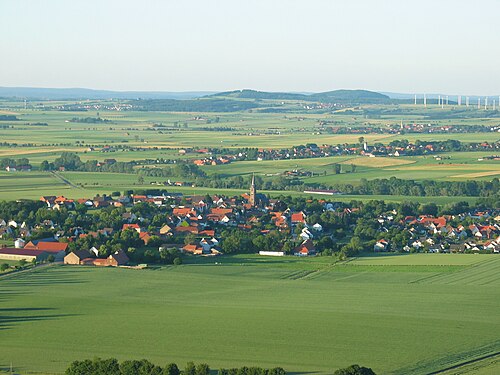
A börde (German pronunciation:[ˈbœʁdə]; plural: börden[ˈbœʁdn̩]) is a region of highly fertile lowland in North Germany, a "fertile plain".[1] These landscapes often cover great areas and are particularly important for arable farming on account of their rich soils.
These regions coincide closely with areas of flat, fertile loess soil and few trees. Börden are found in Germany, especially in the North German Old Drift region on the northern edges of Central Uplands. The resulting black earth soils are some of the best soils in Germany.
These landscapes are restricted to, or concentrated on, those regions where the Eastphalian and Westphalian dialects are spoken. There are two opposing explanations for the name. According to one, the term is connected with the Old High German word giburida ("judicial district") or the plattdeutsch word bören ("to bear"). The börde in this context is seen as a district in which the inhabitants had to "bear" public charges, i.e. it was effectively a taxation district.[2] This may thus be a dialect variation of de:Bürde ("burden", "heavy load").
Because of the fertility of the börden another connexion has been made to the word bören, whose primary meaning was "yield" or "output", thus a börde would be a "land that produced a rich yield". Semasiological comparisons are made in this regard to the word tragen ("to carry", "to bear"): the related words Ertrag ("yield") and Getreide ("grain") stem from the Middle High Germangetregede ("that which is borne"). In the heraldic motto of the House of Alsleben is the term Vorborde, which is translated today as "for the ancestral land".
黄土帯は北ドイツ山地からドイツ中央高地の境界まで広がり、主に東風によって堆積した黄土から構成されています。場所によっては、黄土は氷礫粘土の上に堆積しており(ヴェーザー川、ライネ川、オーカー川沿い)、また別の場所では中生代および第三紀の堆積岩の上に堆積しています(ヘルヴェーク帯とハルツ山地の前縁部)。黄土層は最大10 メートルの厚さがあり、地形の起伏を緩和する傾向があります。(亜)海洋性気候地域では、黄土は大部分が脱灰され、ローム化しています。黄土帯の北端は、土壌と植生の境界であるだけでなく、居住地帯でもあり、 ミンデン、ハノーバー、マクデブルクなどの都市が黄土帯の境界に位置しています。