Loading article…
アールフォルス理論は、ラース・アールフォルスがネヴァンリンナ理論の幾何学的対応物として考案した数学理論である。アールフォルスはこの理論により、1936年に最初のフィールズ賞2つのうちの1つを受賞した。
これは、被覆写像の基本的な性質を、ある明確な意味で「ほぼ被覆」である写像に一般化したものと考えることができる。これは、共形リーマン計量を備えた境界付きリーマン面に適用できる。
境界付きリーマン面X は、コンパクトリーマン面上の領域で、その境界∂ X が有限個の互いに素なジョルダン曲線から構成される領域として定義できます。ほとんどの応用では、これらの曲線は区分的に解析的ですが、理論を機能させるために必要な、これらの曲線に関する明示的な最小正則性条件があります。これは、アールフォルス正則性と呼ばれます。共形リーマン計量は、共形局所座標zでds = ρ ( z ) | dz |と表される長さ要素dsによって定義されます。ここで、 ρは孤立した零点を持つ滑らかな正値関数です。零点がない場合、計量は滑らかであると呼ばれます。長さ要素は、次の式によって可測曲線の長さと領域の面積を定義します。
すると、2点間の距離は、これらの点を結ぶ曲線の長さの最小値として定義される。
XとYを境界付きリーマン面とし、Yには滑らかな(境界を含む)共形計量σ ( z ) dzが備わっているとする。fをXからYへの正則写像とする。このとき、 X上にはプルバック計量が存在し、それは次のように定義される。
Xにこの尺度が適用される場合、 fは局所等長写像となります。つまり、曲線の長さはその像の長さと等しくなります。XとY上のすべての長さと面積は、これら2つの尺度に基づいて測定されます。
fがXの境界をYの境界に写像する場合、fは分岐被覆である。特に、
ここで、 Xの境界の一部がYの内部にマッピングされると仮定します。この部分を相対境界と呼びます。この相対境界の長さをLとします。
平均被覆数は次の式で定義されます。
この数値は被覆の次数を一般化したものである。同様に、Y内の任意の正則曲線γおよび任意の正則領域Dに対して 、平均被覆数が次のように定義される。
第一主定理によれば、すべての正則領域とすべての正則曲線に対して、
ここで、Lは相対境界の長さであり、kはY、σ、D、γのみに依存する定数であり 、fとXには依存しません。L = 0 の場合、これらの不等式は被覆の性質 a) の弱い類似物になります。
ρをオイラー標数の負の値とする(したがって、m個の穴を持つ球の場合、ρ = 2m − 2となる)。すると
これは、 ρ ( Y ) > 0 の場合、例えばY が3 つ(またはそれ以上)の穴を持つ球体である場合にのみ意味を持ちます。この場合、結果は被覆の性質 b) の一般化と考えることができます。
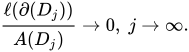
ここで、Zが開リーマン面、例えば複素平面や単位円盤であると仮定し、Z に共形計量dsが備わっているとする。Z に含まれる境界付き曲面D jとその閉包の増加列が存在し、それらの和集合がZに含まれ、かつ、
Ahlfors proved that the complex plane with arbitrary conformal metric is regularly exhaustible. This fact, together with the two main theorems implies Picard's theorem, and the Second main theorem of Nevanlinna theory. Many other important generalizations of Picard's theorem can be obtained from Ahlfors theory.
One especially striking result (conjectured earlier by André Bloch) is the Five Island theorem.
Let D1,...,D5 be five Jordan regions on the Riemann sphere with disjoint closures. Then there exists a constant c, depending only on these regions, and having the following property:
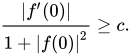
Let f be a meromorphic function in the unit disc such that the spherical derivative satisfies
Then there is a simply connected region G contained with its closure in the unit disc, such that f maps G onto one of the regions Dj homeomorphically.
This does not hold with four regions. Take, for example f(z) = ℘(Kz), where K > 0 is arbitrarily large, and ℘ is the Weierstrass elliptic function satisfying the differential equation
All preimages of the four points e1,e2,e3,∞ are multiple, so if we take four discs with disjoint closures around these points, there will be no region which is mapped on any of these discs homeomorphically.
Besides Ahlfors' original journal paper,[1] the theory is explained in books.[2][3][4] Simplified proofs of the Second Main Theorem can be found in the papers of Toki[5] and de Thelin.[6]
A simple proof of the Five Island Theorem, not relying on Ahlfors' theory, was developed by Bergweiler.[7]