公理 以下に、略語を定義します。
1 ∣ b := ∃ n ( 1 ⋅ n = b ) 1つ ( e ) := ∀ n ( n ⋅ e = n ) プライム ( p ) := ¬ 1つ ( p ) ∧ ∀ 1 ( 1 ∣ p → ( 1つ ( 1 ) ∨ 1 = p ) ) プライムパワー ( p 、 P ) := プライム ( p ) ∧ p ∣ P ∧ ∀ q ( プライム ( q ) ∧ ¬ ( q = p ) → ¬ ( q ∣ P ) ) InvAdicAbs ( p 、 n 、 P ) := プライムパワー ( p 、 P ) ∧ P ∣ n ∧ ∀ Q ( ( プライムパワー ( p 、 Q ) ∧ Q ∣ n ) → Q ∣ P ) AdicAbsDiff n ( p 、 1 、 b ) := プライム ( p ) ∧ p ∣ 1 b ∧ ∃ P ∃ Q ( InvAdicAbs ( p 、 1 、 P ) ∧ InvAdicAbs ( p 、 b 、 Q ) ∧ Q = p n P ) {\displaystyle {\begin{aligned}a\mid b&:=\exists n\;(a\cdot n=b)\\\operatorname {One} (e)&:=\forall n\;(n\cdot e=n)\\\operatorname {Prime} (p)&:=\lnot \operatorname {One} (p)\land \forall a\;(a\mid p\to (\operatorname {One} (a)\lor a=p))\\\operatorname {PrimePower} (p,P)&:=\operatorname {Prime} (p)\land p\mid P\land \forall q\;(\operatorname {Prime} (q)\land \lnot (q=p)\to \lnot (q\mid P))\\\operatorname {InvAdicAbs} (p,n,P)&:=\operatorname {PrimePower} (p,P)\land P\mid n\land \forall Q\;((\operatorname {PrimePower} (p,Q)\land Q\mid n)\to Q\mid P)\\\operatorname {AdicAbsDiff} _{n}(p,a,b)&:=\operatorname {Prime} (p)\land p\mid ab\land \exists P\,\exists Q\;(\operatorname {InvAdicAbs} (p,a,P)\land \operatorname {InvAdicAbs} (p,b,Q)\land Q=p^{n}P)\end{aligned}}}
InvAdicAbs ( p 、 n 、 P ) {\displaystyle \operatorname {InvAdicAbs} (p,n,P)} のは、 P {\displaystyle P} p {\displaystyle p} n {\displaystyle n} AdicAbsDiff n ( p 、 1 、 b ) {\displaystyle \operatorname {AdicAbsDiff} _{n}(p,a,b)} のは、 p進評価 がb {\displaystyle b} [ 3 ] 1 {\displaystyle a} n {\displaystyle n} v p ( b ) = v p ( 1 ) + n {\displaystyle v_{p}(b)=v_{p}(a)+n} スコレム算術の公理は次のとおりです。
∀ 1 ∀ b ( 1 b = b 1 ) {\displaystyle \forall a\,\forall b\;(ab=ba)} ∀ 1 ∀ b ∀ c ( ( 1 b ) c = 1 ( b c ) ) {\displaystyle \forall a\,\forall b\,\forall c\;((ab)c=a(bc))} ∃ e 1つ ( e ) {\displaystyle \exists e\;\operatorname {One} (e)} ∀ 1 ∀ b ( 1つ ( 1 b ) → 1つ ( 1 ) ∧ 1つ ( b ) ) {\displaystyle \forall a\,\forall b\;(\operatorname {One} (ab)\to \operatorname {One} (a)\land \operatorname {One} (b))} ∀ 1 ∀ b ∀ c ( 1 c = b c → 1 = b ) {\displaystyle \forall a\,\forall b\,\forall c\;(ac=bc\to a=b)} ∀ 1 ∀ b ( 1 n = b n → 1 = b ) 各整数について n > 0 {\displaystyle \forall a\,\forall b\;(a^{n}=b^{n}\to a=b){\text{ for each integer }}n>0} ∀ x ∃ 1 ∃ r ( x = 1 r n ∧ ∀ b ∀ s ( x = b s n → 1 ∣ b ) ) 各整数について n > 0 {\displaystyle \forall x\,\exists a\,\exists r\;(x=ar^{n}\land \forall b\,\forall s\;(x=bs^{n}\to a\mid b)){\text{ for each integer }}n>0} ∀ 1 ∃ p ( プライム ( p ) ∧ ¬ ( p ∣ 1 ) ) {\displaystyle \forall a\,\exists p\;(\operatorname {Prime} (p)\land \lnot (p\mid a))} [ 5 ] ∀ p ∀ P ∀ Q ( ( プライムパワー ( p 、 P ) ∧ プライムパワー ( p 、 Q ) ) → ( P ∣ Q ∨ Q ∣ P ) ) {\displaystyle \forall p\,\forall P\,\forall Q\;((\operatorname {PrimePower} (p,P)\land \operatorname {PrimePower} (p,Q))\to (P\mid Q\lor Q\mid P))} ∀ p ∀ n ( プライム ( p ) → ∃ P InvAdicAbs ( p 、 n 、 P ) ) {\displaystyle \forall p\,\forall n\;(\operatorname {Prime} (p)\to \exists P\;\operatorname {InvAdicAbs} (p,n,P))} ∀ n ∀ m ( n = m ↔ ∀ p ( プライム ( p ) → ∃ P ( InvAdicAbs ( p 、 n 、 P ) ∧ InvAdicAbs ( p 、 m 、 P ) ) ) ) {\displaystyle \forall n\,\forall m\;\left(n=m\leftrightarrow \forall p\;(\operatorname {Prime} (p)\to \exists P\;(\operatorname {InvAdicAbs} (p,n,P)\land \operatorname {InvAdicAbs} (p,m,P)))\right)} [ 6 ] ∀ p ∀ n ∀ m ( プライム ( p ) → ∃ P ∃ Q ( InvAdicAbs ( p 、 n 、 P ) ∧ InvAdicAbs ( p 、 m 、 Q ) ∧ InvAdicAbs ( p 、 n m 、 P Q ) ) ) {\displaystyle \forall p\,\forall n\,\forall m\;\left(\operatorname {Prime} (p)\to \exists P\,\exists Q\;(\operatorname {InvAdicAbs} (p,n,P)\land \operatorname {InvAdicAbs} (p,m,Q)\land \operatorname {InvAdicAbs} (p,nm,PQ))\right)} [ 7 ] ∀ 1 ∀ b ( ∀ p ( プライム ( p ) → ∃ P ∃ Q ( InvAdicAbs ( p 、 1 、 P ) ∧ InvAdicAbs ( p 、 b 、 Q ) ∧ P ∣ Q ) ) → 1 ∣ b ) {\displaystyle \forall a\,\forall b\;\left(\forall p\;(\operatorname {Prime} (p)\to \exists P\,\exists Q\;(\operatorname {InvAdicAbs} (p,a,P)\land \operatorname {InvAdicAbs} (p,b,Q)\land P\mid Q))\to a\mid b\right)} [ 8 ] ∀ 1 ∀ b ∃ c ∀ p ( プライム ( p ) → ( ( p ∣ 1 → ∃ P ( InvAdicAbs ( p 、 b 、 P ) ∧ InvAdicAbs ( p 、 c 、 P ) ) ) ∧ ( p ∣ b → p ∣ 1 ) ) ) {\displaystyle \forall a\,\forall b\,\exists c\,\forall p\;\left(\operatorname {Prime} (p)\to \left((p\mid a\to \exists P\;(\operatorname {InvAdicAbs} (p,b,P)\land \operatorname {InvAdicAbs} (p,c,P)))\land (p\mid b\to p\mid a)\right)\right)} [ 9 ] ∀ 1 ∃ b ∀ p ( プライム ( p ) → ( ∃ P ( InvAdicAbs ( p 、 1 、 P ) ∧ InvAdicAbs ( p 、 b 、 p P ) ) ) ∧ ( p ∣ b → p ∣ 1 ) ) {\displaystyle \forall a\,\exists b\,\forall p\;\left(\operatorname {Prime} (p)\to \left(\exists P\;(\operatorname {InvAdicAbs} (p,a,P)\land \operatorname {InvAdicAbs} (p,b,pP))\right)\land (p\mid b\to p\mid a)\right)} [ 10 ] ∀ 1 ∀ b ∃ c ∀ p ( プライム ( p ) → ( ( AdicAbsDiff n ( p 、 1 、 b ) → InvAdicAbs ( p 、 c 、 p ) ) ∧ ( p ∣ c → AdicAbsDiff n ( p 、 1 、 b ) ) ) ) {\displaystyle \forall a\,\forall b\,\exists c\,\forall p\;\left(\operatorname {Prime} (p)\to \left((\operatorname {AdicAbsDiff} _{n}(p,a,b)\to \operatorname {InvAdicAbs} (p,c,p))\land (p\mid c\to \operatorname {AdicAbsDiff} _{n}(p,a,b))\right)\right)} [ 11 ]
決定可能性の概念 スコレム算術の式の真偽値は、 素因数分解を構成する非負整数の列の真偽値に帰着し、乗算は列の要素ごとの加算となる。決定可能性は、量化子消去 を用いて示すことができるフェファーマン・ヴォートの定理から導かれる。別の言い方をすれば、正整数の1階理論は、多重集合和演算を持つ非負整数の有限 多重集合 の1階理論と同型であり、その決定可能性は要素理論の決定可能性に帰着する。
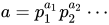
さらに詳しく言うと、算術の基本定理 によれば、正の整数は1 > 1 {\displaystyle a>1}
1 = p 1 1 1 p 2 1 2 ⋯ {\displaystyle a=p_{1}^{a_{1}}p_{2}^{a_{2}}\cdots } 素数の場合p k {\displaystyle p_{k}} 1 k {\displaystyle a_{k}} 1 1 、 1 2 、 … {\displaystyle a_{1},a_{2},\ldots } N * {\displaystyle N^{*}}
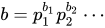
次に、別の正の数の分解を考えてみましょう。
b = p 1 b 1 p 2 b 2 ⋯ {\displaystyle b=p_{1}^{b_{1}}p_{2}^{b_{2}}\cdots } 乗算1 b {\displaystyle ab}
1 b = p 1 1 1 + b 1 p 2 1 2 + b 2 ⋯ {\displaystyle ab=p_{1}^{a_{1}+b_{1}}p_{2}^{a_{2}+b_{2}}\cdots } 対応するシーケンス上のポイントごとの加算を次のように定義します。
( 1 1 、 1 2 、 … ) + ¯ ( b 1 、 b 2 、 … ) = ( 1 1 + b 1 、 1 2 + b 2 、 … ) {\displaystyle (a_{1},a_{2},\ldots ){\bar {+}}(b_{1},b_{2},\ldots )=(a_{1}+b_{1},a_{2}+b_{2},\ldots )} したがって、乗法を持つ正の整数の構造と、( N 、 ⋅ ) {\displaystyle (N,\cdot )} ( N * 、 + ¯ ) {\displaystyle (N^{*},{\bar {+}})}
1 階述語論理の Feferman–Vaught 定理 によれば、数列とその数列上の各要素の加算に関する 1 階述語論理式の真理値は、アルゴリズム的に、加算を伴う数列の要素の理論における式の真理値に帰着し、この場合はPresburger 算術 となる。Presburger 算術は決定可能であるため、Skolem 算術も決定可能である。
決定可能な拡張 フェファーマン・ヴォートの定理を用いた上記の還元のおかげで、素因数の多重集合の理論を強化すれば、開式がより大きな関係の集合を定義する一階理論を得ることができます。例えば、次の関係を考えてみましょう。1 ~ b {\displaystyle a\sim b} 1 {\displaystyle a} b {\displaystyle b}
| { p ∣ p r 私 m e ( p ) ∧ ( p | 1 ) } | = | { p ∣ p r 私 m e ( p ) ∧ ( p | b ) } | {\displaystyle |\{p\mid \mathrm {prime} (p)\land (p|a)\}|\ =\ |\{p\mid \mathrm {prime} (p)\land (p|b)\}|} 例えば、2 10 ⋅ 3 100 ~ 5 8 ⋅ 19 9 {\displaystyle 2^{10}\cdot 3^{100}\sim 5^{8}\cdot 19^{9}}
関係を追加すると~ {\displaystyle \sim } フェファーマン・ヴォートの定理 で示されているように、集合上の等数性 演算子が存在する場合でも、インデックス集合の理論が決定可能であるためである。
決定不能な拡張 後継述語によるスコレム算術の拡張、s u c c ( n ) = n + 1 {\displaystyle succ(n)=n+1}
( c = 0 ∨ c = 1 + b ) ⇔ ( 1 c + 1 ) ( b c + 1 ) = c 2 ( 1 b + 1 ) + 1 {\displaystyle (c=0\lor c=a+b)\Leftrightarrow (ac+1)(bc+1)=c^{2}(ab+1)+1} そして関係を定義するc = 1 + b {\displaystyle c=a+b}
s u c c ( 1 c ) s u c c ( b c ) = s u c c ( c 2 s u c c ( 1 b ) ) {\displaystyle \mathrm {succ} (ac)\,\mathrm {succ} (bc)=\mathrm {succ} (c^{2}\mathrm {succ} (ab))} 乗算と加算の両方を表現できるため、結果として得られる理論は決定不能である。
自然数に対する順序付け述語(より小さい、< {\displaystyle <} s u c c {\displaystyle \mathrm {succ} }
s u c c ( 1 ) = b ⇔ 1 < b ∧ ∀ c 。 ( 1 < c ⇒ ( b = c ∨ b < c ) ) {\displaystyle \mathrm {succ} (a)=b\ \ \Leftrightarrow \ \ a<b\land \forall c.{\big (}a<c\Rightarrow (b=c\lor b<c){\big )}} そのため、拡張機能は< {\displaystyle <}
参考文献 ベス、アレクシス (2001)。「算術的定義可能性の調査」(PDF) 。クラッベでは、マルセル。ポイント、フランソワーズ。ミショー、クリスチャン(編)。モーリス・ボファへのトリビュート 。ブリュッセル: ベルギー数学協会。1 ~ 54ページ。 Bès, Alexis; Richard, Denis (1998). "Skolem算術の決定不能な拡張". Journal of Symbolic Logic 63 (2): 379–401 . CiteSeerX 10.1.1.2.1139 . doi : 10.2307/2586837 . JSTOR 2586837. S2CID 14566619 . パトリック・セギエルスキ (1981)。「自然の乗算に関する理論」(PDF) 。ベルリン、シャンタル。マクアルーン、ケネス。レセイル、ジャン=ピエール(編)。モデル理論と算術: Comptes Rendus d'une Action Thématique Programmée du CNRS sur la Théorie des Modeles et l'Arithmétique 。数学の講義ノート (フランス語)。 Vol. 890. ベルリン:シュプリンガー。ページ44–89 。土井 : 10.1007/BFb0095657。ISBN 978-3-540-11159-7 PDFファイルは、一般公開されているプレプリントへのリンクです。 Ferrante, Jeanne; Rackoff, Charles W. (1979).論理理論の計算複雑性 . ベルリン、ハイデルベルク、ニューヨーク: Springer-Verlag. doi : 10.1007/BFb0062837 . ISBN 3-540-09501-2 。 Grädel, Erich (1989年6月) 「ドミノと論理理論のサブクラスの複雑性」純粋応用論理年報 43 ( 1): 1–30 . doi : 10.1016/0168-0072(89)90023-7 .