
Loading article…
| Rhinolophus hilli | |
|---|---|
Scientific classification | |
| Kingdom: | Animalia |
| Phylum: | Chordata |
| Class: | Mammalia |
| Infraclass: | Placentalia |
| Order: | Chiroptera |
| Family: | Rhinolophidae |
| Genus: | Rhinolophus |
| Species: | R. hilli |
| Binomial name | |
| Rhinolophus hilli Aellen, 1973 | |
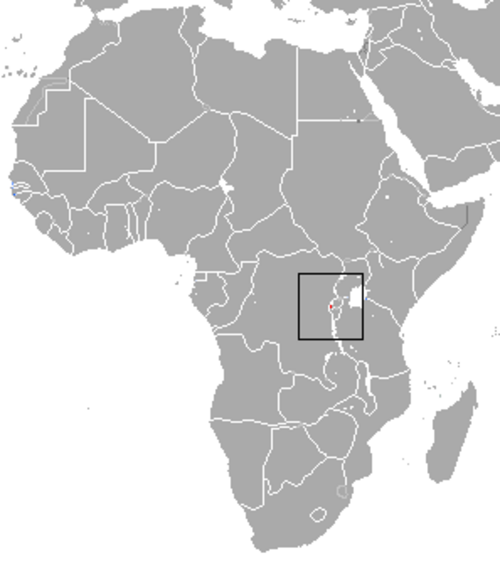 | |
| Hill's horseshoe bat range | |
Rhinolophus hilli, Hill's horseshoe bat, is a species of bat in the family Rhinolophidae. It is endemic to Rwanda. Its natural habitats are subtropical or tropical moist montane forests, caves, and subterranean habitats (other than caves). In 2013, Bat Conservation International listed this species as one of the 35 species of its worldwide priority list of conservation.[2] It is threatened by habitat loss.
As the genus Rhinolophus is quite speciose, it is split into groups. Maclaud's horseshoe bat is the identifier of one of these groups, called the maclaudi group, which currently consists of six species, three of which were not described before 2003.[3] Members of this group have large ears, and a diminished connection between the sella and lancet.[3]
R. maclaudi and R. ziama are considered the two West African taxa, while the other four species are found further east around the Albertine Rift.[3] The West African species are larger in size than the East African species, with R. maclaudi as the largest bat of the species group.[4] As these species are very similar morphologically, it was previously thought that R. hilli and R. ruwenzorii were the same taxon, and that the taxon was a subspecies of the Maclaud's horseshoe bat.[5]
この種の最初の 2 個体は 1964 年と 1981 年に発見されました。 2 個体の場所はわずか8 km (5 mi )離れていました。 この種が日中どこにねぐらをとるかは不明です。[ 4 ] IUCNは、生息範囲が100 km 2 (39 mi 2 )未満と狭いこと、生息地の破壊、亜集団の数が少ないこと、ブッシュミートのための乱獲のため、この種を絶滅危惧種に指定しています。[ 1 ] 2019 年に、ルワンダのニュングウェ国立公園で 1 個体が発見されたとき、1981 年以来初めて、ヒルのキクガシラコウモリが再び記録されました。その鳴き声が録音され、その後、この地域の他の 8 つの場所で音響的にこの種が特定されました。[ 6 ]
