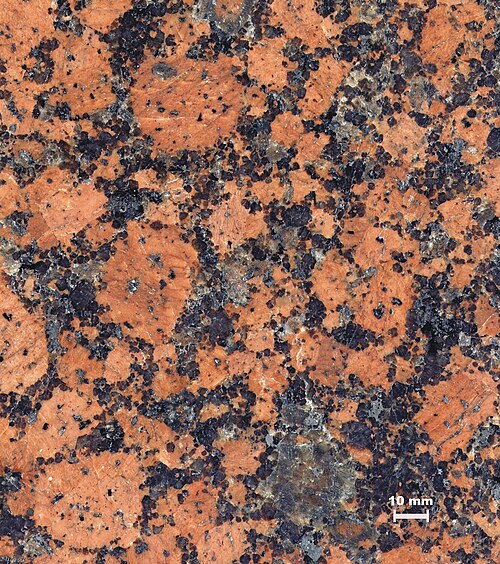
Rapakivi granite is an igneousintrusive rock and variant of alkali feldspar granite. It is characterized by large, rounded crystals of orthoclase each with a rim of oligoclase (a variety of plagioclase). Common mineral components include hornblende and biotite. The name has come to be used most frequently as a textural term where it implies plagioclase rims around orthoclase in plutonic (intrusive) rocks. Rapakivi is a Finnish compound of "rapa" (meaning "mud" or "sand", while rapautua means "to erode") and "kivi" (meaning "rock"),[1] because the different heat expansion coefficients of the component minerals make exposed rapakivi crumble easily into sand.[2]
Rapakivi was first described by Finnish petrologist Jakob Sederholm in 1891.[3] Since then, southern Finland's rapakivi granite intrusions have been the type locality of this variety of granite.[4] In the same publication, Sederholm introduced the term rapakivi texture to describe the occurrence of two generations of quartz and alkali feldspar crystals in rapakivi granites, the older alkali feldspar crystals being ovoid-shaped.[5]
Finnish Rapakivi granites occur in the Åland, Laitila, Vehmaa, and Wiborg batholiths. The age of the rapakivi granites of the Wiborg batholith ranges between 1646 and 1627 Ma; these granites were intruded into older metamorphic rocks. The Wiborg rapaviki granites consist of 80% wiborgite, and smaller amounts of pyterlite, porphyritic rapakivi granite, even-grained rapakivi granite, and aplitic rapakivi granite.[8]
Rapakivi granites have formation ages from Archean to recent and are usually attributed to anorogenictectonic settings. They have formed in shallow (a few km deep) sills of up to 10km thickness.
Rapakivi is enriched in K, Rb, Pb, Nb, Ta, Zr, Hf, Zn, Ga, Sn, Th, U, F and rare earth elements, and poor in Ca, Mg, Al, P and Sr. Fe/Mg, K/Na and Rb/Sr ratios are high. SiO2 content is 70.5%, which makes rapakivi an acidic granite.[11]
Rapakivi is high in fluoride, ranging 0.04–1.53%, compared to other similar rocks at around 0.35%. Consequently, groundwater in rapakivi zones is high in fluoride (1–2mg/L), making the water naturally fluoridated. Some water companies actually have to remove fluoride from the water.[11][12]
The uranium content of rapakivi is fairly high, up to 24 ppm. Thus, in rapakivi zones, the hazard from radon, a decay product of uranium, is elevated. Some indoor spaces surpass the 400 Bq/m3 safety limit.[13][14]
Rapakivi type wiborgite
Petrography
Rapakivi type pyterlite
Vorma (1976) states that rapakivi granites can be defined as:[15]
Most (but not all) orthoclase crystals have plagioclase rims (wiborgite or viborgite type, named after the city of Vyborg)[16]:157
Orthoclase and quartz have crystallized in two phases, early quartz is in tear-drop shaped crystals (pyterlite type, named after the location of Pyterlahti).[16]:134[17]
A more recent definition by Haapala & Rämö is:[18] Rapakivi granites are A-type granites that, at least in the larger batholiths, have rapakivi texture.
Use as a building material
Rapakivi is the material used in Åland's mediaeval stone churches.[19] In 1770, a rapakivi granite monolith boulder, the "Thunder Stone", was used as the pedestal for the Bronze Horsemanstatue in Saint Petersburg, Russia. Weighing 1,250 tonnes, this boulder is claimed to be the largest stone ever moved by humans.[20] Modern building uses of rapakivi granites are in polished slabs used for covering buildings, floors, counter tops or pavements. As a building material, rapakivi granite of the wiborgite type is also known as "Baltic Brown".[21][22]
↑Some geologists of the first half of the 20th century regarded the rapakivi granites as "granitized" Jotnian sediments, an idea which is now discredited.[10]
↑"3000 miljoonaa vuotta, Suomen KallioperäArchived 2011-07-20 at the Wayback Machine" Finnish geological society, 1998, chapter 9, ISBN952-90-9260-1 . Language: Finnish.
↑Haapala, I.; Rämö, O.T. (1992). "Tectonic setting and origin of the Proterozoic rapakivi granites of southeastern Fennoscandia". Transactions of the Royal Society of Edinburgh: Earth Sciences. 83 (1–2): 165–171. doi:10.1017/s0263593300007859. S2CID129835203.
↑Teixeira, Wilson; D'Agrella-Filho, Manoel S.; Hamilton, Mike A.; Ernst, Richard E.; Girardi, Vicente A.V.; Mazzucchelli, Maurizio; Bettencourt, Jorge S. (2013). "U–Pb (ID-TIMS) baddeleyite ages and paleomagnetism of 1.79 and 1.59 Ga tholeiitic dyke swarms, and position of the Rio de la Plata Craton within the Columbia supercontinent". Lithos. 174: 157–174. Bibcode:2013Litho.174..157T. doi:10.1016/j.lithos.2012.09.006. hdl:11380/887090.
↑Bettencourt, J.S.; Tosdal, R.M.; Leite, W.B.; Payolla, B.L. (1999). "Mesoproterozoic rapakivi granites of the Rondoˆnia Tin Province, southwestern border of the Amazonian craton, Brazil — I. Reconnaissance U–Pb geochronology and regional implications". Precambrian Research. 95 (1–2): 41–67. Bibcode:1999PreR...95...41B. doi:10.1016/S0301-9268(98)00126-0.
↑Harma, Paavo; Selonen, Olavi (2018). "Natural stone production in the Wiborg rapakivi granite batholith in southeastern Finland". ResearchGate. The Finnish Natural Stone Association. Retrieved 4 March 2025.
↑Zhang, S-H., Liu, S-W., Zhao, Y., Yang, J-H. Song, B. and Liu, X-M. The 1.75–1.68 Ga anorthosite-mangerite-alkali granitoid-rapakivi granite suite from the northern North China Craton: Magmatism related to a Paleoproterozoic orogen. Precambrian Research, 155, 287–312.
12Rämö, T., Haapala, I. ja Laitakari, I. 1998. Rapakivigraniitit – peruskallio repeää ja sen juuret sulavat. In: Lehtinen, M., Nurmi, RA., Rämö, O.T. (Toim.), Suomen kallioperä – 3000 vuosimiljoonaa. Suomen geologinen seura. Gummerus kirjapaino, Jyväskylä. 257–283.
↑Lahermo, P.; Sandström, H.; ja Malisa, E. (1991). "The occurrence and geochemistry of fluorides in natural waters in Finland and East Africa with reference to their geomedical implications". Journal of Geochemical Exploration. 41 (1–2): 65–79. doi:10.1016/0375-6742(91)90075-6.
↑Valmari, T., Arvela, H., ja Reisbacka, H. 2012. Radon in Finnish apartment buildings. Radiation Protection Dosimetry, 152, 146–149.
↑Weltner, A., Mäkeläinen, I., ja Arvela, H. 2002. Radon mapping strategy in Finland. In: International Congress Series 1225, 63–69.
↑Vorma A., 1976. On the petrochemistry of rapakivi granites with special reference to the Laitila massif, southwestern Finland. Geological Survey of Finland, Bulletin 285, 98 pages.
12Le Maitre, R. W., ed. (2002). Igneous Rocks — A Classification and Glossary of Terms. Cambridge: Cambridge University Press. ISBN978-0-521-66215-4.
↑Walter Wahl: Die Gesteine des Wiborger Rapakiwigebietes. Fennia, Band 45/20, Helsingfors (Tilgmann) 1925, p. 24 https://www.kristallin.de/rapakiwis/Wahl_1925.pdf
↑Haapala, I.; Rämö, O.T. (1992). "Tectonic setting and origin of the Proterozoic rapakivi granites of southeastern Fennoscandia". Transactions of the Royal Society of Edinburgh: Earth Sciences. 83 (1–2): 165–171. doi:10.1017/s0263593300007859. S2CID129835203.
↑Adam, Jean-Pierre (1977). "À propos du trilithon de Baalbek: Le transport et la mise en oeuvre des mégalithes". Syria. 54 (1/2): 31–63. doi:10.3406/syria.1977.6623.
↑North Carolina Museum of Natural Sciences blog, Retrieved 2012-10-19.
↑"Baltic Brown". Finnish Natural Stones. KIVI, Finnish Natural Stone Industry Association. Retrieved 12 April 2024.
External links
Media related to Rapakivi granite at Wikimedia Commons
Categories:
Granite
Geology of Finland
Precambrian Europe
Mesoproterozoic
Hidden categories:
Articles with short description
Short description is different from Wikidata
Webarchive template wayback links
All articles with unsourced statements
Articles with unsourced statements from October 2025



 Media related to Rapakivi granite at Wikimedia Commons