
Loading article…
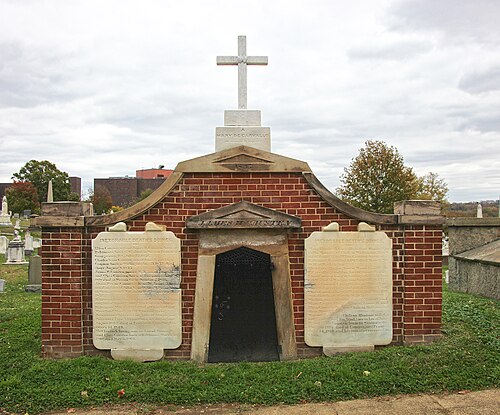
The Public Vault at the Congressional Cemetery in Washington, D.C. is an early classical revival structure built 1832–1834 with funds appropriated by the United States Congress to store the bodies of government officials and members of the public before burial. About 4,600 individuals were temporarily interred in the vault, including three U.S. presidents, First Lady Dolley Madison, and sixteen congressmen who died while serving in office.[2][3]
As a contributing structure to the cemetery, the vault was listed on the National Register of Historic Places on June 23, 1969, and a National Historic Landmark in 2011.[4]
Congress approved an expenditure of $1,000 on July 14, 1832, to build "a substantial brick or stone vault in the Washington Parish Burial Ground, for the temporary interment of members of Congress". Additional appropriations of $1,600 on March 2, 1833, and $194 on June 30, 1834, were approved to complete the vault. These two bills included the name "Public Vault" and allowed the use by members of the public. Use by the government was permitted without further payment, and members of the public were to be charged $5.00 per temporary use. The sexton of Christ Church was to be given $1.50 of this sum for his services, with the remainder given to the vestry of Christ Church, which owns the burial ground, "to be expended in the improvement of the grounds and in keeping the same in order".[5]

A classical marble facade with baroque scrolls decorates the partially subterranean vault. Double wrought iron doors have the words "PUBLIC VAULT" displayed through vent holes.[6] The vault is constructed of Aquia Creek sandstone, which was also used to construct many important early structures in Washington, including the White House, the Capitol, and the Latrobe cenotaphs in the cemetery.[7] The vault does not have any niches or shelves to hold coffins; the coffins were placed on the floor and stacked if necessary.[8]
一時埋葬されたのは、 ジョン・クインシー・アダムズ(1848年2月26日~3月6日)、ウィリアム・ヘンリー・ハリソン(1841年4月7日~6月26日)、ザカリー・テイラー(1850年7月13日~10月26日)の3人の米国大統領である。ハリソン大統領の遺体は、大統領在任期間の2倍以上にあたる約3か月間、納骨堂に安置されていた。[ 9 ] [ 10 ]
ドリー・マディソンは、モンペリエへの再埋葬のための資金が集められている間、1849年7月16日から1852年2月10日まで公共の納骨堂に埋葬された。これは納骨堂での埋葬期間としては最長である。[ 9 ]資金が集められるまでの6年間、彼女の遺体は公共の納骨堂のすぐ西にあるカウステン家の納骨堂に移された。[ 8 ] 1852年5月には、ファーストレディのルイザ・キャサリン・アダムズがカウステン家の納骨堂に一時的に加わったが、アダムズは公共の納骨堂に埋葬されたと報告されている。[ 11 ] [ 12 ] [ 13 ]
ジョン・C・カルフーン上院議員は、1850年4月2日に国会議事堂から正式な葬儀と盛大な行列が行われた後、公営納骨堂に埋葬された。彼は、腐敗を遅らせるフィスク金属製棺の初期型に納められた。4月22日、彼の遺体は納骨堂を出て、蒸気船でサウスカロライナ州チャールストンへ運ばれた。[ 14 ] 輸送と葬儀技術の発展により納骨堂の利用は増加したが、その利用は制限された。例えば、 1852年にヘンリー・クレイが亡くなった後、彼の遺体もフィスク金属製棺に納められ、公営納骨堂で待機することなく鉄道で故郷の州へ運ばれた。[ 14 ]
1844年2月29日、USSプリンストン号の爆発事故の後、国務長官エイベル・P・アップシャー、海軍長官トーマス・ウォーカー・ギルマー、ベバリー・ケノン准将、ジョン・タイラー大統領の将来の義父であるデイビッド・ガーディナーが一時的に地下納骨堂に埋葬された。[ 15 ]
Several grand public or state funeral processions ended in front of the Public Vault, starting at the White House or the Capitol and then moving down Pennsylvania Avenue and E Street SE to the cemetery. These included the funerals for Presidents Harrison, J. Q. Adams, and Taylor; Senator Calhoun; First Ladies Dolley Madison and Louisa Adams; the victims of the USS Princeton disaster; and several other congressmen.[16][17][18][19] Some of these processions were two miles long, led by military bands and troops for the funerals of military men, members of both houses of Congress and the administration, and pallbearers carefully chosen for political balance to symbolize unity and stability in government.[16]
John Quincy Adams rode in a carriage in the funeral procession for President Harrison. He wrote in his diary, "The corpse was deposited in the receiving vault - with some difficulty from the excessive crowd, but not the slightest disorder."[20]
South Carolina Congressman Preston Smith Brooks lay in the Public Vault in January 1857, within a year of brutally beating Senator Charles Sumner with a cane on the floor of the Senate, an attack that is viewed as an omen of the Civil War.[21]
Legend says that Lewis Powell spent a night in the vault while avoiding pursuit for his role in the assassination of President Lincoln.[10]
While the Public Vault was an important, if semi-official, national memorial during its first few decades, it was used less and less during the second half of the nineteenth century, and much of the twentieth century was unused.[22] During the twentieth century, it became unclear whether the U.S. Government or Christ Church owned the Public Vault and several dozen burial lots. In 1953, a Congressional report suggested that the government clear the record by selling the otherwise unnamed "receiving vault" and the burial lots to the church for $100.[23] As late as 2003, the vault was "empty and decaying." It has since been restored with funds provided by the federal government.[24] During a c. 2010 Prohibition-based fundraiser, it was used as a cocktail bar.[8]
 Media related to Public Vault (Congressional Cemetery) at Wikimedia Commons