
Loading article…
キロキティア(綴りはチョイロコイティアとも表記される。ギリシャ語: Χοιροκοιτία [ çiɾociˈti.a ]、意味は豚のゆりかご、χοίρος「豚、イノシシ」+ κοιτίς「起源の場所、ゆりかご」から)は、キプロス島にある新石器時代の考古遺跡である。 1998年以来、ユネスコの世界遺産に登録されている。[ 1 ]この遺跡は、東地中海で最も重要かつ保存状態の良い先史時代の遺跡の一つとして知られている。その重要性の多くは、共同体を保護するための周囲の要塞を備えた集団居住地という形で組織化された機能的な社会の証拠にある。この集落と島全体に点在する約20の同様の集落は、新石器時代の無土器時代を代表するものである。 [ 2 ]
この遺跡は、1934年に考古局長のポルフィリオス・ディカイオスによって発見され、 1934年から1946年の間に6回の発掘調査が行われた。[ 3 ]彼の最初の調査結果は、1934年に『ヘレニック研究ジャーナル』に掲載された。[ 4 ]ディカイオスは当初、この集落は紀元前4000年頃に設立されたと考えていた。しかし、放射性炭素年代測定により、紀元前7000年頃の設立であることが明らかになった。[ 5 ]その後、1970年代初頭にさらなる発掘調査が行われたが、1974年のトルコによるキプロス侵攻により中断された。[ 6 ]アラン・ルブランの指揮の下、フランスの調査団が1977年にこの遺跡の発掘調査を再開した。 [ 7 ]この遺跡は紀元前7千年紀から4千年紀まで居住されていた。[ 8 ] [ 9 ]
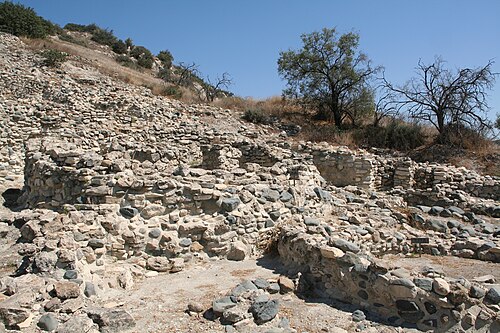
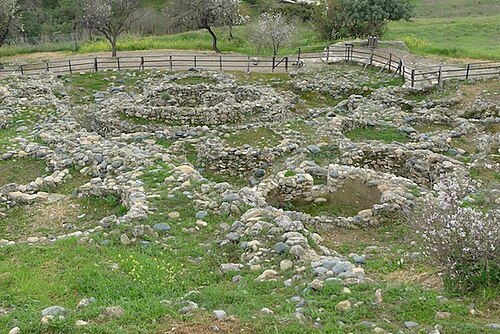
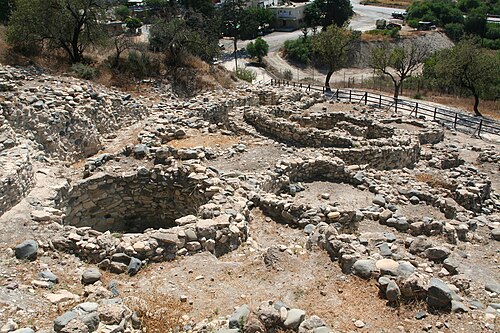
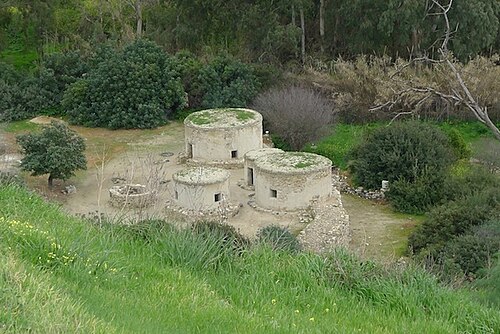
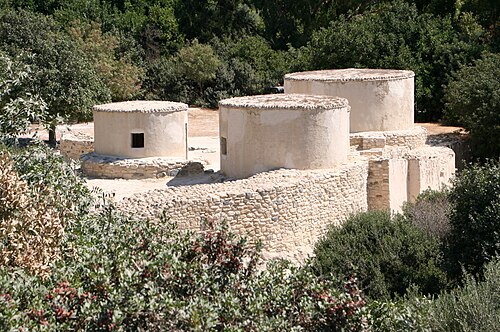
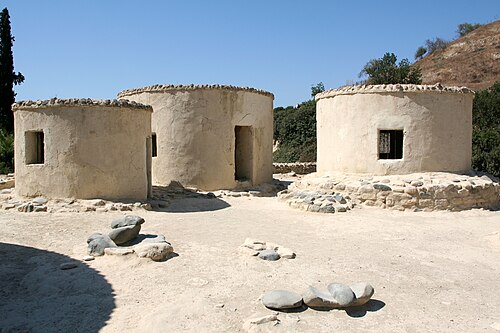
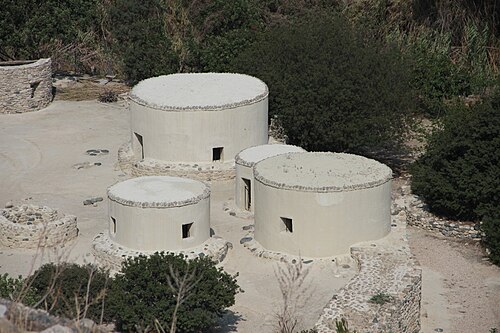
キロキティアの集落は、島の南海岸に向かってマロニ川の谷にある丘の斜面に位置し、海から約6 km (3.7マイル)の距離にあった。 [ 10 ]新石器時代の住民が行っていた生活様式には、小麦、大麦、レンズ豆、エンドウ豆、ソラマメ、レンゲなどの作物の栽培、オリーブ、亜麻、イチジク、ピスタチオ、プラム、ナシの採集、羊、ヤギ、豚の放牧、鹿の狩猟などがあった。[ 11 ] [ 12 ] [ 13 ]村は閉鎖的で、川を除いて外界から隔絶されており、厚さ2.5 m (8.2フィート) 、保存されている最高レベルで高さ3 m (9.8フィート)の頑丈な石壁があった。[ 14 ]村へは、おそらく壁のいくつかの入り口からアクセスできた。この壁の内側の建物は、直径2~9メートル(6.6~29.5フィート)の円形構造物が密集して建ち並び、トロスと呼ばれ、窓があった可能性がある。 [ 15 ]これらのトロスは、屋根のない「中庭」を囲むように密集して配置されており、学者たちはこの中庭が家族グループを表していると考えている。[ 16 ]これらの建物の下部はしばしば石造りで、石の層を絶えず追加することで巨大な規模にまで成長している。ある建物の平らな屋根が崩れていることから、当初考えられていたようにすべての屋根がドーム型だったわけではないことがわかる。[ 17 ]
Each hut was divided internally according to the purpose of its usage. Low walls, platforms designated work, rest or storage areas. They had hearths presumably used for cooking and heating, benches and windows and in many cases there is evidence of piers to support an upper floor. It is believed that the huts were like rooms several of which were grouped around an open courtyard and together formed the home. The population of the village at any one time is thought not to have exceeded 300 to 600 inhabitants. The people were rather short – the men about 160 centimeters (5 ft 3 in) on average and the women about 150 centimeters (4 ft 11 in). Infant mortality was very high. On average adult men reached 35 years of age and women 33. The dead were buried in crouched positions just under the floors of the houses. In some instances provision was made for offerings, possibly indicating a form of ancestor cult within the households. This, the earliest known culture in Cyprus, consisted of a well-organised, developed society mainly engaged in farming, hunting and herding. Farming was mainly of cereal crops. They also gathered fruit in the surrounding area such as pistachio nuts, figs, olives and plums. The four main species of animals whose remains were found on the site were deer, sheep, goats and pigs.[18]
The village of Khirokoitia was suddenly abandoned for unknown reasons around 6000 BC and it seems that the island[19] remained uninhabited for about 1,500 years until the next recorded entity, the Sotira group. More recent discoveries, however, including several sites in the vicinity of the ancient acropolis of Amathus on the eastern edge of modern Limassol, have filled this chronological gap considerably, revealing that the island was probably occupied continuously from at least the ninth millennium BC. Early communities were small and widely dispersed, so not every region would have been as heavily exploited as later in prehistory.[20][21]
有力な説によれば、この村の名前は「Khiros」(豚)と「Kiti」という言葉を組み合わせたもので、豚が飼育されていた地域を示唆している。他の説では、元の名前は「Sidirokitida」で、鉄が発見された地域だったとされている。また、「Khirogetia」という言葉に由来し、手相占いが行われていたことを示唆しているとも言われている。さらに、「Ierokitida」(聖地)のような初期の名前から来ているという説もある。先史時代の小屋が円形であることから、「gyros」と「oikia」という言葉に由来しているという説もある。また、言い伝えでは、この名前は女王「Rigena」がキティオン出身のある女性の友人に呼びかける際に使った「Chere Kitia」という言葉に由来しているとも言われている。また、この名前はキプロスで「Cheromolia」という名前で栽培されている植物Cherimoyaに由来する可能性があるとも主張されているが、これは非常に可能性が低いと考えられている。いずれにせよ、古い地図ではこの村はCherocheticaまたはChierochitiaと記されている。[ 22 ]


{{cite journal}}:ジャーナルを引用するには|journal=(ヘルプ)