
Loading article…
インターネットプロトコル スイート(一般にTCP/IPと呼ばれる) は、インターネットや同様のコンピュータ ネットワークで使用される通信プロトコルのセットを機能基準に従って編成するためのフレームワークです。スイート内の基本プロトコルは、伝送制御プロトコル(TCP)、ユーザー データグラム プロトコル(UDP)、およびインターネット プロトコル(IP) です。このネットワーク モデルの初期のバージョンは、米国国防総省のDARPAを通じて研究開発に資金が提供されたため、国防総省( DoD )モデルとして知られていました。
インターネット プロトコル スイートは、データのパケット化、アドレス指定、送信、ルーティング、受信の方法を指定して、エンドツーエンドのデータ通信を提供します。この機能は 4 つの抽象化レイヤーで構成され、各プロトコルのネットワーク範囲に応じてすべての関連プロトコルを分類します。[1] [2]特定のアプリケーションに対するレイヤーの実装がプロトコル スタック を形成します。最下位から最上位の順に、レイヤーは、単一のネットワーク セグメント (リンク) 内にとどまるデータの通信方法を含むリンクレイヤー、独立したネットワーク間のインターネットワーキングを提供するインターネット レイヤー、ホスト間通信を処理するトランスポート レイヤー、およびアプリケーションのプロセス間データ交換を提供するアプリケーション レイヤーです。
インターネット プロトコル スイートとその構成プロトコルの基礎となる技術標準は、インターネット技術タスク フォース (IETF) によって管理されています。インターネットプロトコルスイートは、一般的なネットワーク システムのより包括的な参照フレームワークであるOSI モデルよりも古いものです。
歴史
初期の研究

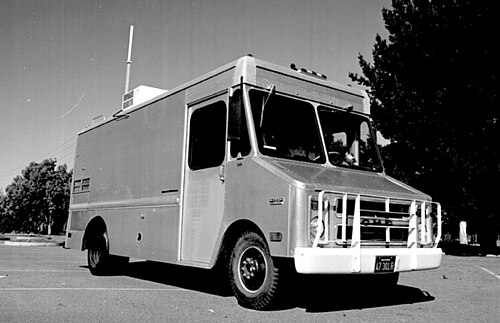
当初DOD インターネット アーキテクチャ モデルと呼ばれていたインターネット プロトコル スイートは、1960 年代後半に国防高等研究計画局 ( DARPA ) が後援した研究開発にそのルーツがあります。 [3] DARPA が 1969 年に先駆的なARPANETを開始した後、スティーブ クロッカーは「ネットワーキング ワーキング グループ」を設立し、ホスト間プロトコルであるネットワーク制御プログラム(NCP) を開発しました。[4] 1970 年代初頭、DARPA はモバイル パケット ラジオ、パケット衛星サービス、ローカル エリア ネットワーク、およびパブリック ドメインとプライベート ドメインのその他のデータ ネットワークを含む、いくつかの他のデータ伝送テクノロジの開発を開始しました。1972 年、ボブ カーン氏は DARPA情報処理技術オフィスに加わり、衛星パケット ネットワークと地上ベースの無線パケット ネットワークの両方に携わり、両方で通信できることの価値を認識しました。1973 年春、ヴィントン サーフ氏がカーン氏に加わり、インターネットワーキングを可能にする ARPANET の次世代プロトコルを設計することを目標としました。[5] [6]彼らは、ARPANET研究コミュニティ、サーフが議長を務めた国際ネットワークワーキンググループ、ゼロックスPARCの研究者からの経験を活用しました。[7] [8] [9]
1973年の夏までに、カーン氏とサーフ氏は根本的な再定式化を完成し、共通のインターネットワークプロトコルを使用することでローカルネットワークプロトコル間の違いを隠蔽し、既存のARPANETプロトコルのようにネットワークが信頼性の責任を負う代わりに、この機能をホストに委任しました。サーフ氏は、この設計に重要な影響を与えたのはCYCLADESネットワークの設計者であるルイ・プーザン氏とヒューバート・ツィンマーマン氏であると述べています。 [10] [11]この新しいプロトコルは、1974年にサーフ氏、ヨゲン・ダラル氏、カール・サンシャイン氏によって伝送制御プログラムとして実装されました。[12]
当初、伝送制御プログラム(インターネット プロトコルは独立したプロトコルとしては存在していなかった)は、信頼性の高いバイト ストリームサービスのみをユーザーに提供し、データグラムは提供していなかった。[13]インターネット実験ノートシリーズを通じて、いくつかのバージョンが開発された。 [14]プロトコルの経験が増えるにつれて、協力者たちは機能を個別のプロトコルのレイヤーに分割し、ユーザーがデータグラム サービスに直接アクセスできるようにすることを推奨した。その支持者には、ゼロックス PARC のBob Metcalfeと Yogen Dalal 、[15] [16] パケット音声作業にそれを必要としていたDanny Cohen 、インターネット開発を文書化し促進してきた技術および戦略文書シリーズであるRequest for Comments (RFC)を編集した南カリフォルニア大学情報科学研究所の Jonathan Postel などがいた。 [17] Postel は、「レイヤー化の原則に違反することで、インターネット プロトコルの設計を台無しにしている」と述べた。[18]異なるメカニズムをカプセル化することで、上位層が下位層から必要なものにのみアクセスできる環境を作り出すことが意図されていました。モノリシックな設計は柔軟性に欠け、スケーラビリティの問題につながります。 1978年に書かれたバージョン4では、ポステルは伝送制御プログラムを2つの異なるプロトコルに分割しました。1つはコネクションレス層としてのインターネットプロトコル、もう1つは信頼性の高いコネクション指向サービスとしての伝送制御プロトコルです。[19] [20] [21] [注 1]
ネットワークの設計には、エンド ノード間のトラフィックを効率的に送信およびルーティングする機能のみを提供し、その他のすべてのインテリジェンスはネットワークのエッジ、つまりエンド ノードに配置する必要があるという認識が含まれていました。このエンドツーエンドの原則は、ドナルド デイビスのアイデアに基づいて、ルイ プーザンが CYCLADES ネットワークで開拓しました[22]。[23] [24]この設計を使用すると、他のローカル特性に関係なく、同じ原則を使用する他のネットワークを ARPANET に接続できるようになり、カーンの初期のインターネットワーキングの問題が解決されました。よく知られている表現は、サーフとカーンの作業の最終的な成果である TCP/IP は、「2 つのブリキ缶と 1 本のひも」で実行できるということです。[要出典]数年後、1999 年に冗談として、 IP over Avian Carriers の正式なプロトコル仕様が作成され[25]、2 年後にテストに成功しました。さらに 10 年後、IPv6 に適合されました[26]
DARPAはBBNテクノロジーズ、スタンフォード大学、ロンドン大学と契約し、いくつかのハードウェアプラットフォーム上でプロトコルの運用バージョンを開発しました。[27]プロトコルの開発中に、パケットルーティング層のバージョン番号はバージョン1からバージョン4に進み、後者は1983年にARPANETにインストールされました。これは、現在の後継であるインターネットプロトコルバージョン6(IPv6)と並んで、インターネットで現在も使用されているプロトコルであるため、インターネットプロトコルバージョン4(IPv4)として知られるようになりました。
早期導入
1975年には、スタンフォード大学とロンドン大学ユニバーシティ・カレッジの間で2ネットワークのIP通信テストが実施された。1977年11月には、米国、英国、ノルウェーの拠点間で3ネットワークのIPテストが実施された。1978年から1983年にかけて、複数の研究センターで他のいくつかのIPプロトタイプが開発された。[14]
ルータと呼ばれるコンピュータには、各ネットワークへのインターフェースが備わっており、ネットワークパケットをネットワーク間で転送します。[28]もともとルータはゲートウェイと呼ばれていましたが、他の種類のゲートウェイとの混同を避けるためにこの用語が変更されました。[29]
採択
In March 1982, the US Department of Defense declared TCP/IP as the standard for all military computer networking.[30][31][32] In the same year, NORSAR/NDRE and Peter Kirstein's research group at University College London adopted the protocol.[33] The migration of the ARPANET from NCP to TCP/IP was officially completed on flag day January 1, 1983, when the new protocols were permanently activated.[30][34]
In 1985, the Internet Advisory Board (later Internet Architecture Board) held a three-day TCP/IP workshop for the computer industry, attended by 250 vendor representatives, promoting the protocol and leading to its increasing commercial use. In 1985, the first Interop conference focused on network interoperability by broader adoption of TCP/IP. The conference was founded by Dan Lynch, an early Internet activist. From the beginning, large corporations, such as IBM and DEC, attended the meeting.[35][36]
IBM, AT&T and DEC were the first major corporations to adopt TCP/IP, this despite having competing proprietary protocols. In IBM, from 1984, Barry Appelman's group did TCP/IP development. They navigated the corporate politics to get a stream of TCP/IP products for various IBM systems, including MVS, VM, and OS/2. At the same time, several smaller companies, such as FTP Software and the Wollongong Group, began offering TCP/IP stacks for DOS and Microsoft Windows.[37] The first VM/CMS TCP/IP stack came from the University of Wisconsin.[38]
Some of the early TCP/IP stacks were written single-handedly by a few programmers. Jay Elinsky and Oleg Vishnepolsky of IBM Research wrote TCP/IP stacks for VM/CMS and OS/2, respectively.[citation needed] In 1984 Donald Gillies at MIT wrote a ntcp multi-connection TCP which runs atop the IP/PacketDriver layer maintained by John Romkey at MIT in 1983–84. Romkey leveraged this TCP in 1986 when FTP Software was founded.[39][40] Starting in 1985, Phil Karn created a multi-connection TCP application for ham radio systems (KA9Q TCP).[41]
The spread of TCP/IP was fueled further in June 1989, when the University of California, Berkeley agreed to place the TCP/IP code developed for BSD UNIX into the public domain. Various corporate vendors, including IBM, included this code in commercial TCP/IP software releases. For Windows 3.1, the dominant PC operating system among consumers in the first half of the 1990s, Peter Tattam's release of the Trumpet Winsock TCP/IP stack was key to bringing the Internet to home users. Trumpet Winsock allowed TCP/IP operations over a serial connection (SLIP or PPP). The typical home PC of the time had an external Hayes-compatible modem connected via an RS-232 port with an 8250 or 16550 UART which required this type of stack. Later, Microsoft would release their own TCP/IP add-on stack for Windows for Workgroups 3.11 and a native stack in Windows 95. These events helped cement TCP/IP's dominance over other protocols on Microsoft-based networks, which included IBM's Systems Network Architecture (SNA), and on other platforms such as Digital Equipment Corporation's DECnet, Open Systems Interconnection (OSI), and Xerox Network Systems (XNS).
Nonetheless, for a period in the late 1980s and early 1990s, engineers, organizations and nations were polarized over the issue of which standard, the OSI model or the Internet protocol suite, would result in the best and most robust computer networks.[42][43][44]
Formal specification and standards
The technical standards underlying the Internet protocol suite and its constituent protocols have been delegated to the Internet Engineering Task Force (IETF).[45][46]
The characteristic architecture of the Internet protocol suite is its broad division into operating scopes for the protocols that constitute its core functionality. The defining specifications of the suite are RFC 1122 and 1123, which broadly outlines four abstraction layers (as well as related protocols); the link layer, IP layer, transport layer, and application layer, along with support protocols.[1][2] These have stood the test of time, as the IETF has never modified this structure. As such a model of networking, the Internet protocol suite predates the OSI model, a more comprehensive reference framework for general networking systems.[44]
Key architectural principles
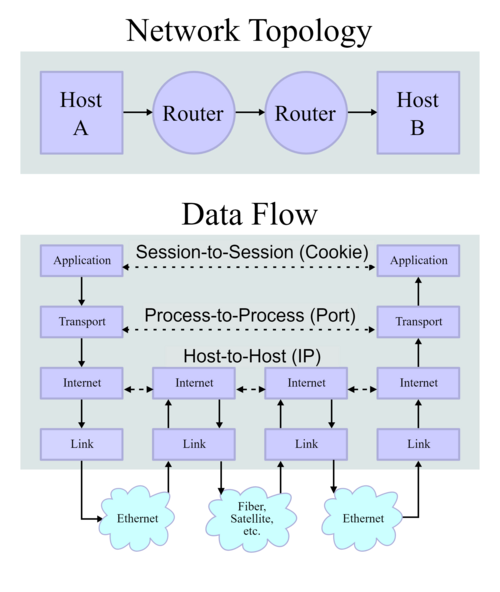
The end-to-end principle has evolved over time. Its original expression put the maintenance of state and overall intelligence at the edges, and assumed the Internet that connected the edges retained no state and concentrated on speed and simplicity. Real-world needs for firewalls, network address translators, web content caches and the like have forced changes in this principle.[47]
The robustness principle states: "In general, an implementation must be conservative in its sending behavior, and liberal in its receiving behavior. That is, it must be careful to send well-formed datagrams, but must accept any datagram that it can interpret (e.g., not object to technical errors where the meaning is still clear)."[48]: 23 "The second part of the principle is almost as important: software on other hosts may contain deficiencies that make it unwise to exploit legal but obscure protocol features."[1]: 13
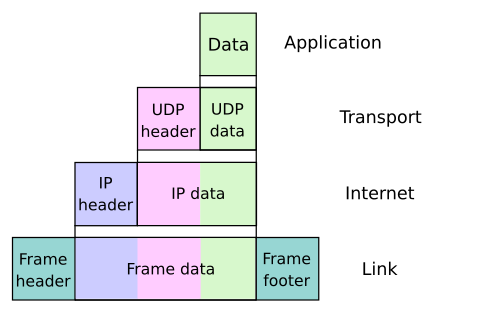
Encapsulation is used to provide abstraction of protocols and services. Encapsulation is usually aligned with the division of the protocol suite into layers of general functionality. In general, an application (the highest level of the model) uses a set of protocols to send its data down the layers. The data is further encapsulated at each level.
An early pair of architectural documents, RFC 1122 and 1123, titled Requirements for Internet Hosts, emphasizes architectural principles over layering.[49] RFC 1122/23 are structured in sections referring to layers, but the documents refer to many other architectural principles, and do not emphasize layering. They loosely defines a four-layer model, with the layers having names, not numbers, as follows:[1][2]
- The application layer is the scope within which applications, or processes, create user data and communicate this data to other applications on another or the same host. The applications make use of the services provided by the underlying lower layers, especially the transport layer which provides reliable or unreliable pipes to other processes. The communications partners are characterized by the application architecture, such as the client–server model and peer-to-peer networking. This is the layer in which all application protocols, such as SMTP, FTP, SSH, HTTP, operate. Processes are addressed via ports which essentially represent services.
- The transport layer performs host-to-host communications on either the local network or remote networks separated by routers.[50] It provides a channel for the communication needs of applications. UDP is the basic transport layer protocol, providing an unreliable connectionless datagram service. The Transmission Control Protocol provides flow-control, connection establishment, and reliable transmission of data.
- The internet layer exchanges datagrams across network boundaries. It provides a uniform networking interface that hides the actual topology (layout) of the underlying network connections. It is therefore also the layer that establishes internetworking. Indeed, it defines and establishes the Internet. This layer defines the addressing and routing structures used for the TCP/IP protocol suite. The primary protocol in this scope is the Internet Protocol, which defines IP addresses.[51][failed verification][52] Its function in routing is to transport datagrams to the next host, functioning as an IP router, that has the connectivity to a network closer to the final data destination.[52][failed verification]
- The link layer defines the networking methods within the scope of the local network link on which hosts communicate without intervening routers. This layer includes the protocols used to describe the local network topology and the interfaces needed to effect the transmission of internet layer datagrams to next-neighbor hosts.[53]
Link layer
The protocols of the link layer operate within the scope of the local network connection to which a host is attached. This regime is called the link in TCP/IP parlance and is the lowest component layer of the suite. The link includes all hosts accessible without traversing a router. The size of the link is therefore determined by the networking hardware design. In principle, TCP/IP is designed to be hardware independent and may be implemented on top of virtually any link-layer technology. This includes not only hardware implementations but also virtual link layers such as virtual private networks and networking tunnels.
The link layer is used to move packets between the internet layer interfaces of two different hosts on the same link. The processes of transmitting and receiving packets on the link can be controlled in the device driver for the network card, as well as in firmware or by specialized chipsets. These perform functions, such as framing, to prepare the internet layer packets for transmission, and finally transmit the frames to the physical layer and over a transmission medium. The TCP/IP model includes specifications for translating the network addressing methods used in the Internet Protocol to link-layer addresses, such as media access control (MAC) addresses. All other aspects below that level, however, are implicitly assumed to exist and are not explicitly defined in the TCP/IP model.
The link layer in the TCP/IP model has corresponding functions in Layer 2 of the OSI model.
Internet layer
Internetworking requires sending data from the source network to the destination network. This process is called routing and is supported by host addressing and identification using the hierarchical IP addressing system. The internet layer provides an unreliable datagram transmission facility between hosts located on potentially different IP networks by forwarding datagrams to an appropriate next-hop router for further relaying to its destination. The internet layer has the responsibility of sending packets across potentially multiple networks. With this functionality, the internet layer makes possible internetworking, the interworking of different IP networks, and it essentially establishes the Internet.
The internet layer does not distinguish between the various transport layer protocols. IP carries data for a variety of different upper layer protocols. These protocols are each identified by a unique protocol number: for example, Internet Control Message Protocol (ICMP) and Internet Group Management Protocol (IGMP) are protocols 1 and 2, respectively.
The Internet Protocol is the principal component of the internet layer, and it defines two addressing systems to identify network hosts and to locate them on the network. The original address system of the ARPANET and its successor, the Internet, is Internet Protocol version 4 (IPv4). It uses a 32-bit IP address and is therefore capable of identifying approximately four billion hosts. This limitation was eliminated in 1998 by the standardization of Internet Protocol version 6 (IPv6) which uses 128-bit addresses. IPv6 production implementations emerged in approximately 2006.
Transport layer
The transport layer establishes basic data channels that applications use for task-specific data exchange. The layer establishes host-to-host connectivity in the form of end-to-end message transfer services that are independent of the underlying network and independent of the structure of user data and the logistics of exchanging information. Connectivity at the transport layer can be categorized as either connection-oriented, implemented in TCP, or connectionless, implemented in UDP. The protocols in this layer may provide error control, segmentation, flow control, congestion control, and application addressing (port numbers).
For the purpose of providing process-specific transmission channels for applications, the layer establishes the concept of the network port. This is a numbered logical construct allocated specifically for each of the communication channels an application needs. For many types of services, these port numbers have been standardized so that client computers may address specific services of a server computer without the involvement of service discovery or directory services.
Because IP provides only a best-effort delivery, some transport-layer protocols offer reliability.
TCP is a connection-oriented protocol that addresses numerous reliability issues in providing a reliable byte stream:
- data arrives in-order
- data has minimal error (i.e., correctness)
- duplicate data is discarded
- lost or discarded packets are resent
- includes traffic congestion control
The newer Stream Control Transmission Protocol (SCTP) is also a reliable, connection-oriented transport mechanism. It is message-stream-oriented, not byte-stream-oriented like TCP, and provides multiple streams multiplexed over a single connection. It also provides multihoming support, in which a connection end can be represented by multiple IP addresses (representing multiple physical interfaces), such that if one fails, the connection is not interrupted. It was developed initially for telephony applications (to transport SS7 over IP).
Reliability can also be achieved by running IP over a reliable data-link protocol such as the High-Level Data Link Control (HDLC).
The User Datagram Protocol (UDP) is a connectionless datagram protocol. Like IP, it is a best-effort, unreliable protocol. Reliability is addressed through error detection using a checksum algorithm. UDP is typically used for applications such as streaming media (audio, video, Voice over IP, etc.) where on-time arrival is more important than reliability, or for simple query/response applications like DNS lookups, where the overhead of setting up a reliable connection is disproportionately large. Real-time Transport Protocol (RTP) is a datagram protocol that is used over UDP and is designed for real-time data such as streaming media.
The applications at any given network address are distinguished by their TCP or UDP port. By convention, certain well-known ports are associated with specific applications.
The TCP/IP model's transport or host-to-host layer corresponds roughly to the fourth layer in the OSI model, also called the transport layer.
QUIC is rapidly emerging as an alternative transport protocol. Whilst it is technically carried via UDP packets it seeks to offer enhanced transport connectivity relative to TCP. HTTP/3 works exclusively via QUIC.
Application layer
The application layer includes the protocols used by most applications for providing user services or exchanging application data over the network connections established by the lower-level protocols. This may include some basic network support services such as routing protocols and host configuration. Examples of application layer protocols include the Hypertext Transfer Protocol (HTTP), the File Transfer Protocol (FTP), the Simple Mail Transfer Protocol (SMTP), and the Dynamic Host Configuration Protocol (DHCP).[54] Data coded according to application layer protocols are encapsulated into transport layer protocol units (such as TCP streams or UDP datagrams), which in turn use lower layer protocols to effect actual data transfer.
The TCP/IP model does not consider the specifics of formatting and presenting data and does not define additional layers between the application and transport layers as in the OSI model (presentation and session layers). According to the TCP/IP model, such functions are the realm of libraries and application programming interfaces. The application layer in the TCP/IP model is often compared to a combination of the fifth (session), sixth (presentation), and seventh (application) layers of the OSI model.
Application layer protocols are often associated with particular client–server applications, and common services have well-known port numbers reserved by the Internet Assigned Numbers Authority (IANA). For example, the HyperText Transfer Protocol uses server port 80 and Telnet uses server port 23. Clients connecting to a service usually use ephemeral ports, i.e., port numbers assigned only for the duration of the transaction at random or from a specific range configured in the application.
At the application layer, the TCP/IP model distinguishes between user protocols and support protocols.[1]: §1.1.3 Support protocols provide services to a system of network infrastructure. User protocols are used for actual user applications. For example, FTP is a user protocol and DNS is a support protocol.
Although the applications are usually aware of key qualities of the transport layer connection such as the endpoint IP addresses and port numbers, application layer protocols generally treat the transport layer (and lower) protocols as black boxes which provide a stable network connection across which to communicate. The transport layer and lower-level layers are unconcerned with the specifics of application layer protocols. Routers and switches do not typically examine the encapsulated traffic, rather they just provide a conduit for it. However, some firewall and bandwidth throttling applications use deep packet inspection to interpret application data. An example is the Resource Reservation Protocol (RSVP).[citation needed] It is also sometimes necessary for Applications affected by NAT to consider the application payload.
Layering evolution and representations in the literature
The Internet protocol suite evolved through research and development funded over a period of time. In this process, the specifics of protocol components and their layering changed. In addition, parallel research and commercial interests from industry associations competed with design features. In particular, efforts in the International Organization for Standardization led to a similar goal, but with a wider scope of networking in general. Efforts to consolidate the two principal schools of layering, which were superficially similar, but diverged sharply in detail, led independent textbook authors to formulate abridging teaching tools.
The following table shows various such networking models. The number of layers varies between three and seven.
Some of the networking models are from textbooks, which are secondary sources that may conflict with the intent of RFC 1122 and other IETF primary sources.[63]
Comparison of TCP/IP and OSI layering
The three top layers in the OSI model, i.e. the application layer, the presentation layer and the session layer, are not distinguished separately in the TCP/IP model which only has an application layer above the transport layer. While some pure OSI protocol applications, such as X.400, also combined them, there is no requirement that a TCP/IP protocol stack must impose monolithic architecture above the transport layer. For example, the NFS application protocol runs over the External Data Representation (XDR) presentation protocol, which, in turn, runs over a protocol called Remote Procedure Call (RPC). RPC provides reliable record transmission, so it can safely use the best-effort UDP transport.
Different authors have interpreted the TCP/IP model differently, and disagree whether the link layer, or any aspect of the TCP/IP model, covers OSI layer 1 (physical layer) issues, or whether TCP/IP assumes a hardware layer exists below the link layer. Several authors have attempted to incorporate the OSI model's layers 1 and 2 into the TCP/IP model since these are commonly referred to in modern standards (for example, by IEEE and ITU). This often results in a model with five layers, where the link layer or network access layer is split into the OSI model's layers 1 and 2.[citation needed]
The IETF protocol development effort is not concerned with strict layering. Some of its protocols may not fit cleanly into the OSI model, although RFCs sometimes refer to it and often use the old OSI layer numbers. The IETF has repeatedly stated[45][failed verification] that Internet Protocol and architecture development is not intended to be OSI-compliant. RFC 3439, referring to the internet architecture, contains a section entitled: "Layering Considered Harmful".[63]
For example, the session and presentation layers of the OSI suite are considered to be included in the application layer of the TCP/IP suite. The functionality of the session layer can be found in protocols like HTTP and SMTP and is more evident in protocols like Telnet and the Session Initiation Protocol (SIP). Session-layer functionality is also realized with the port numbering of the TCP and UDP protocols, which are included in the transport layer of the TCP/IP suite. Functions of the presentation layer are realized in the TCP/IP applications with the MIME standard in data exchange.
Another difference is in the treatment of routing protocols. The OSI routing protocol IS-IS belongs to the network layer, and does not depend on CLNS for delivering packets from one router to another, but defines its own layer-3 encapsulation. In contrast, OSPF, RIP, BGP and other routing protocols defined by the IETF are transported over IP, and, for the purpose of sending and receiving routing protocol packets, routers act as hosts. As a consequence, routing protocols are included in the application layer.[28] Some authors, such as Tanenbaum in Computer Networks, describe routing protocols in the same layer as IP, reasoning that routing protocols inform decisions made by the forwarding process of routers.
IETF protocols can be encapsulated recursively, as demonstrated by tunnelling protocols such as Generic Routing Encapsulation (GRE). GRE uses the same mechanism that OSI uses for tunnelling at the network layer.
Implementations
The Internet protocol suite does not presume any specific hardware or software environment. It only requires that hardware and a software layer exists that is capable of sending and receiving packets on a computer network. As a result, the suite has been implemented on essentially every computing platform. A minimal implementation of TCP/IP includes the following: Internet Protocol (IP), Address Resolution Protocol (ARP), Internet Control Message Protocol (ICMP), Transmission Control Protocol (TCP), User Datagram Protocol (UDP), and Internet Group Management Protocol (IGMP). In addition to IP, ICMP, TCP, UDP, Internet Protocol version 6 requires Neighbor Discovery Protocol (NDP), ICMPv6, and Multicast Listener Discovery (MLD) and is often accompanied by an integrated IPSec security layer.
See also
- BBN Report 1822, an early layered network model
- Fast Local Internet Protocol
- List of automation protocols
- List of information technology initialisms
- List of IP protocol numbers
- Lists of network protocols
- List of TCP and UDP port numbers
Notes
- ^ For records of discussions leading up to the TCP/IP split, see the series of Internet Experiment Notes at the Internet Experiment Notes Index.
References
- ^ a b c d e R. Braden, ed. (October 1989). Requirements for Internet Hosts -- Communication Layers. Network Working Group. doi:10.17487/RFC1122. STD 3. RFC 1122. Internet Standard 3. Updated by RFC 1349, 4379, 5884, 6093, 6298, 6633, 6864, 8029 and 9293.
- ^ a b c R. Braden, ed. (October 1989). Requirements for Internet Hosts -- Application and Support. Network Working Group. doi:10.17487/RFC1123. STD 3. RFC 1123. Internet Standard 3. Updated by RFC 1349, 2181, 5321, 5966 and 7766.
- ^ Cerf, Vinton G. & Cain, Edward (October 1983). "The DoD Internet Architecture Model". Computer Networks. 7 (5). North-Holland: 307–318. doi:10.1016/0376-5075(83)90042-9.
- ^ J. Reynolds; J. Postel (November 1987). THE REQUEST FOR COMMENTS REFERENCE GUIDE. Network Working Group. doi:10.17487/RFC1000. RFC 1000. Status Unknown. Obsoletes RFC 84, 100, 160, 170, 200, 598, 699, 800, 899 and 999.
- ^ Hafner, Katie; Lyon, Matthew (1996). Where wizards stay up late : the origins of the Internet. Internet Archive. New York : Simon & Schuster. p. 263. ISBN 978-0-684-81201-4.
- ^ a b Russell, Andrew L. (2014). Open standards and the digital age: history, ideology, and networks. New York: Cambridge Univ Press. p. 196. ISBN 978-1107039193. Archived from the original on December 28, 2022. Retrieved December 20, 2022.
- ^ Abbate, Janet (2000). Inventing the Internet. MIT Press. pp. 123–4. ISBN 978-0-262-51115-5. Archived from the original on January 17, 2023. Retrieved May 15, 2020.
- ^ Taylor, Bob (October 11, 2008), "Oral History of Robert (Bob) W. Taylor" (PDF), Computer History Museum Archive, CHM Reference number: X5059.2009: 28
- ^ Isaacson, Walter (2014). The innovators : how a group of hackers, geniuses, and geeks created the digital revolution. Internet Archive. New York : Simon & Schuster. ISBN 978-1-4767-0869-0.
- ^ Cerf, V.; Kahn, R. (1974). "A Protocol for Packet Network Intercommunication" (PDF). IEEE Transactions on Communications. 22 (5): 637–648. doi:10.1109/TCOM.1974.1092259. ISSN 1558-0857. Archived (PDF) from the original on October 10, 2022. Retrieved October 18, 2015.
The authors wish to thank a number of colleagues for helpful comments during early discussions of international network protocols, especially R. Metcalfe, R. Scantlebury, D. Walden, and H. Zimmerman; D. Davies and L. Pouzin who constructively commented on the fragmentation and accounting issues; and S. Crocker who commented on the creation and destruction of associations.
- ^ "The internet's fifth man". Economist. December 13, 2013. Archived from the original on April 19, 2020. Retrieved September 11, 2017.
In the early 1970s Mr Pouzin created an innovative data network that linked locations in France, Italy and Britain. Its simplicity and efficiency pointed the way to a network that could connect not just dozens of machines, but millions of them. It captured the imagination of Dr Cerf and Dr Kahn, who included aspects of its design in the protocols that now power the internet.
- ^ V. Cerf; Y. Dalal; C. Sunshine (December 1974). SPECIFICATION OF INTERNET TRANSMISSION CONTROL PROGRAM. Network Working Group. doi:10.17487/RFC0675. RFC 675. Obsolete. Obsoleted by RFC 7805. NIC 2. INWG 72.
- ^ Cerf, Vinton (March 1977). "Specification of Internet Transmission Control Protocol TCP (Version 2)" (PDF). Archived (PDF) from the original on May 25, 2022. Retrieved August 4, 2022.
- ^ a b Cerf, Vinton G. (April 1, 1980). "Final Report of the Stanford University TCP Project".
- ^ Panzaris, Georgios (2008). Machines and romances: the technical and narrative construction of networked computing as a general-purpose platform, 1960–1995. Stanford University. p. 128. Archived from the original on January 17, 2023. Retrieved September 5, 2019.
- ^ Pelkey, James L. (2007). "Yogen Dalal". Entrepreneurial Capitalism and Innovation: A History of Computer Communications, 1968–1988. Archived from the original on October 8, 2022. Retrieved October 8, 2020.
- ^ Internet Hall of Fame
- ^ Postel, Jon (August 15, 1977), 2.3.3.2 Comments on Internet Protocol and TCP, IEN 2, archived from the original on May 16, 2019, retrieved June 11, 2016
- ^ Abbate, Inventing the Internet, 129–30.
- ^ Vinton G. Cerf (October 1980). "Protocols for Interconnected Packet Networks". ACM SIGCOMM Computer Communication Review. 10 (4): 10–11.
- ^ Russell, Andrew L. (2007). "Industrial Legislatures": Consensus Standardization in the Second and Third Industrial Revolutions (PDF) (PhD thesis). Johns Hopkins University. Archived (PDF) from the original on December 28, 2022. Retrieved December 28, 2022.
- ^ Bennett, Richard (September 2009). "Designed for Change: End-to-End Arguments, Internet Innovation, and the Net Neutrality Debate" (PDF). Information Technology and Innovation Foundation. pp. 7, 11. Retrieved September 11, 2017.
- ^ Pelkey, James. "8.3 CYCLADES Network and Louis Pouzin 1971-1972". Entrepreneurial Capitalism and Innovation: A History of Computer Communications 1968-1988. Archived from the original on June 17, 2021. Retrieved November 21, 2021.
The inspiration for datagrams had two sources. One was Donald Davies' studies. He had done some simulation of datagram networks, although he had not built any, and it looked technically viable. The second inspiration was I like things simple. I didn't see any real technical motivation to overlay two levels of end-to-end protocols. I thought one was enough.
- ^ Davies, Donald; Bartlett, Keith; Scantlebury, Roger; Wilkinson, Peter (October 1967). A Digital Communication Network for Computers Giving Rapid Response at remote Terminals (PDF). ACM Symposium on Operating Systems Principles. Archived (PDF) from the original on October 10, 2022. Retrieved September 15, 2020. "all users of the network will provide themselves with some kind of error control"
- ^ D. Waitzman (April 1, 1990). A Standard for the Transmission of IP Datagrams on Avian Carriers. Network Working Group. doi:10.17487/RFC1149. RFC 1149. Experimental. This is an April Fools' Day Request for Comments.
- ^ B. Carpenter; R. Hinden (April 1, 2011). Adaptation of RFC 1149 for IPv6. Internet Engineering Task Force. doi:10.17487/RFC6214. ISSN 2070-1721. RFC 6214. Informational. This is an April Fools' Day Request for Comments.
- ^ by Vinton Cerf, as told to Bernard Aboba (1993). "How the Internet Came to Be". Archived from the original on September 26, 2017. Retrieved September 25, 2017.
We began doing concurrent implementations at Stanford, BBN, and University College London. So effort at developing the Internet protocols was international from the beginning.
- ^ a b F. Baker, ed. (June 1995). Requirements for IP Version 4 Routers. Network Working Group. doi:10.17487/RFC1812. RFC 1812. Proposed Standard. Obsoletes RFC 1716 and 1009. Updated by RFC 2644 and 6633.
- ^ Crowell, William; Contos, Brian; DeRodeff, Colby (2011). Physical and Logical Security Convergence: Powered By Enterprise Security Management. Syngress. p. 99. ISBN 9780080558783.
- ^ a b Ronda Hauben. "From the ARPANET to the Internet". TCP Digest (UUCP). Archived from the original on July 21, 2009. Retrieved July 5, 2007.
- ^ IEN 207.
- ^ IEN 152.
- ^ Hauben, Ronda (2004). "The Internet: On its International Origins and Collaborative Vision". Amateur Computerist. 12 (2). Retrieved May 29, 2009.
Mar '82 – Norway leaves the ARPANET and become an Internet connection via TCP/IP over SATNET. Nov '82 – UCL leaves the ARPANET and becomes an Internet connection.
- ^ "TCP/IP Internet Protocol". Archived from the original on January 1, 2018. Retrieved December 31, 2017.
- ^ Leiner, Barry M.; et al. (1997), Brief History of the Internet (PDF), Internet Society, p. 15, archived (PDF) from the original on January 18, 2018, retrieved January 17, 2018
- ^ "Vinton G. Cerf : An Oral History". Stanford Oral History Collections - Spotlight at Stanford. 2020. p. 113, 129, 145. Retrieved June 29, 2024.
- ^ "Using Wollongong TCP/IP with Windows for Workgroups 3.11". Microsoft Support. Archived from the original on January 12, 2012.
- ^ "A Short History of Internet Protocols at CERN". Archived from the original on November 10, 2016. Retrieved September 12, 2016.
- ^ Baker, Steven; Gillies, Donald W. "Desktop TCP/IP at middle age". Archived from the original on August 21, 2015. Retrieved September 9, 2016.
- ^ Romkey, John (February 17, 2011). "About". Archived from the original on November 5, 2011. Retrieved September 12, 2016.
- ^ Phil Karn, KA9Q TCP Download Website
- ^ Andrew L. Russell (July 30, 2013). "OSI: The Internet That Wasn't". IEEE Spectrum. Vol. 50, no. 8. Archived from the original on August 1, 2017. Retrieved February 6, 2020.
- ^ Russell, Andrew L. "Rough Consensus and Running Code' and the Internet-OSI Standards War" (PDF). IEEE Annals of the History of Computing. Archived from the original (PDF) on November 17, 2019.
- ^ a b Davies, Howard; Bressan, Beatrice (April 26, 2010). A History of International Research Networking: The People who Made it Happen. John Wiley & Sons. ISBN 978-3-527-32710-2. Archived from the original on January 17, 2023. Retrieved November 7, 2020.
- ^ a b "Introduction to the IETF". IETF. Retrieved February 27, 2024.
- ^ Morabito, Roberto; Jimenez, Jaime (June 2020). "IETF Protocol Suite for the Internet of Things: Overview and Recent Advancements". IEEE Communications Standards Magazine. 4 (2): 41–49. arXiv:2003.10279. doi:10.1109/mcomstd.001.1900014. ISSN 2471-2825.
- ^ Blumenthal, Marjory S.; Clark, David D. (August 2001). "Rethinking the design of the Internet: The end-to-end arguments vs. the brave new world" (PDF). Archived (PDF) from the original on October 8, 2022. Retrieved October 8, 2022.
- ^ J. Postel, ed. (September 1981). INTERNET PROTOCOL - DARPA INTERNET PROGRAM PROTOCOL SPECIFICATION. IETF. doi:10.17487/RFC0791. STD 5. RFC 791. IEN 128, 123, 111, 80, 54, 44, 41, 28, 26. Internet Standard 5. Obsoletes RFC 760. Updated by RFC 1349, 2474 and 6864.
- ^ B. Carpenter, ed. (June 1996). Architectural Principles of the Internet. Network Working Group. doi:10.17487/RFC1958. RFC 1958. Informational. Updated by RFC 3439.
- ^ Hunt, Craig (2002). TCP/IP Network Administration (3rd ed.). O'Reilly. pp. 9–10. ISBN 9781449390785.
- ^ Guttman, E. (1999). "Service location protocol: automatic discovery of IP network services". IEEE Internet Computing. 3 (4): 71–80. doi:10.1109/4236.780963. ISSN 1089-7801.
- ^ a b Zheng, Kai (July 2017). "Enabling "Protocol Routing": Revisiting Transport Layer Protocol Design in Internet Communications". IEEE Internet Computing. 21 (6): 52–57. doi:10.1109/mic.2017.4180845. ISSN 1089-7801.
- ^ Huang, Jing-lian (April 7, 2009). "Cross layer link adaptation scheme in wireless local area network". Journal of Computer Applications. 29 (2): 518–520. doi:10.3724/sp.j.1087.2009.00518 (inactive May 13, 2024). ISSN 1001-9081.
{{cite journal}}: CS1 maint: DOI inactive as of May 2024 (link) - ^ Stevens, W. Richard (February 1994). TCP/IP Illustrated: the protocols. Addison-Wesley. ISBN 0-201-63346-9. Archived from the original on April 22, 2012. Retrieved April 25, 2012.
- ^ Dye, Mark; McDonald, Rick; Rufi, Antoon (October 29, 2007). Network Fundamentals, CCNA Exploration Companion Guide. Cisco Press. ISBN 9780132877435. Retrieved September 12, 2016 – via Google Books.
- ^ Kozierok, Charles M. (January 1, 2005). The TCP/IP Guide: A Comprehensive, Illustrated Internet Protocols Reference. No Starch Press. ISBN 9781593270476. Retrieved September 12, 2016 – via Google Books.
- ^ Comer, Douglas (January 1, 2006). Internetworking with TCP/IP: Principles, protocols, and architecture. Prentice Hall. ISBN 0-13-187671-6. Retrieved September 12, 2016 – via Google Books.
- ^ Tanenbaum, Andrew S. (January 1, 2003). Computer Networks. Prentice Hall PTR. p. 42. ISBN 0-13-066102-3. Retrieved September 12, 2016 – via Internet Archive.
networks.
- ^ Forouzan, Behrouz A.; Fegan, Sophia Chung (August 1, 2003). Data Communications and Networking. McGraw-Hill Higher Education. ISBN 9780072923544. Retrieved September 12, 2016 – via Google Books.
- ^ Kurose, James F.; Ross, Keith W. (2008). Computer Networking: A Top-Down Approach. Pearson/Addison Wesley. ISBN 978-0-321-49770-3. Archived from the original on January 23, 2016. Retrieved July 16, 2008.
- ^ Stallings, William (January 1, 2007). Data and Computer Communications. Prentice Hall. ISBN 978-0-13-243310-5. Retrieved September 12, 2016 – via Google Books.
- ^ ISO/IEC 7498-1:1994 Information technology — Open Systems Interconnection — Basic Reference Model: The Basic Model.
- ^ a b R. Bush; D. Meyer (December 2002). Some Internet Architectural Guidelines and Philosophy. Network Working Group. doi:10.17487/RFC3439. RFC 3439. Informational. Updates RFC 1958.
Bibliography
- Douglas E. Comer (2001). Internetworking with TCP/IP – Principles, Protocols and Architecture. CET [i. e.] Computer Equipment and Trade. ISBN 86-7991-142-9.
- Joseph G. Davies; Thomas F. Lee (2003). Microsoft Windows Server 2003 TCP/IP Protocols and Services. Microsoft Press. ISBN 0-7356-1291-9.
- Forouzan, Behrouz A. (2003). TCP/IP Protocol Suite (2nd ed.). McGraw-Hill. ISBN 978-0-07-246060-5.
- Craig Hunt (1998). TCP/IP Network Administration. O'Reilly. ISBN 1-56592-322-7.
- Maufer, Thomas A. (1999). IP Fundamentals. Prentice Hall. ISBN 978-0-13-975483-8.
- Ian McLean (2000). Windows 2000 TCP/IP Black Book. Coriolis Group Books. ISBN 1-57610-687-X.
- Ajit Mungale (September 29, 2004). Pro .NET 1.1 Network Programming. Apress. ISBN 1-59059-345-6.
- W. Richard Stevens (April 24, 1994). TCP/IP Illustrated, Volume 1: The Protocols. Addison-Wesley. ISBN 0-201-63346-9.
- W. Richard Stevens; Gary R. Wright (1994). TCP/IP Illustrated, Volume 2: The Implementation. Addison-Wesley. ISBN 0-201-63354-X.
- W. Richard Stevens (1996). TCP/IP Illustrated, Volume 3: TCP for Transactions, HTTP, NNTP, and the UNIX Domain Protocols. Addison-Wesley. ISBN 0-201-63495-3.
- アンドリュー・S・タネンバウム(2003年)。コンピュータネットワーク。プレンティス・ホールPTR。ISBN 0-13-066102-3。
- Clark, D. (1988)。「DARPA インターネット プロトコルの設計哲学」( PDF)。通信アーキテクチャとプロトコルに関する Sigcomm '88 シンポジウムの議事録。ACM。pp . 106–114。doi :10.1145 / 52324.52336。ISBN 978-0897912792. S2CID 6156615 . 2011年10月16日閲覧。
- Cerf , Vinton G. ; Kahn, Robert E. (1974 年 5 月)。「パケット ネットワーク相互通信用プロトコル」(PDF)。IEEE Transactions on Communications。22 ( 5): 637–648。doi : 10.1109 /TCOM.1974.1092259。
外部リンク

Wikiversityにはインターネットプロトコルスイートに関する学習リソースがあります
- インターネットの歴史 – Robert Kahn、Vinton Cerf、TCP/IP に関するページ (Cerf と Kahn によるレビュー)。
- T. Socolofsky、C. Kale (1991 年 1 月)。TCP/IP チュートリアル。ネットワーク ワーキング グループ。doi : 10.17487 / RFC1180。RFC 1180 。 情報提供。
- TCP/IP の究極ガイド
- TCP/IP ガイド – プロトコルとそれに関連する手順およびプロセスを包括的に解説します
- ARPANET TCP/IP ダイジェストの研究、2021 年 12 月 4 日のオリジナルからアーカイブ