
Loading article…
In the context of an internal combustion engine, the term stroke has the following related meanings:
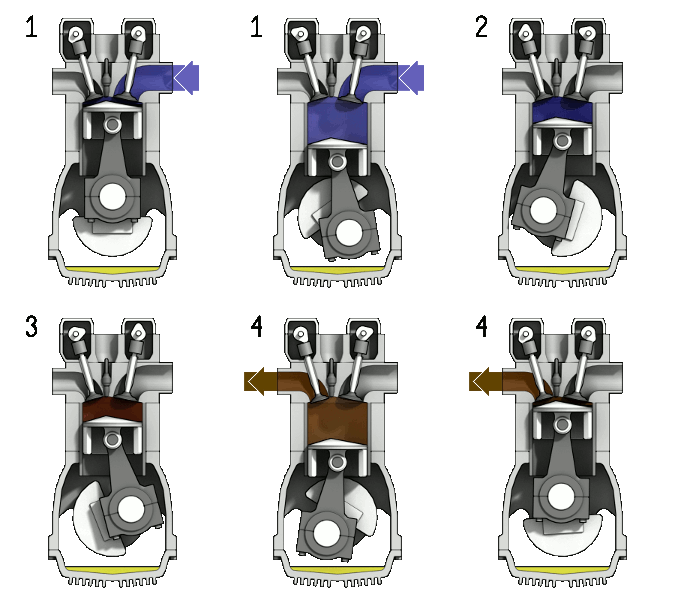
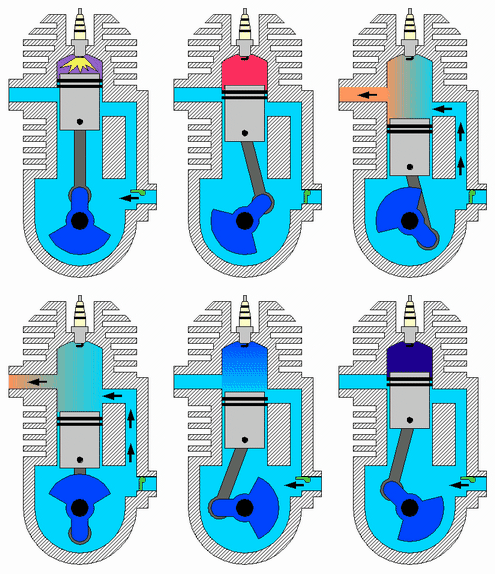
Commonly used engine phases or strokes (i.e. those used in a four-stroke engine) are described below. Other types of engines can have very different phases.
The induction stroke is the first phase in a four-stroke (e.g. Otto cycle or Diesel cycle) engine. It involves the downward movement of the piston, creating a partial vacuum that draws an air-fuel mixture (or air alone, in the case of a direct injection engine) into the combustion chamber. The mixture enters the cylinder through an intake valve at the top of the cylinder.
The compression stroke is the second of the four stages in a four-stroke engine.
In this stage, the air-fuel mixture (or air alone, in the case of a direct injection engine) is compressed to the top of the cylinder by the piston. This is the result of the piston moving upwards, reducing the volume of the chamber. Towards the end of this phase, the mixture is ignited, by a spark plug for petrol engines or by self-ignition for diesel engines.
The combustion stroke is the third phase, where the ignited air-fuel mixture expands and pushes the piston downwards. The force created by this expansion is what creates an engine's power.
The exhaust stroke is the final phase in a four stroke engine. In this phase, the piston moves upwards, squeezing out the gasses that were created during the combustion stroke. The gasses exit the cylinder through an exhaust valve at the top of the cylinder. At the end of this phase, the exhaust valve closes and the intake valve opens, which then closes to allow a fresh air-fuel mixture into the cylinder so the process can repeat itself.
ピストンエンジンで使用される熱力学サイクルは、1サイクルを完了するのに必要なストローク数で表されることが多い。最も一般的なエンジンの設計は、2ストロークと4ストロークである。あまり一般的ではない設計としては、1ストロークエンジン、5ストロークエンジン、6ストロークエンジン、および2ストロークと4ストロークを組み合わせたエンジンなどがある。
スペインのグラナダに拠点を置くINNengine社は、両側に4つのピストン、合計8つのピストンを備えた対向ピストンエンジンを発明しました。固定ロッドがすべてのピストンを結合し、1つの燃焼室を共有しています。これらのロッドは、振動する波状のデザインのプレートに押し付けられ、ロッドが同期してスムーズなプロセスでピストンを押したり解放したりできるようにします。e-REXとして知られるこのエンジンは、従来の4ストロークエンジンよりも1回転あたり4倍、2ストロークエンジンよりも2倍多くのパワーイベントを生成します。[ 1 ] e-REXは1ストロークエンジンと呼ばれていますが、実際には2ストロークエンジンであるという議論があり、各ピストンがエンジンの半回転で2つのストローク(つまり、圧縮/燃焼と排気/吸気)を実行するため、1ストロークと呼ばれています。INNengineの論理では、2つのストロークに半回転を掛けたものが、特許取得済みの1ストロークという名前を与えたのです。[ 2 ]
2ストロークエンジンは2ストロークごとに1サイクルの動力サイクルを完了します。つまり、クランクシャフトが1回転するごとに動力サイクルが1サイクル完了します。2ストロークエンジンは、(通常は大型の)船舶用エンジン、屋外用電動工具(芝刈り機やチェーンソーなど)、オートバイなどで一般的に使用されています。[ 3 ]
4ストロークエンジンは4ストロークごとに1サイクルの動力サイクルを完了します。つまり、クランクシャフトが2回転するごとに1サイクルの動力サイクルが完了します。ほとんどの自動車エンジンは4ストローク設計です。[ 3 ]
5ストロークエンジンは、 5回のストロークごとに1回の動力サイクルを完了します。このエンジンは試作機としてのみ存在します。
6ストロークエンジンは、6回のストロークごとに1回の動力サイクルを完了します。つまり、クランクシャフトが3回転するごとに1回の動力サイクルが完了するということです。
ストローク長とは、ピストンがシリンダー内を移動する距離のことで、クランクシャフト上のクランクによって決まります。
エンジンの排気量は、シリンダーの断面積(ボアによって決まる)にストローク長を掛けることで算出されます。この数値にエンジンのシリンダー数を掛けることで、総排気量が求められます。
ストロークという用語は、機関車のシリンダー内のピストンの動きにも適用される。