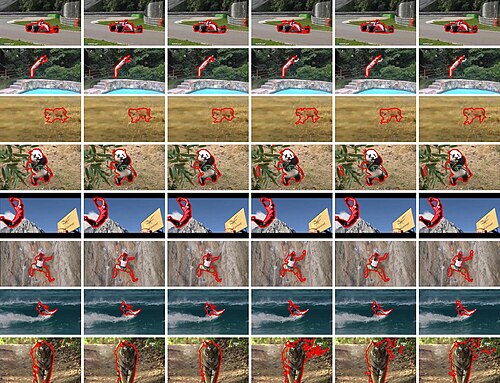
Target representation and localization is mostly a bottom-up process. These methods give a variety of tools for identifying the moving object. Locating and tracking the target object successfully is dependent on the algorithm. For example, using blob tracking is useful for identifying human movement because a person's profile changes dynamically.[6] Typically the computational complexity for these algorithms is low. The following are some common target representation and localization algorithms:
Contour tracking: detection of object boundary (e.g. active contours or Condensation algorithm). Contour tracking methods iteratively evolve an initial contour initialized from the previous frame to its new position in the current frame. This approach to contour tracking directly evolves the contour by minimizing the contour energy using gradient descent.
Filtering and data association is mostly a top-down process, which involves incorporating prior information about the scene or object, dealing with object dynamics, and evaluation of different hypotheses. These methods allow the tracking of complex objects along with more complex object interaction like tracking objects moving behind obstructions.[8] Additionally the complexity is increased if the video tracker (also named TV tracker or target tracker) is not mounted on rigid foundation (on-shore) but on a moving ship (off-shore), where typically an inertial measurement system is used to pre-stabilize the video tracker to reduce the required dynamics and bandwidth of the camera system.[9] The computational complexity for these algorithms is usually much higher. The following are some common filtering algorithms:
Kalman filter: an optimal recursive Bayesian filter for linear functions subjected to Gaussian noise. It is an algorithm that uses a series of measurements observed over time, containing noise (random variations) and other inaccuracies, and produces estimates of unknown variables that tend to be more precise than those based on a single measurement alone.[10]
↑ Peter Mountney、Danail Stoyanov、Guang-Zhong Yang (2010)。「3次元組織変形回復および追跡:腹腔鏡または内視鏡画像に基づく技術の紹介」IEEE Signal Processing Magazine。2010年7月。第27巻(PDF)。IEEE Signal Processing Magazine。27(4):14–24。doi:10.1109 /MSP.2010.936728。hdl:10044/ 1 / 53740。S2CID 14009451。2023年6月29日にオリジナル(PDF)からアーカイブ。 2019年9月23日に取得。
↑S. Kang; J. Paik; A. Koschan; B. Abidi & M. A. Abidi (2003). Tobin, Jr, Kenneth W & Meriaudeau, Fabrice (eds.). "Real-time video tracking using PTZ cameras". Proc. SPIE. Sixth International Conference on Quality Control by Artificial Vision. 5132: 103–111. Bibcode:2003SPIE.5132..103K. CiteSeerX10.1.1.101.4242. doi:10.1117/12.514945. S2CID12298526.
↑Comaniciu, D.; Ramesh, V.; Meer, P., "Real-time tracking of non-rigid objects using mean shift," Computer Vision and Pattern Recognition, 2000. Proceedings. IEEE Conference on, vol.2, no., pp. 142, 149 vol.2, 2000
↑Black, James, Tim Ellis, and Paul Rosin (2003). "A Novel Method for Video Tracking Performance Evaluation". Joint IEEE Int. Workshop on Visual Surveillance and Performance Evaluation of Tracking and Surveillance: 125–132. CiteSeerX10.1.1.10.3365.{{cite journal}}: CS1 maint: multiple names: authors list (link)
↑Gyro Stabilized Target Tracker for Off-shore Installation
↑M. Arulampalam; S. Maskell; N. Gordon & T. Clapp (2002). "A Tutorial on Particle Filters for Online Nonlinear/Non-Gaussian Bayesian Tracking". IEEE Transactions on Signal Processing. 50 (2): 174. Bibcode:2002ITSP...50..174A. CiteSeerX10.1.1.117.1144. doi:10.1109/78.978374. S2CID55577025.
↑Emilio Maggio; Andrea Cavallaro (2010). Video Tracking: Theory and Practice. Vol.1. Addison-Wesley Professional. ISBN9780132702348. Video Tracking provides a comprehensive treatment of the fundamental aspects of algorithm and application development for the task of estimating, over time.
↑Karthik Chandrasekaran (2010). Parametric & Non-parametric Background Subtraction Model with Object Tracking for VENUS. Vol.1. ISBN9780549524892. Background subtraction is the process by which we segment moving regions in image sequences.
↑J. Martinez-del-Rincon, D. Makris, C. Orrite-Urunuela and J.-C. Nebel (2010). "Tracking Human Position and Lower Body Parts Using Kalman and Particle Filters Constrained by Human Biomechanics". IEEE Transactions on Systems Man and Cybernetics – Part B', 40(4).