
Loading article…
SN 1885A (also S Andromedae) was a supernova in the Andromeda Galaxy, the only one seen in that galaxy by astronomers. It was the first supernova ever seen outside the Milky Way,[3] though it was not appreciated at the time due to how far away it was. It is also known as "Supernova 1885".
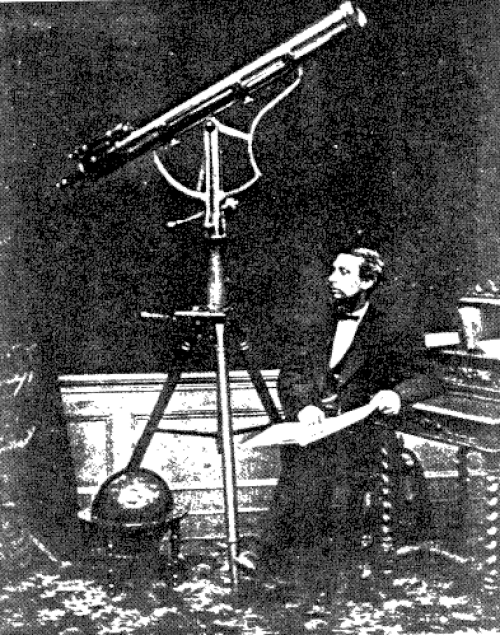
The supernova appears to have been seen first on August 17, 1885, by French astronomer Ludovic Gully during a public stargazing event.[4] Gully thought it was scattered moonlight in his telescope and did not follow up on this observation. Irish amateur astronomer Isaac Ward in Belfast claimed to have seen the object on August 19, 1885, but did not immediately publish its existence.[5][6]
The independent detection of the supernova by Ernst Hartwig at Dorpat (Tartu) Observatory in Estonia on August 20, 1885, however, was communicated in a telegram on August 31, 1885, once Hartwig had verified in more ideal circumstances that the feature was not caused by reflected moonlight.[7][8] The telegram prompted widespread observations of the event,[9] and prompted Isaac Ward, Ludovic Gully, and several others to publish their earlier observations (the first reports on S Andromedae appeared before Hartwig's discovery letter which followed his telegram, since the letter was initially lost by Astronomische Nachrichten and only reprinted in a later issue). The history of the discovery is summarized by K.G. Jones[10] and de Vaucouleurs and H. G. Corwin Jr.[2] Both studies doubt that Ward really saw the event since his estimated magnitude is significantly off from the later reconstructed light curve,[2] and conclude that Hartwig should be considered as the discoverer of the supernova.

SN 1885A は 1885 年 8 月 21 日に 5.85 等級に達し、6 か月後に 14 等級まで暗くなった。[ 2 ]色は赤みがかっており、明るさが急速に低下したが、これはIa 型超新星としては珍しい。一部の天文学者は、この星のスペクトルを目視で観測した (当時は写真によるスペクトル観測は行われなかった)。これらの観測は可視限界で行われたが、互いに、また典型的な Ia 型超新星の現代のデータとよく一致していると考えられた。そのため、SN 1885A はこのタイプに分類された。[ 2 ] Dovi PoznanskiとHagai Peretsによる研究では、SN 1885A はSN 2002bjおよびSN 1939Bとともに、I 型超新星の新しいサブクラスに属すると示唆されている。[ 11 ] [ 12 ]
超新星は、銀河の比較的明るい核から16秒角離れている。そのため、残骸の検出は困難で、初期の試みは失敗に終わった。1988 年、RA フェセンらはキットピークの4 メートル メイオール望遠鏡を使用して、爆発の鉄に富む残骸を発見した。[ 13 ] 1999 年にハッブル宇宙望遠鏡でさらに観測が行われた。 [ 14 ]残骸のスペクトルは、爆発中に生成されたと思われる鉄、カルシウム、マンガンの存在を示している。爆発には球対称の証拠がいくつかあり、これはこの Ia 型超新星が合体によって引き起こされたのではないことを意味する。[ 15 ]