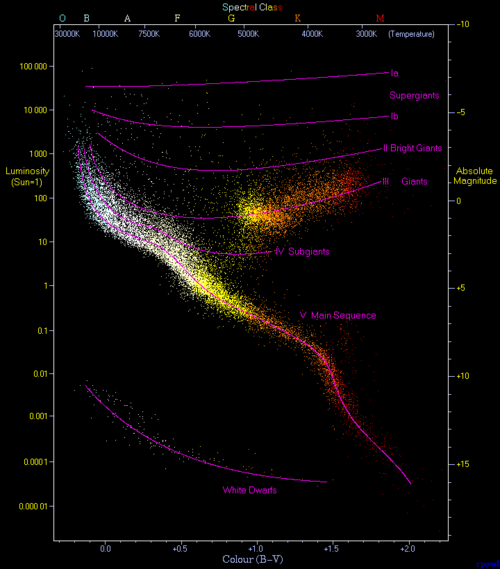
In theory, the absolute luminosities of stars in the red clump are fairly independent of stellar composition or age so that consequently they make good standard candles for estimating astronomical distances both within our galaxy and to nearby galaxies and clusters. Variations due to metallicity, mass, age, and extinctions affect visual observations too much for them to be useful, but the effects are much smaller in the infrared. Near infraredI band observations in particular have been used to establish red clump distances. Absolute magnitudes for the red clump at solar metallicity have been measured at −0.22 in the I band and −1.54 in the K band.[8] The distance to the Galactic Center has been measured in this way, giving a result of 7.52 kpc in agreement with other methods.[9]
Red bump
The red clump should not be confused with the "red bump" or red-giant-branch bump, which is a less noticeable clustering of giants partway along the red-giant branch, caused as stars ascending the red-giant branch temporarily decrease in luminosity because of internal convection.[10]
Examples
Many of the bright "red giants" visible in the sky are actually G or early K class red-clump stars. Pollux, the closest red giant to the Sun, is believed to be a red-clump star.[11] Other well-known examples include:
Arcturus has sometimes been thought to be a clump giant,[16] but is now more commonly considered to be on the red-giant branch, somewhat cooler and more luminous than a red-clump star.[17]
References
↑Soubiran, C.; Bienaymé, O.; Siebert, A. (2003). "Vertical distribution of Galactic disk stars". Astronomy and Astrophysics. 398: 141–151. arXiv:astro-ph/0210628. Bibcode:2003A&A...398..141S. doi:10.1051/0004-6361:20021615. S2CID14060900.
1 2 3 Girardi, Léo (1999). "赤色巨星の二次的な塊:なぜ、どこにあるのか" . Monthly Notices of the Royal Astronomical Society . 308 (3): 818– 832. arXiv : astro-ph/9901319 . Bibcode : 1999MNRAS.308..818G . doi : 10.1046/j.1365-8711.1999.02746.x . S2CID 3253711 .