
Loading article…
Canada | |
| Value | 0.05 CAD |
|---|---|
| Mass | 3.95 g |
| Diameter | 21.2 mm |
| Thickness | 1.76 mm |
| Edge | smooth (plain) |
| Composition | Nickel-plated steel 94.5% steel, 3.5% Cu, 2% Ni plating |
| Years of minting | 1858–present |
| Catalog number | – |
| Obverse | |
 | |
| Design | Elizabeth II, Queen of Canada |
| Designer | Susanna Blunt |
| Design date | 2003 |
| Design discontinued | 2023 |
| Design | Charles III, King of Canada |
| Designer | Steven Rosati |
| Design date | 2023 |
| Reverse | |
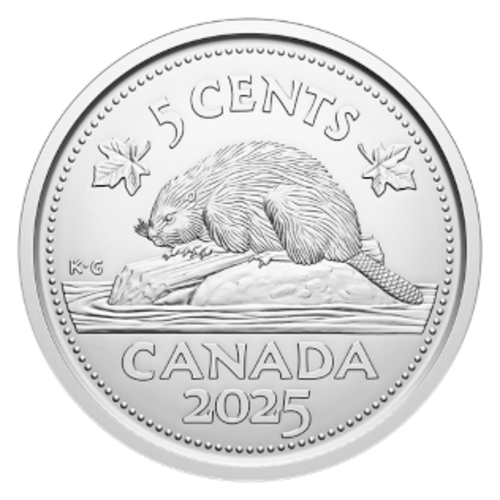 | |
| Design | Beaver sitting on a rock |
| Designer | G.E. Kruger Gray |
| Design date | 1937 |
The Canadian five-cent coin, commonly called a nickel, is a coin worth five cents or one-twentieth of a Canadian dollar. It was patterned on the corresponding coin in the neighbouring United States. It became the smallest-valued coin in the currency upon the discontinuation of the penny in 2013.
History
Types and specifications
Circulation figures
Victoria & Edward VII
George V & George VI


Elizabeth II


Charles III
Commemoratives
Collecting
Five-cent coins dated 1921 are among the rarest and most collectible Canadian circulation coins, known as "the Prince of Canadian Coins." Estimates of the number of specimens known range between 400 and 480. In May 1921, the government of Canada passed an act authorizing the change to the larger nickel coin, and subsequently the majority of the 1921 mint run was melted down.[10] The coin believed to be the finest-known specimen (PCGS MS-67) sold for US$115,000 at auction in January 2010.[11] It was then sold by the Canadian Numismatic Company for $160,000 to a private collector in early 2012.
See also
.svg/500px-Maple_Leaf_(from_roundel).svg.png)


- Big Nickel
- Dei Gratia Regina (or Rex), which appears abbreviated on the face of the coin.
Notes
- ^ One "1944" dated coin is known to have survived in Tombac.
- ^ A circulating version of this coin celebrating the end of World War II later appeared in 2005.
- ^ This nickel came in a set, was struck in silver, and features George VI on the obverse with the original Morse code edge. 6,065 of these coins were also struck in gold-plating.
- ^ This coin is identical to its D-Day 60th anniversary counterpart, but is dated 1945–2020.
References
- ^ a b c "Industrious, enduring–the 5-cent coin". mint.ca. Royal Canadian Mint. Archived from the original on January 12, 2020. Retrieved November 26, 2022.
- ^ a b c d "5 cents". Royal Canadian Mint. Retrieved November 19, 2022.
- ^ Cuhaj, George S., ed. (November 29, 2012). Standard Catalog of World Coins 1801-1900 (7th ed.). Krause Publications. p. 156. ISBN 978-1440230851.
- ^ Michael, Thomas, ed. (July 29, 2016). 2017 Standard Catalog of World Coins 1901-2000 (44th ed.). Krause Publications. p. 310. ISBN 978-1440246548.
- ^ a b c d Michael, Thomas, ed. (July 29, 2016). 2017 Standard Catalog of World Coins 1901-2000 (44th ed.). Krause Publications. pp. 311–312. ISBN 978-1440246548.
- ^ a b Cross, W. K. (July 2005). A Charlton Standard Catalogue Canadian Coins (60th ed.). Charlton Press. p. 98. ISBN 978-0889682979.
- ^ Michael, Thomas, ed. (July 13, 2016). 2017 Standard Catalog of World Coins 2001-Date (11th ed.). Krause Publications. p. 236. ISBN 978-1440246555.
- ^ Royal Canadian Mint (2017). 2017 Annual Report – Delivering Results (PDF) (Report). p. 86. Retrieved November 20, 2022.
- ^ Royal Canadian Mint (2021). Annual Report 2021 - Strong Today, Ready for Tomorrow (PDF) (Report). p. 101. Retrieved November 24, 2022.
- ^ Haxby, J.A.; R.C. Willey (2003). Coins of Canada (21st ed.). Toronto: Unitrade Press. ISBN 1-894763-09-2.
- ^ "Canada: George V 5 Cents 1921,... Canada | Lot #20069". Heritage Auctions.
External links
 Media related to Nickel (Canadian coin) at Wikimedia Commons
- Value of Canadian Nickel
- Canadian Nickel varieties