
Loading article…
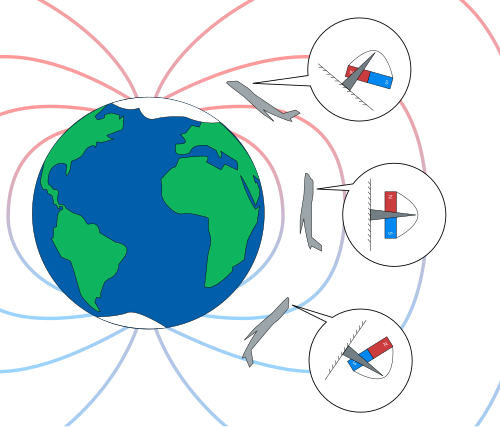

磁気傾斜角、または磁気傾斜とは、地球の磁力線が水平面となす角度のことです。この角度は、地球表面上のさまざまな地点で変化します。傾斜角が正の値の場合、測定地点で地球の磁場が下向き、つまり地球内部に向かっていることを示し、負の値の場合は上向きであることを示します。傾斜角は、原理的には垂直に保持したコンパスの針がなす角度ですが、実際には、通常のコンパスの針は傾斜角に対して重りが付いていたり、正しい平面内で自由に動けなかったりする場合があります。傾斜角は、一般的に傾斜円と呼ばれる特殊な測定器を使用することで、より確実に測定できます。
傾斜角は、 1544年にドイツの技師ゲオルク・ハルトマンによって発見されました。 [ 1 ]傾斜円を使った測定方法は、1581年にイギリスのロバート・ノーマンによって記述されました。 [ 2 ]

磁気傾斜は、磁石が磁力線に沿って整列しようとする性質から生じます。地球の磁力線は地表と平行ではないため、方位磁針の北端は南半球では上向き(負の傾斜)、北半球では下向き(正の傾斜)になります。傾斜の範囲は、-90度(南磁極)から+90度(北磁極)までです。[ 3 ]地表で測定された傾斜が等しい等高線は、等傾斜線と呼ばれます。傾斜がゼロとなる点の軌跡は、磁気赤道または非傾斜線と呼ばれます。[ 4 ]
傾向は地球の核による磁場に対して局所的に定義され、磁場が水平線より下(つまり地球内部)を向いている場合は正の値をとります。ここでは、 の値を決定する方法を示します。特定の緯度において、ファウラーによる処理に従って。[ 5 ]
地球の核の外側では、真空中のマクスウェル方程式を考えます。そしてどこ添え字これは、これらの場の起源としてコアを表します。最初の意味は、スカラーポテンシャルを導入できるということです。そのため2つ目は、ポテンシャルがラプラス方程式を満たすことを意味する。。
主要項まで解くと、磁気双極子ポテンシャルが得られる。
したがって、その分野は
for magnetic moment and position vector on Earth's surface. From here it can be shown that the inclination as defined above satisfies (from )
where is the latitude of the point on Earth's surface.

 ).
).The phenomenon is especially important in aviation. Magnetic compasses on airplanes are made so that the center of gravity is significantly lower than the pivot point. As a result, the vertical component of the magnetic force is too weak to tilt the compass card significantly out of the horizontal plane, thus minimizing the dip angle shown in the compass. However, this also causes the airplane's compass to give erroneous readings during banked turns (turning error) and airspeed changes (acceleration error).[6]


Magnetic dip shifts the center of gravity of the compass card, causing temporary inaccurate readings when turning north or south. As the aircraft turns, the force that results from the magnetic dip causes the float assembly to swing in the same direction that the float turns. This compass error is amplified with the proximity to either magnetic pole.[6]
To compensate for turning errors, pilots in the Northern Hemisphere will have to "undershoot" the turn when turning north, stopping the turn prior to the compass rotating to the correct heading; and "overshoot" the turn when turning south by stopping later than the compass. The effect is the opposite in the Southern Hemisphere.[6]

The acceleration errors occur because the compass card tilts on its mount when under acceleration.[7] In the Northern Hemisphere, when accelerating on either an easterly or westerly heading, the error appears as a turn indication toward the north. When decelerating on either of these headings, the compass indicates a turn toward the south.[6] The effect is the opposite in the Southern Hemisphere.
方位磁針の針は、磁気偏角を補正するために製造時に重りが付けられることが多く、それによってほぼ水平にバランスが取れるようになります。このバランス調整は緯度に依存します。詳しくは「方位磁針のバランス調整(磁気偏角)」を参照してください。


![${\displaystyle {\textbf {B}}_{c}=-\mu _{o}\nabla \phi _{c}={\frac {\mu _{o}}{4\pi }}{\big [}{\frac {3{\hat {\textbf {r}}}({\hat {\textbf {r}}}\cdot {\textbf {m}})-{\textbf {m}}}{r^{3}}}{\big ]}}$](https://wikimedia.org/api/rest_v1/media/math/render/svg/ce6943f702df92815ab629058a1c3f9d9a6bf539)




